Word of the Day: SCRIPTITATION

ETYMOLOGY
from Latin scriptitation-scriptitatio (act of writing down, act of writing or composing, that which is written, text) from scriptitat-, past participial stem of scriptitare (to be in the habit of writing, to write regular or repeated letters), (frequentative formation from scribere (to write))

EXAMPLE
“… There is something in this Amory’s manner of scriptitation which is..utterly void of all pretensions to the business of argument. …”

From: The Church of England Vindicated, 1779

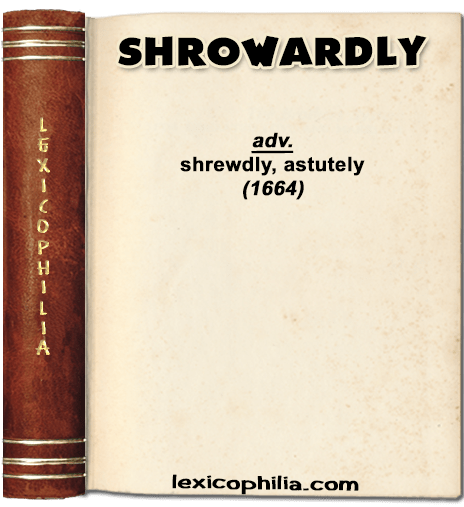
Word of the Day: SHROWARDLY

ETYMOLOGY
perhaps from shrow (shrew, a wicked or malignant person), after frowardly

EXAMPLE
“… Now have I most unmanfully fallen foul upon some
Woman, I’le warrant you, and wounded her
Reputation
shrowardly: Oh drink, drink! thou
Art a vile enemy to the civillest sort of curteous
Ladies.
…”

From: The Comical Revenge, or, Love in a Tub
By George Etherege, 1664

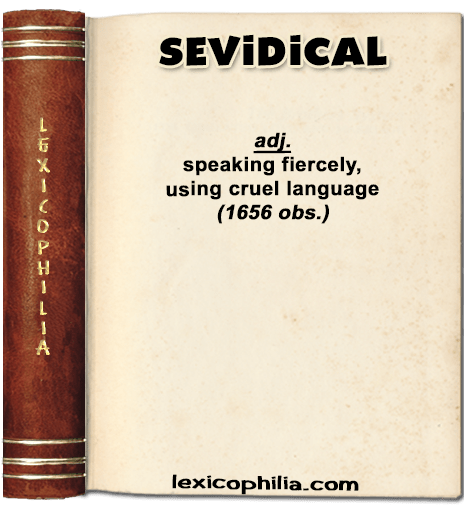
Word of the Day: SEVIDICAL

ETYMOLOGY
from Latin sævidicus; from sævus (fierce, furious) + dic- stem of dicere (to say, speak) + -al

EXAMPLE
“… Carolyn smiled and gave a crafty wink, “It means a filthy, slobbering person. That’s the way you left him wasn’t it? And I think we can assume he was quite sevidical in his comments about you, don’t you think? …”

From: Something to Crowe About
By E. W. Nickerson, 2013

Word of the Day: SIT-UPONS

ETYMOLOGY
from sit (vb.) + upon (prep.), after to sit upon

EXAMPLE
“… I need scarcely say that he kept a tiger, and that the tiger was a perfect model of a brute. He wore a sky-blue coat with silver buttons, a pink-striped waistcoat, green plush sit-upons, and flesh-coloured silks in-doors; out of doors the lower garments were exchanged for immaculate white doeskins, and topboots — virgin Woodstocks on his hands, and a glazed hat upon his head with forty-two yards of silver-thread upon it to loop up the brims to two silver buttons. …”

From: Peter Priggins, The College Scout
By Theodore Hook, 1841

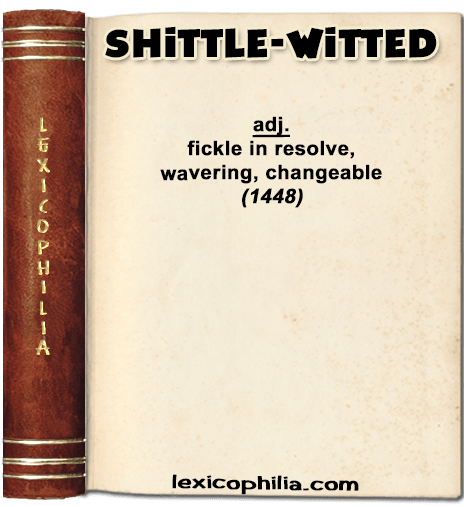
Word of the Day: SHITTLE-WITTED

ETYMOLOGY
from shittle (obsolete, fickle, flighty, inconstant) + witted

EXAMPLE
“… I am aferd þat Jon of Sparham js so schyttyl-wyttyd þat he wyl sett hys gode to morgage to Heydon, or to sum oþer of vwre gode frendys, but jf I can hold hym jnne þe better ere ȝe kom hom…”

From: Paston Letters and Papers of the Fifteenth Century
Margaret Paston to Jon Paston, 1448

Word of the Day: SWASIVIOUS

ETYMOLOGY
from Italian suasivo (suasive, having the power of persuading or urging) + -ious

EXAMPLE
“…Who is most merciful, bountiful, and liberal, and willing to helpe and further you, in your intended loues, burning desires, and high conceites. Plucke vp a good heart, man, come let vs goe on.
With pleasurable actions, maydenly iestures,
swasiuious behauiours, girlish sportes, wanton regardes, and with sweet vvords they ledde mee on thither, beeing vvel content vvith euerie present action, but that my Polia vvas not there to the suppliment of my felicitie, and to haue been the sixt person in the making vp of a perfect number. …”

From: Hypnerotomachia: The Strife of Loue in a Dreame
By Francesco Colonna
Translated by Robert Dallington, 1592

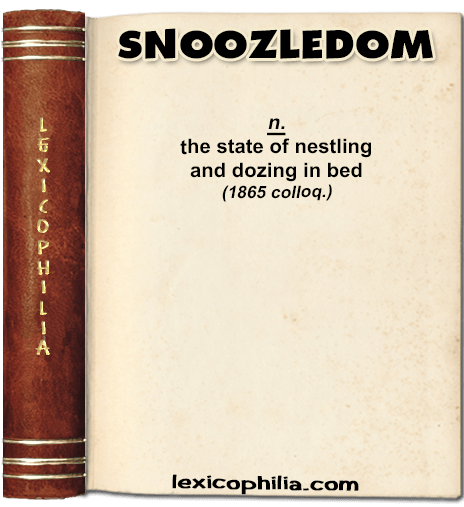
Word of the Day: SNOOZLEDOM

ETYMOLOGY
from snoozle (to nestle and sleep or doze) + -dom

EXAMPLE
“…There are times with us all, when in a concave mirror we see a minute distorted into long hours; and, again, in the convex glass the long hours dwindle to a point. When summoned by peremptory duty from a warm bed upon a keen, frosty morning, how precious are the last five minutes of snoozledom! You live introspectively all through them; you chew the cud of your own cosiness. …”

From: The Casquet of Literature, a Selection in Poetry and Prose
Edited by C. Gibbon, 1873
‘The Philosophy of Sorrow’
By D’Arcy Wentworth Thompson

Word of the Day: SPLENDIDIOUS

ETYMOLOGY
from Latin splendidus (bright, glittering, splendid) + -ious

EXAMPLE
“…Of whom Gregorius Naz[i]anzen spekethe, seyenge, “Suche men reprove liȝhtely straunge thinges, but vnnethe with grete difficulte thei folowe goode thynges.” Wherefore y seenge the poverte and insufficience of my connynge after so splendidious laboures dredde to proferre a raw thynge with bareyne eloquence and to purpose as a thynge bytter to so mellifluous delices….”

From: Polychronicon Ranulphi Higden maonachi Cestrensis
By Ranulf Higden 
Translated by John Trevisa, a1475

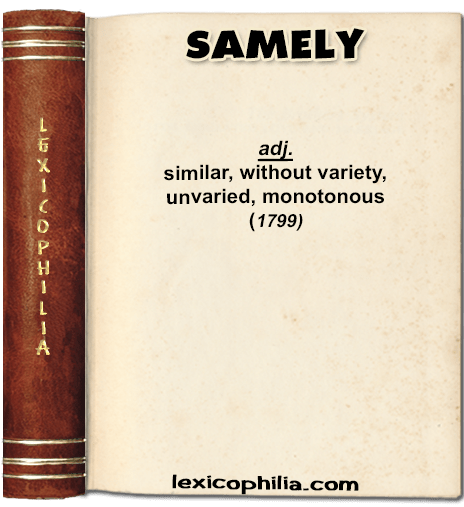
Word of the Day: SAMELY

ETYMOLOGY
from same (adj.) + -ly

EXAMPLE
“…and by making judicious openings, so as to break straight lines, and separate parts that were in some places too heavy and samely: so that the same extent of land has now not only a much larger appearance, but exhibits a much greater variety of ground …”

From: Transactions of the Society of instituted at London for the Encouragement of Arts, Manufactures, and Commerce;
with Premiums offered in the Year 1799. Vol. XVII.