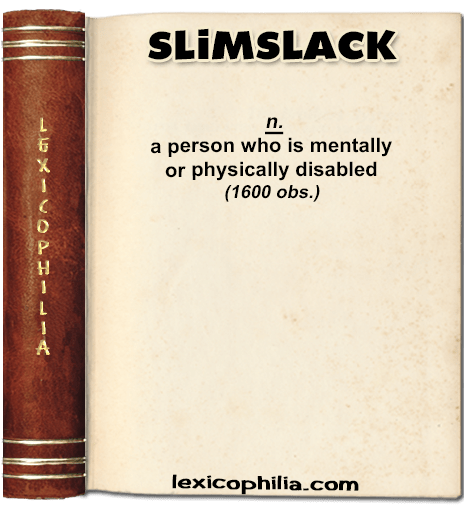
Word of the Day: SLIMSLACK

ETYMOLOGY
from slim (adj.) + slack (adj.)

EXAMPLE
“…Thou planter of Amfrisus, inhabiter of Parnassus, louer of Helicone; lord of fount Caballyne, patrone of the Laurell, inuentor of the Harpe, master of Astrologie, and prince of Phisicke, helpe these poore slimslacks, who haue need of internal remedies, for the restitution of their disturbed braine, destitute witte, obfuscate vnderstanding, lost memorie: …”

From: translation of The Hospitall of Incurable Fooles
By Tomaso Garzoni, 1600

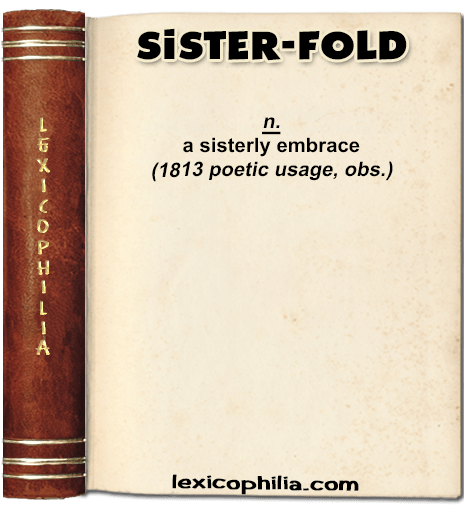
Word of the Day: SISTER-FOLD

ETYMOLOGY
from sister + fold (a clasp or embrace, obs.)

EXAMPLE
“…Are these of such fantastic mould,
Seen distant down the fair arcade,
These Maids enlink’d in sister-fold,
Who late at bashful distance staid,
Now tripping from the greenwood shade,
Nearer the musing champion draw,
And, in a pause of seeming awe,
Again stand doubtful now?
…”

From: The Bridal of Triermain
By Walter Scott, 1813

Word of the Day: STRATIOTIC

ETYMOLOGY
from Latin stratioticus (characteristic of a soldier), and its etymon ancient Greek στρατιωτικoς (military, warlike), from στρατιώτης stratiote (a Greek soldier) + ‑ικός (‑ic)

EXAMPLE
“…The Theoric board dominated the financial administration, as later on Demosthenes’ own Stratiotic board did.…”

From: The Olynthiac Speeches of Demosthenes
By Terrot Reaveley Glover, 1897

Word of the Day: SACK-PANTS

ETYMOLOGY
from sack + pants

EXAMPLE
“…I left the brig at 10 ½ A.M. with but five dogs and a load so light as to be hardly felt. 
It required some suggestive incident to show us how we have gradually become assimilated in our habits to the necessities of our peculiar life. Such an incident I find in my equipment. Compare it with similar sledge outfits of last winter and you will see that we are more than half Esquimaux. It consists of
1. One small sledge, five feet six by two.
2. An extra jumper and sack pants for sleeping.
3. A ball of raw walrus meat. This is all …”

From: Arctic Explorations:
The Second Grinnell Expedition
In Search of Sir John Franklin, 1853, ’54, ’55
Journey in Search of Hans. Tuesday Apr. 10.
By Elisha Kent Kane, 1856

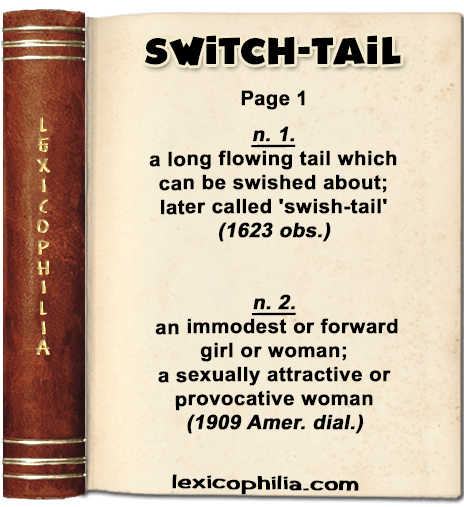
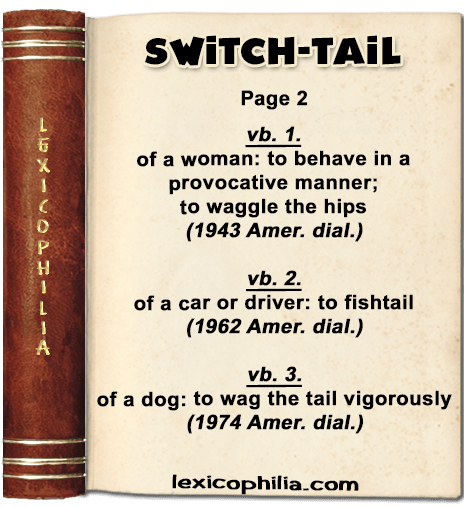
Word of the Day: SWITCH-TAIL


ETYMOLOGY
from switch + tail


EXAMPLE 1 (for n.1)
“…she was observed to ride forth in a Cavalcade somewhat extraordinary pleasant , viz. a good rich Velvet Saddle, and fashionable upon a sorry Horse with a Switch-Tail that us’d to carry Lime, and not Ladies; A gentile Surtout or riding-Suit; with her Shoulders warmly wrapt up in a good White Serge whittle: A pretty handsome Commode of the newest fashion, upon which was gracefully plac’d a good homely Straw Hat, with a long Pole like a Sugar Loaf, so that Cit and Bumpkin seem’d never better met or set off since the Creation …”

From: The Adventures of the Helvetian Hero, with the Young Countess of Albania;
Or, The Amours of Armadorus and Vicentina: a Novel
Unknown author, 1694


EXAMPLE 2 (for n. 2.)
“…I can look a gangster in the eye and make him change his mind, but I can’t do a thing with a woman no more. At one time I had nine big switch-tail women on my personal payroll, and they all stole from me, picked me clean. Buzzards!

From: McSorley’s Wonderful Saloon
By Joseph Mitchell, 1943

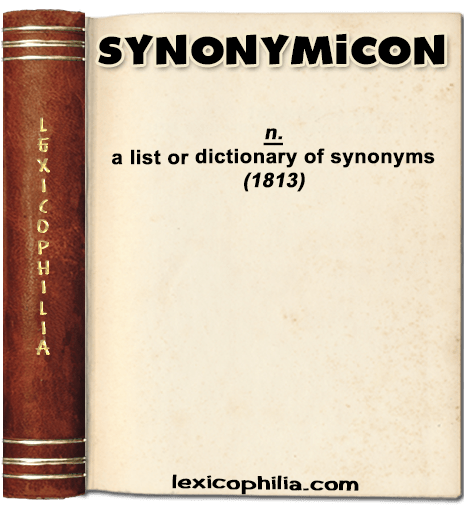
Word of the Day: SYNONYMICON


ETYMOLOGY
from synonym + –icon, after lexicon


EXAMPLE
“…these were interspersed with original definitions of some contiguous terms peculiar to ourselves. His neat and useful, though not wholly trustworthy, book attained a second edition in 1783. It will not be superseded by the subsequent but inferior attempt of Mrs. Piozzi. Blair has deposited in his Rhetoric, and Dawson in his Philologia anglica, some further contributions to an english synonymicon …”

From: English Synonyms Discriminated
Introduction
By William Taylor, 1813

Word of the Day: STRIVABLE


ETYMOLOGY
from Old French estrivable, from estriver (to quarrel, contend) + -able


EXAMPLE
“…that eke the lay peple of the newe lawe is bounde, undir perel of greet synne, forto receyve her feith and al the leernyng of Goddis lawe, now beyng, in ech doutable and strivable poynt therof, fro and of the preestis of the newe lawe, and forto obeie to hem therynne, in lasse thanne the case of the seid excepcioun kan be executid …”

From: Book of Faith; a fifteenth century theological tractate
From the manuscript in the library of Trinity college, Cambridge
By Reginald Pecock, c1456

Reverse Dictionary: SOILED DOVE


ETYMOLOGY
from soiled (defiled) + dove (gentle, innocent, or loving woman)


EXAMPLE
“…In “A Daughter of Eve,” Mr. Hain Friswell, who is favourably known as a producer of light literature, introduces, by way of arousing a sensation, a young lady, whom he euphemistically styles “a soiled dove.” It is impossible to regard modern society without acknowledging the abundant existence of such persons…”

From: Dublin University Magazine
A Literary and Political Journal
January to June 1863
‘Modern Novel and Romance’

Word of the Day: SPECTIBLE


ETYMOLOGY
from Latin spect-, ppl. stem of specere (to look)


EXAMPLE
“…Furthermore to make him more carefull to regard vertue, he planted into him very deepe rootes and prickes of conscience, hee added moreouer Statutes and Lawes, not onely emprinted within euery ones hart, but engrauen also outwardly in spectible Tables…”

From: Against Ierome Osorius Byshopp of Siluane in Portingall and against his slaunderous inuectiues An aunswere apologeticall.
By Walter Haddon and John Foxe
Translation by James Bell, 1581

Word of the Day: STRATAGEMATIC


ETYMOLOGY
from obsolete French strategematique,
or from Latin strategematicus, from strategēmat-strategema (stratagem) + -icus (-ic)


EXAMPLE
“…Wherefore such persons as be illuminated with the brightest irradiations of knowledge and of the veritie and due proportion of things, they are called by the learned men not phantastici but euphantasioti, and of this sorte of phantasie are all good Poets, notable Captaines stratagematique, all cunning artificers and enginers, all Legislators, Polititiens, & Counsellours of estate, in whose exercises the inuentiue part is most employed, and is to the sound and true iudgement of man most needful…”

From: The Arte of English Poesie
By George Puttenham, 1589