Word of the Day: SACRIPANT


ETYMOLOGY
from French Sacripant, from Italian Sacripante, a character in Boiardo’s Orlando innamorato


EXAMPLE
“…He is surprised by a nymph of exquisite loveliness, who vainly assails his constancy, and who is  at length seized by the supervening  Itifal, a Sacripant of  knighthood.  The adventures in general  are spun out and interrupted by flat conversations…”

From: Historic Survey of German Poetry
By William Taylor, 1829

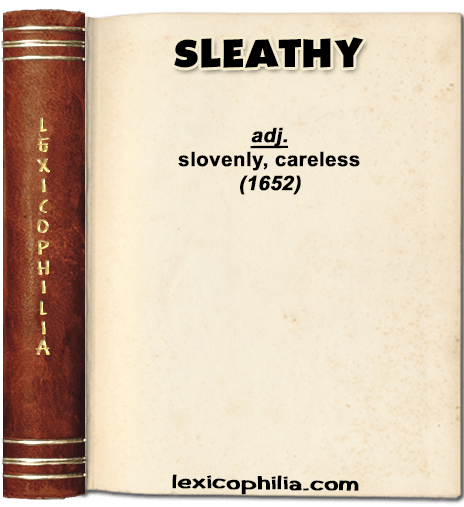
Word of the Day: SLEATHY


ETYMOLOGY
? from Old Norse slœ́ða (to drag, trail) (so Norwegian slöda; also, to work carelessly)


EXAMPLE
“…Again, the combination of labourers and Poor people may very much prejudice, besides their slothfull and sleathy slubbering of it, if not exceeding carefully overseen…”

From: The English Improver Improved Or the Survey of Husbandry Surveyed
By Walter Blith, 1652

Word of the Day: STULTITIOUS


ETYMOLOGY
for adj. 1: from Latin stultitia (folly),
from stultus (foolish)


EXAMPLE
“…In Wales in diuers places is vsed these two stulticious matters, the fyrste is, that they wyl sell their lams, and theyr calues, and theyr corne the whyche is not sowen, and all other newynges, a yere before that they be sure of any newynge; and men wyl bye it, trustynge vppon hope of suche thynges that wyl come…”

From:
The Fyrst Boke of the Introduction of Knowledge
By Andrew Boorde, 1549

Word of the Day: SITIBUND


ETYMOLOGY
from Latin sitibundus (thirsty),
from Latin sitio (to be thirsty) + abundo (to abound)


EXAMPLE
“…The spas of Germany turned the tide towards Kissingen, Wildbad, and Carlsbad; and now Vichy will be the Thule of the sitibund Britishers who like to drink mineral water in good company, and now learn that they are certain to find both in perfection at Vichy…”

From:
The Mineral Springs of Vichy
By Augustus Bozzi Granville, 1859

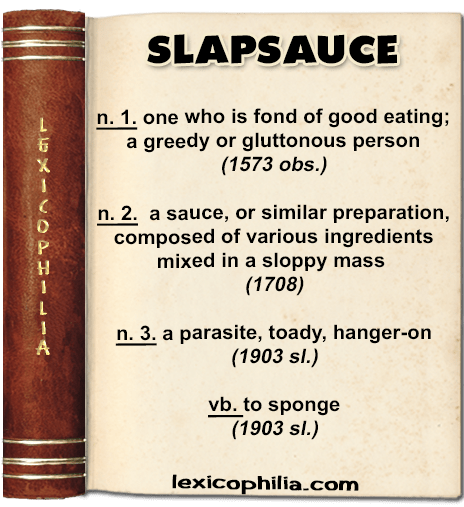
Word of the Day: SLAPSAUCE


ETYMOLOGY
from slap (to lap → Eng. dial.) + sauce


EXAMPLE
“…At dinner and supper the table doth craue
good fellowly neighbour good manner to haue.
Aduise thee well therefore, ere tongue be too free,
or slapsauce be noted too saucie to bee…”

From: Points of Huswifrie
In Fiue Hundreth Points of Good Husbandry
By Thomas Tusser, 1573

Word of the Day: SNATTER


ETYMOLOGY
vb.: from Dutch snateren or Low German snat(t)ern (Greek schnattern, Swedish snattra),
of imitative origin


EXAMPLE (for vb.)
“…for if thou considerest the things are easie attained, every ditch offering the some of them, and the preparation so trinial, that there is as much art to make a mess of pottage; in this above all other I have deserved well at thy hand, if thou hast a heart to improve it, neither do I doubt, although many will be angry and snatter at it, but this entrance which I have given in this receipt will stand while the world indures and get strength, and my memory held in honor, for so good service in it…”

From: The Unlearned Alchymist His Antidote
By Richard Mathews, 1662

Word of the Day: SUBDOLOUS


ETYMOLOGY
either from late Latin subdolosus (rather cunning), from classical Latin subdolus (sly, deceitful, treacherous) + -osus (-ous),
or from classical Latin subdolus (sly, deceitful, treacherous) (from sub- (sub-) + dolus (dole the corrupt, malicious, or evil intention essential to the guilt of a crime)) + -ous


PRONUNCIATION
SUB-duh-luhss


EXAMPLE
“…The subdolous crafte and deceate of Satan…”

From: Ane Cathechisme or Schort Instrvction of Christian Religion
By Peter Canisius
Translated by Adam King, 1588

Word of the Day: SMELLFUNGUS


ETYMOLOGY
after Smelfungus, a hypercritical traveller in A Sentimental Journey through France and Italy (1768) by Laurence Sterne (died 1768 British novelist), who intended this character to satirize Tobias Smollett (died 1771 British novelist) for his descriptions in Travels through France and Italy (1766)


EXAMPLE
“…I was, however, much pleased to see that red maintains its ground against all other colors, because red is the color of Mr. Jefferson’s ********, Tom Paine’s nose, and my slippers. Let the grumbling smellfungi of this world, who cultivate taste among books, cobwebs, and spiders, rail at the extravagance of the age; for my part, I was delighted with the magic of the scene, and as the ladies tripped through the mazes of the dance, sparkling and glowing and dazzling, I, like the honest Chinese, thanked them heartily for the jewels and finery with which they loaded themselves, merely for the entertainment of bystanders, and blessed my stars that I was a bachelor…”

From: Salmagundi; or, The Whim-Whams and Opinions of Launcelot Langstaff, (pseudonym) Esq. and Others
By William Irving, James Kirke Paulding and Washington Irving, 1807