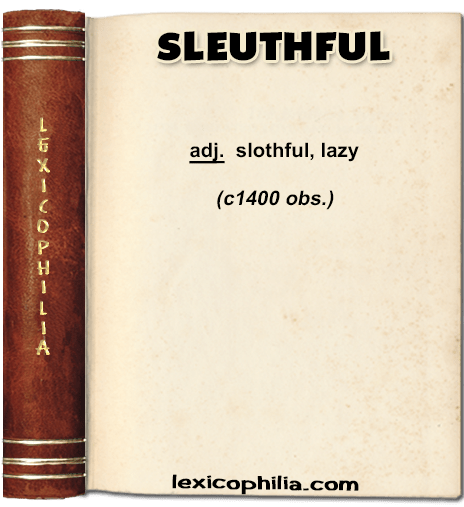
Word of the Day: SLEUTHFUL


ETYMOLOGY
from sleuth (sloth, laziness obs.) + -ful


EXAMPLE
“…And he þat hauys greet egℏen̛ ys enuyous & witℏ-outen shame, sleuthful, and vnobeyssant. He þat hauys lityƚƚ eghen̛, lyk to heuenly colour, or blake, ys of sharpe vnderstondynge, curteys, and leel…”

From: Secreta Secretorum,
(a treatise which purports to be a letter from Aristotle to his student Alexander the Great on an encyclopedic range of topics, including statecraft, ethics, physiognomy, astrology, alchemy, magic, and medicine)

Word of the Day: SMARTFUL


ETYMOLOGY
from smart (sharp physical pain) + -ful


EXAMPLE
“…What kind harted husband: can se his kind wife,
In like carefull case, without wo at his hart.
What naturall father can se: for his life,
His naturall childerne, in dread quake and start.
Without his hart smarting, in most smartfull smart.
I thinke, ye thinke none: and euin so thinke I.
Meruell not then: though the spider be toucht nie…”

From: The Spider and the Flie 
By John Heywood, 1556

Word of the Day: SLOWBACK


ETYMOLOGY
from slow (adj.) + back (n.)


EXAMPLE
“…For God doth not assiste slouthfull persons and idle slowbackes. Now I call those needelesse occupations, whiche idle and ill disposed people do vse, thereby to be troublesome to their neighbours and to deceiue other men, exercising, I confesse, an occupation, but such an one as is vtterly vnlawfull & vnprofitable to all men…”

From: Fiftie Godlie and Learned Sermons Diuided into Fiue Decades
By Heinrich Bullinger, 1577

Word of the Day: SAMSONISTIC


ETYMOLOGY
from Samson (in reference to his enormous strength) + -istic


EXAMPLE
“…The new Governor-General seemed to be impressed with the idea that all political officers, small and great, were in fault. Forthwith he commenced dealing out upon them the most ferocious and Samsonistic blows. The shower unfortunately fell, like Don Quixote’s strokes on a certain occasion, upon an innocent race of puppets…”

From: Dry Leaves from Young Egypt
Being a Glance at Sindh Before the Arrival of Sir Charles Napier,
By An Ex-Political (Edward Backhouse Eastwick), 1849
Chapter XII. A Flea

Word of the Day: SPLENDICANT


ETYMOLOGY
from present pple. of Latin splendicare to shine


EXAMPLE
“…and yet cast into a curious desire to vnderstand and knowe what should be the reason and cause that the purple humiditie in the touch of hir bodie, in the smoothnes of hir hand should be as white as pure milke: and by what meanes that nature had bestowed in hir faire bodie the fragrant sweetnes of Arabia. And by what industrie in hir starrie forehead pampynulated with threds of gold aptly disposed, she had infixed the fairest part of the heauens, or the splendycant Heraclea…”

From: Hypnerotomachia: The Strife of Loue in a Dreame
By Francesco Colonna
Translated by Robert Dallington, 1592

Word of the Day: SUSPECTUOUS


ETYMOLOGY
from Latin suspectus (u-stem) (suspect n.) + -ous


EXAMPLE
“…I thynke as our Cytezens be suspectuous and full of coniectoures; so dyd hee feare the comodyte of the place, and woulde eschewe the occasyon …”

From: The goodli history of the moste noble and beautyfull Ladye Lucres of Scene in Tuskane, and of her louer Eurialus verye pleasaunt and delectablevnto ye reder
By Pope Pius II, 1553

Word of the Day: STIVER-CRAMPED


ETYMOLOGY
– a stiver was a small coin (originally silver) of the Low Countries:
applied to the nickel piece of 5 cents of the Netherlands


EXAMPLE
“…as, according to a very nice calculation, that cutaneous reservoir, vulgarly called the breeches-pocket, and notorious for its unaffected sympathy with the animal spirits, will be stiver-cramped: I shall then indulge them with a touch of the sublime!…”

From: The Life and Extraordinary Adventures of James Molesworth Hobart
By N. Dralloc, 1794

Word of the Day: SNAPHANCE

ETYMOLOGY
From OED: Of Continental origin, representing Dutch and Flemish snaphaan (in Kilian snap-haen ), Middle Low German snaphân , Low German snapphân , German schnapphahn (†-han ),
from snappen , schnappen (snap v.) + haan, hahn (cock).
It is not quite clear whether the sense is ‘snapping cock’ or ‘cock-snapper’ (i.e. cock-stealer).
In English the second element may have been confused with the personal name Hans; but Heyne (in Grimm’s Dict.) cites an early example of German schnaphons.

EXAMPLE
“…Fyrste to make this realme a praye to al venturers, al spoylers, all snaphanses, all forlornehopes, all cormerauntes, all rauenours of the worlde, that wyll inuade this realme…”

From: A Sermon of Cuthbert Tonstall, Bishop of Durham,
Preached on Palm Sunday, 1539, Before King Henry VIII;
By Cuthbert Tunstall

Word of the Day: SQUIRE OF DAMES

ETYMOLOGY
from squire

EXAMPLE
“…Me, silly wretch, she so at vantage caught,
After she long in wait for me did lie,
And meant unto her prison to have brought,
Her loathsome pleasure there to satisfy;
That thousand deaths me lever were to die
Than break the vow that to fair Columbell
I plighted have, and yet keep steadfastly.
As for my name, it mistreth not to tell;
Call me the Squire of Dames, that me beseemeth well
…”

From: The Faerie Queene
By Edmund Spenser, 1590