Word of the Day: VINOMADEFIED

ETYMOLOGY
from Latin vinum (wine) + madefieri (to be soaked) + -ed

EXAMPLE
“…The Prince unwilling to miss of his mark, and not having in all the quivers of his reason one shaft wherewith to hit it, resolved to interpose some authority with his argumentations, and where the foxes skin could not serve, to make use of the Lyons: to the prosecuting of which intent, he with his vinomadefied retinue, resolved to press in upon the Page, and, maugre his will, to get up staires, and take their fortune in the quest of the Chamber they aimed at: for albeit the stradling as wide as he could, of pretty Pomponacio at the door whereat they made account to force their passage, did for a while retard their designe, …”

From: Εκσκυβαλαυρον, Ekskybalauron: or, The Discovery of a Most Exquisite Jewel, more precious then diamonds inchased in gold, the like whereof was never seen in any age
By Thomas Urquhart, 1652

Word of the Day: VITUPERIOUS

ETYMOLOGY
from Old French vituperieus (implied in the adv. vituperieusement), 
or from late or medieval Latin vituperiōsus from vituperium (vitupery)


EXAMPLE
“…Muse I inuoke the vtmost of thy might,
That with an armed and auspitious wing,
Thou be obsequious in his doubtlesse right
Gainst the vile Athiests vituperious sting:
Where thou that gate industriously mai’st flie,
Which Nature striues but fainedlie to goe,
Borne by a power so eminent and hie,
As in his course leaues reason farre belowe,
To shew how Poesie (simplie hath her praise)
That from full Joue takes her celestiall birth,
And quicke as fire, her glorious selfe can raise
Aboue this base and euitable earth
…”

From: Moyses in a Map of his Miracles
By Michael Drayton, 1604

Word of the Day: VERECUND


ETYMOLOGY
from Latin verecundus, from vereri (to reverence, fear)


EXAMPLE 1
“…And sum of thame I sall now specifie,
Quhilk to ressoun salbe correspondent.
Than said Venus with vult verecund,
Say quhat ʒe will and keip ʒow within bound
Not pretendand to argune throw ʒour will:
Bot to ressoun that ʒour Sermone resound,
Or ellis the lak to ʒour self sall redound
…”

From: Ane treatise callit The Court of Venus deuidit into four buikis
By John Rolland, 1575


EXAMPLE 2
“…In my Father’s house,” says Christ, “are many mansions.” Verily, that appears to be also the case in some of His Scotch Evangelical servants’ houses here. And verecund Mr. McCosh, who will not venture to suggest any better arrangement of the heavens, – has he likewise no suggestion to offer as to the arrangement of No. 23, St. James’s Street?…”

From: Fors Clavigera: Letters to the Workmen and Labourers of Great Britain,
By John Ruskin, 1873

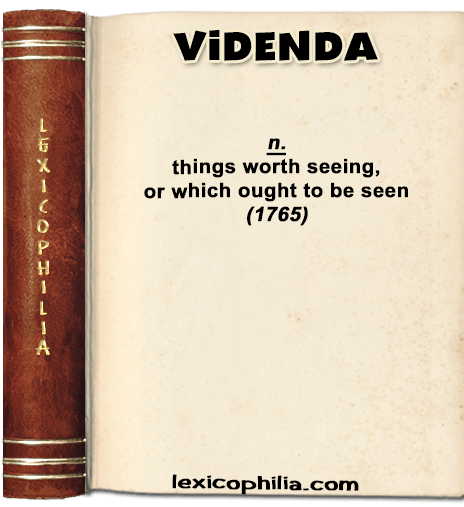
Word of the Day: VIDENDA


ETYMOLOGY
Latin, plural of videndum, from videre (to see)


EXAMPLE
“…In my list, therefore, of Videnda at Lyons, this, tho’ last, – was not, you see, least; so taking a dozen or two of longer strides than usual cross my room, just whilst it passed my brain, I walked down calmly into the basse cour, in order to sally forth; and having called for my bill – as it was uncertain whether I should return to my inn, I had paid it – had moreover given the maid ten sous, and was just receiving the dernier compliments of Monsieur Le Blanc, for a pleasant voyage down the Rhône – when I was stopped at the gate…”

From: The Life and Opinions of Tristram Shandy, Gentleman
by Laurence Sterne, 1765

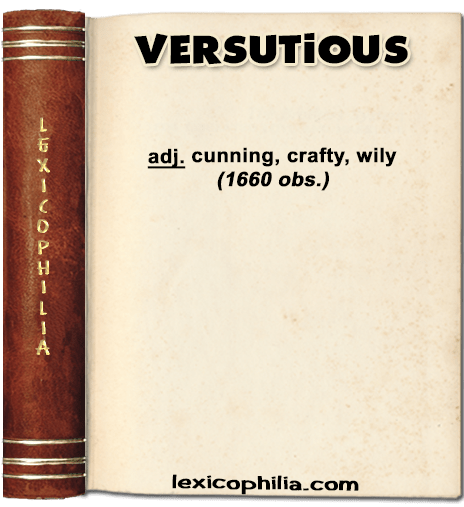
Word of the Day: VERSUTIOUS


ETYMOLOGY
from Latin versutus (wily, cunning) + – ious


EXAMPLE
“…And what do I not ow thee for thy versutious Comple­ments to my Lady Lambert, whose beauty and ele­gance bewitched my affections, as thou well knowest; so that I could not forbear toying and tickling her at my son Ireton’s Funeral in Somerset-house, before all the Company!…”

From: A Third Conference Between O. Cromwell and Hugh Peters In Saint James’s Park, 1660

Word of the Day: VOUTER


ETYMOLOGY
aphetic formed on avouter (an adulterer, esp. a male one);
in its oldest form from Old French avoutre, aoutre


EXAMPLE
“…For in þis werlde is no doge for þe bowe
þat knowe an hurt dere fro an holde bet cowe
þan þis Somenour knewe a licour
Or a vouter or elles a paramour
And for þat was þe fruyte of al þe rente
Ther-for on it he set al his entente
…”

From: The Lansdowne Manuscript of Chaucer’s Canterbury Tales,
Geoffrey Chaucer, c1386

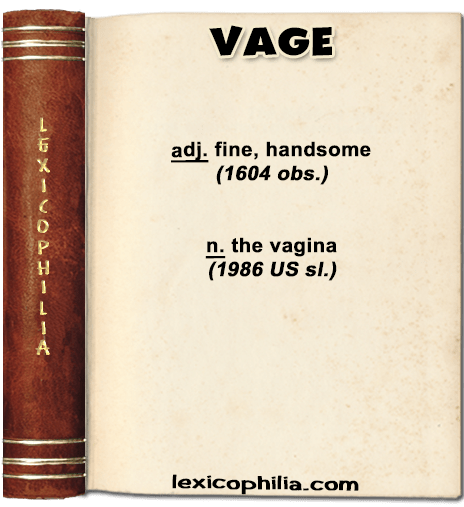
Word of the Day: VAGE


ETYMOLOGY
adj,: apparently from Italian vago


EXAMPLE
“…no doubt but better parts, finer colours, purer lights proportionably combined, cause a more excellent beautie, shew, and lustre: as the siner gold, the richer stones (if art bee correspondent) the more vage and beautifull iewell…”

From: The Passions of the Minde in Generall
By Thomas Wright, 1604

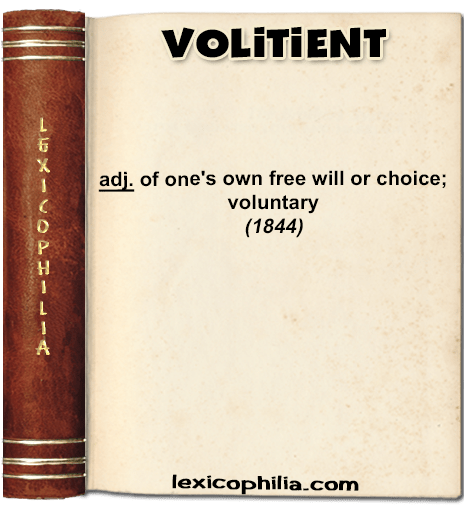
Word of the Day: VOLITIENT


ETYMOLOGY
irregularly from voliti-,
from French volition,
from medieval Latin volition-volitio (noun of action),
from Latin volo (I wish, will) + -ent 


EXAMPLE
“…I chose this ruin: I elected it
Of my will, not of service, What I do, I do volitient, not obedient,
And overtop thy crown with my despair
…”

From: A Drama of Exile
By Elizabeth Barrett Browning, 1844