Word of the Day: WATER-FUNK

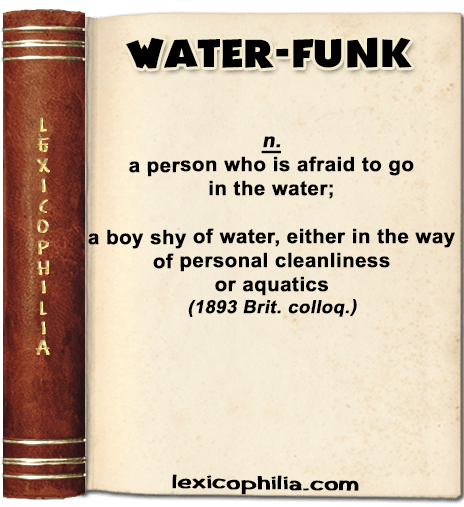
ETYMOLOGY
from water + funk (a cowardly or nervous person)

EXAMPLE
“… The arms, he may next be taught, do little more in the act of swimming than support the body; the necessary speed is procured by the action of the legs. A sensible lad, who is not a “ water-funk ”— to use the expressive term of the period— if the theory of the art be thus explained to him, ought to swim in six or seven lessons. …”

From: The Academy. A weekly review of literature, science, and art
Swimming. By A. Sinclair and W. Henry
August, 1893

Word of the Day: WINDY-WALLETS

ETYMOLOGY
from windy (1. speaking at length; 2. of food or drink: causing flatulence) + wallet (possibly from Scottish sense of a fund of stories, poems, recollections, etc.)

EXAMPLE
“… Gowkscroft and Barnside,
Windy-wallets fu’ o’ pride;
Monynut, and Laikyshiel,
Plenty milk, plenty meal;
Straphunton Mill, and Bankend,
Green cheese as teugh as bend;
Shannabank and Blackerstane,
Pike the flesh to the bane;
Quixwood, and Butterdean,
Lu’ o’ parritch to the een!
…”

From: The Popular Rhymes, Sayings, and Proverbs of the County of Berwick
By George Henderson, 1856

Word of the Day: WUZZY

ETYMOLOGY
of uncertain origin;
possibly a variant of woozy (dizzy or unsteady); possibly after muzzy (drowsy, spiritless; confused, mentally hazy; dazed and unfocused)

EXAMPLE
“… I am very nearly mad, I am quite slowly turning wuzzy. I see four people instead of one, and I have an irresistible longing to eat the fire and beat my door-handle. …”

From: Antony (Viscount Knebworth): A Record of Youth
By Edward Anthony James Lytton, 1935
Letter written 10 March, 1921

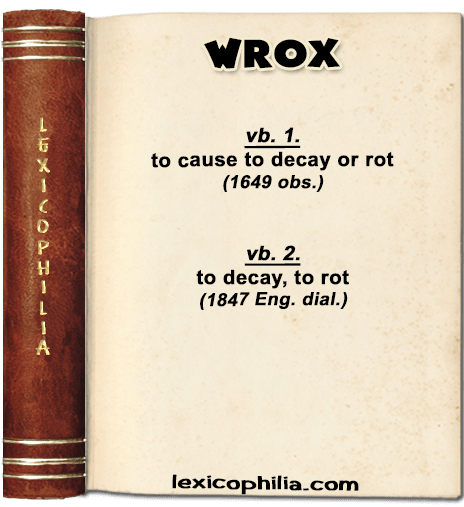
Word of the Day: WROX

ETYMOLOGY
of obscure origin

EXAMPLE
“… be sure to give it a second plowing, just overthwart all the lands, and so cut the Turfe, that the Soard may have all the Winters frost to wroxe, and moulder it, which towards March thou mayst plow again, and so cast it, or raise it, as thy Land requireth …”

From: The English Improver, or a New Survey of Husbandry discovering to the kingdome that some land, both arrable and pasture, may be advanced double or treble
By Walter Blith, 1649
Reducement of Land to Pristine Fertility

Word of the Day: WRINGLE-WRANGLE

ETYMOLOGY
reduplication of wrangle (n.) with change of vowel as in jingle-jangletingle-tangle, etc.

EXAMPLE
“…It was a most delightful godsend to the paper in which it appeared, and it came at a time when the House was not sitting, and there was no wringle-wrangle of debates to furnish material for the columns of big type which are supposed to sway the masses. …”

From: All Sorts and Conditions of Men: An Impossible Story
By Walter Besant, 1882

Word of the Day: WAG-TONGUE

ETYMOLOGY
from wag (vb.) + tongue (n.)

EXAMPLE
“…but now indeet her tongue is loosened, and she talks, yes indeet, she does talk nineteen to the dozen and more. A silent woman she was. It is the nearest approach to a miracle I ever care to see. A chatterbox she is, and worse – a regular woman wag-tongue, a regular woman wag-tongue. I cannot get in a word edgeways now …”

From: Macmillan’s Magazine
Volume LXXXVI, May to October,1902
A Woman Wag-tongue

Word of the Day: WAY-WORN


ETYMOLOGY
from way (a track, a road, a path) + worn


EXAMPLE
“…Say then, if England’s youth in earlier days
On Glory’s field with well train’d armies vy’d,
Why shall they now renounce that gen’rous praise?
Why dread the foreign mercenary’s pride?
Tho’ Valois brav’d young Edward’s gentle hand,
And Albret rush’d on Henry’s way-worn band,
With Europe’s chosen sons in arms renown’d,
Yet not on Vere’s bold archers long they look’d,
Nor Audley’s squires nor Mowbray’s yeomen brook’d;
They saw their standard fall, and left their monarch bound
….”

From: Ode to the Country Gentlemen of England.
By Mark Akenside, 1758

Word of the Day: WHEY-BLOODED


ETYMOLOGY
from whey  + blooded


EXAMPLE
“…Beantosser
Here here, a pox o’ these full mouth’d Fox hounds.

Hectorio
They hunt devilish hard, I’me affrai’d they’l earth us.

Stephania
Give Hectorio a dram of the Bottle, the Whey-Blooded Rogue looks as if his heart were melted into his Breeches…”

From: The Mock-Tempest, or, The Enchanted Castle
By Thomas Duffett, 1675

Word of the Day: WEALSOME


ETYMOLOGY
from weal (well-being, Old English wela [wealth], in late Old English also welfare, well-being), + –some


EXAMPLE
“…I preisede more the deade than the liuende; and I demede hym welsumere than either, that ȝit is not born …”

From: The Holy Bible, containing the Old and New Testaments, with the Apocryphal books
(Wycliffite, early version), a1382
Edited by Josiah Forshall and Frederic Madden. 1850