ETYMOLOGY
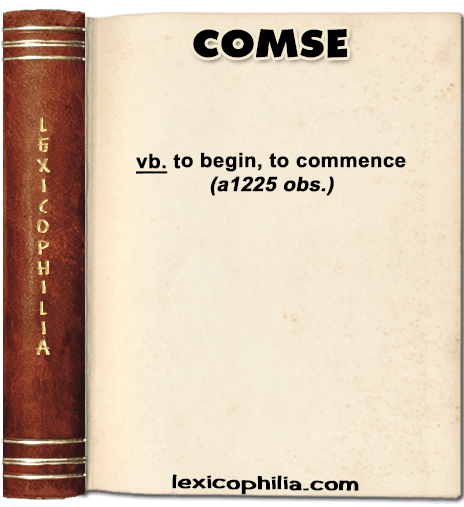
shortened by-form of commence
EXAMPLE
“…Her cumſeð þe uie of seinte iuliane. ant telleð of liflade hire…”
From: Þe Liflade of St. Juliana (The Life of St. Juliana)
(Royal Manuscript), a1225
ETYMOLOGY
shortened by-form of commence
EXAMPLE
“…Her cumſeð þe uie of seinte iuliane. ant telleð of liflade hire…”
From: Þe Liflade of St. Juliana (The Life of St. Juliana)
(Royal Manuscript), a1225
ETYMOLOGY
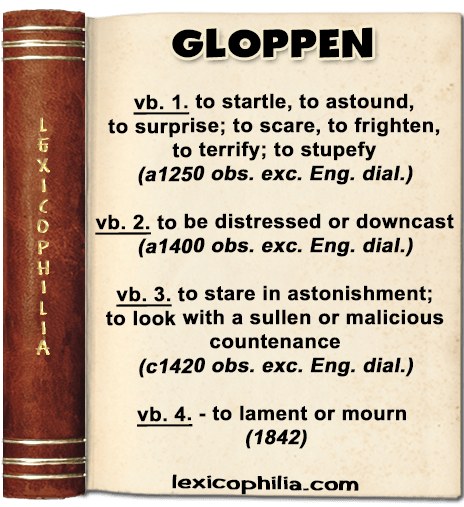
from Old Norse glupna (to be downcast);
a root of identical form appears in Old Frisian glûpa, Middle Low German glûpen (to lie in wait for), Dutch gluipen (to watch slily, to sneak), Old Swedish glupa (to gape, swallow), Swedish glupande, Danish glubende (ravenous, fierce);
whether there is any etymological connection is uncertain
ETYMOLOGY
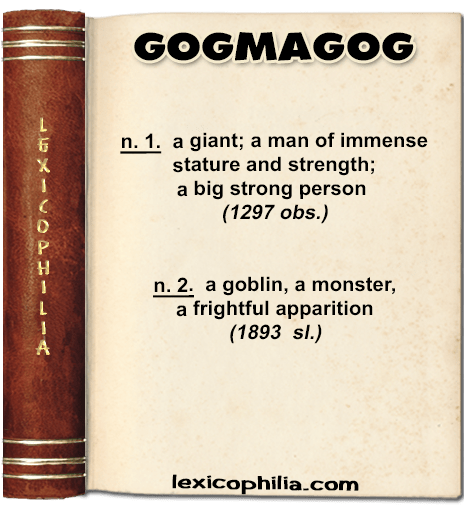
from Goemagot, the greatest of the British giants, according to Geoffrey of Monmouth;
altered after the biblical names Gog and Magog
EXAMPLE
“…Gogmagog was a geant · suiþe gret & strong
Vor aboute an twenti vet · me seiþ he was long …”
From: The Metrical Chronicle of Robert of Gloucester, c1325

ETYMOLOGY
from under-;
(From E-NED: In Old English, various secondary meanings of under- are represented by such verbs as under(be)ᵹinnan (to begin or attempt), underfón (to receive), underᵹietan, -niman, -standan (to understand), undersécan (to investigate))
EXAMPLE
“…Ȝif hie cumeð fram mannen, hie cann hwatliche underfinden, an hwos half he is icumen, and ðar after hie hine underfengð …”
From: Vices and Virtues : a Soul’s Confession of its Sins with Reason’s Description of the Virtues,
A Middle-English Dialogue of about 1200 A.D.
ETYMOLOGY
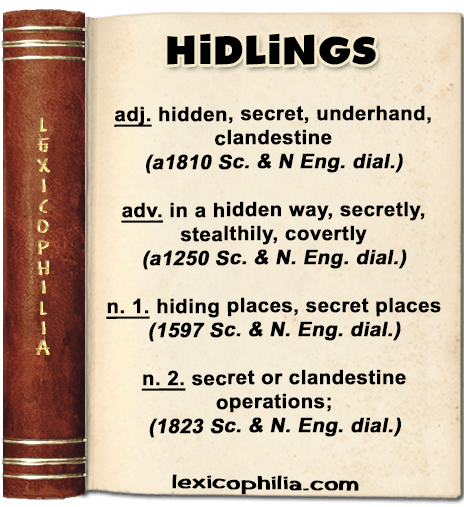
from hid (adj.) + -ling
EXAMPLE
“…Anna: Yes: to come to me without loss of time. There is money for thee. Do thy errand speedily and secretly: let nobody know that I have sent thee
Bawldy: An’ she’s to come to you here, hidlings, as it war?
Anna: Yes, Bawldy; and when she comes, let her wait for me in the cattle shed…”
From: Witchcraft
By Joanna Baillie, 1836

ETYMOLOGY
from be- + gab (to impose upon)
EXAMPLE
“…And wend [þat] he begabbit had bene Be wesch-crafte…”
From: Legends of the Saints in the Scottish dialect of the fourteenth century
St. Clemens c1375
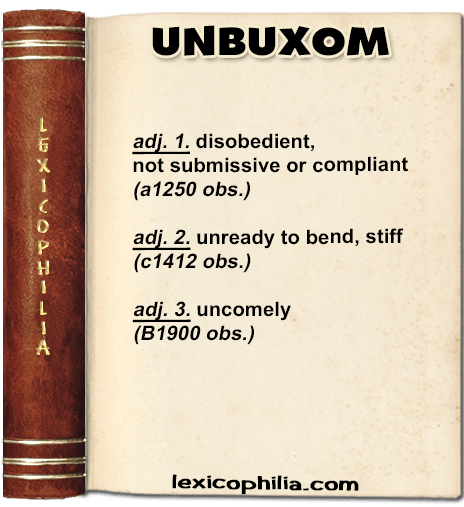
ETYMOLOGY
from un- (prefix) + buxom (adj.)
EXAMPLE
“…Betere þe were.
iboren þat he nere.
for betere is child vnbore. þane vnbuhsum.
þe mon þe spareþ yeorde. and yonge childe.
and let hit arixlye. þat he hit areche ne may…”
From: The Proverbs of Aelfred, a1250

ETYMOLOGY
from wan- (a prefix approximately equivalent to un- or mis-) + hope
EXAMPLE
“…& is men as in wanhope wende hom aȝen bliue
So þat ich hopie to god pais þe wule ich am aliue
Messagers to denemarch sone isend were
& as þe king adde ised al clene hii founde þere…”
From: The Metrical Chronicle of Robert of Gloucester, 1297
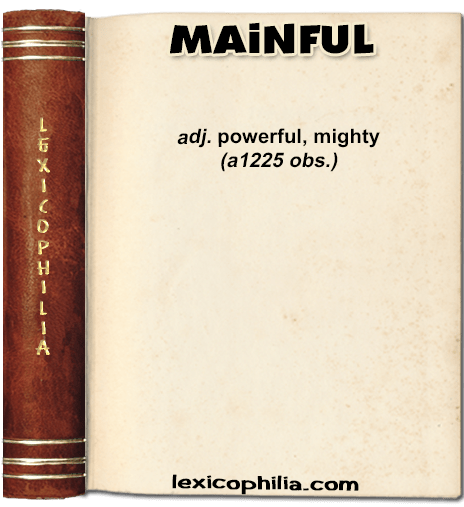
ETYMOLOGY
from main (physical strength, force or power + -ful
EXAMPLE
“…To eke (increase) this that he so mighty and mainful, he is loveliest life for to look upon, and sweetest to smell, nor his sweet savour nor his almighty might…”
From: Seinte Marharete Modernized
Saint Margaret the Maiden and Martyr
 Lexicophilia