ETYMOLOGY
vb. 1: from participial stem of Latin uberare , from uber (rich, plentiful) + -ate
vb. 2: from Latin uber (udder) + –ate
EXAMPLE (for vb. 1.)
Seafood uberates at the historic market in the old fishing village.
ETYMOLOGY
vb. 1: from participial stem of Latin uberare , from uber (rich, plentiful) + -ate
vb. 2: from Latin uber (udder) + –ate
EXAMPLE (for vb. 1.)
Seafood uberates at the historic market in the old fishing village.
ETYMOLOGY
from Latin basiat- participial stem of basiare, from basium (kiss)
EXAMPLE
(With apologies to William B. Felts;
Taken from Hernarne: A Comedy, 1891
“I kissed my love and he kissed me
And so we kissed each other” )
I basiated my love and he basiated me
And so we basiated each other
ETYMOLOGY
from Latin plus, plur- (more) + animous;
after unanimous (from Latin unanimis, unanimus [from unus (one) + animus (mind)] + -ous)
EXAMPLE
“… Should I make a parallel of this present Basis with the former, & were I sure my Mare would not stumble, I could demonstrate it to be Heterogeneous, Heterodoxous, Incongrous, Omnigenous, Pluranimous, Versipellous, Centireligious, Nummiamorous; I thought I should hit it at length, but I take in Army and all, or else my Mare would soone stand on her head. …”
From: Discolliminium, or, A most obedient reply to a late book, called, Bounds & bonds, so farre as concerns the first demurrer and no further
By B. (Nathaniel Ward), 1650
ETYMOLOGY
from late Latin egestuosus, irregularly from egestas (poverty)
EXAMPLE
“… You call me oscitant, – ah! well,
Obtenebration hides my tears;
I may become sejungible,
When labefaction comes with years.
Exequial nights, egestuous days
No nummary relief can soothe, –
No xenodochium allays
Radicate thirst with “Bass” or “Booth.” …”
From: The Savage-Club Papers
Edited by Andrew Halliday, 1867
A Social Science Valentine, By Thomas Archer

ETYMOLOGY
from Latin innubilus, (from in- + nubilus (nubilous, cloudy, foggy, misty)) + -ous
EXAMPLE
“… Through the benignity of our largifical essence always inclin’d to succour the egestuosity of our votaries conceptions, and to inlighten their offuscated intellects upon the least petitionary susurration, we will now descend from our innubilous empireum to infuse some rays of knowledge for solving the problem of our obsequious querist, so far as is fit to be communicated to the humble spawn of earth; …”
From: The British Apollo,
Containing Two Thousand Answers to Curious Questions in Most Arts and Sciences, Serious, Comical, and Humorous
1st Edition, 1708-1711

ETYMOLOGY
onomatopœic: suggested by full, chub, etc.
EXAMPLE
“… Caspia the decrepit old rich Croot,
Whose face (th’antiquity of time bewraying)
Is riueld like a ruffled summer Boot;
Shee that’s in all things, but in wealth, decaying:
Caspia, that same fowle deformed Fubs,
Who neuer needs feare coughing out her teeth,
(For she hath none, but a few Holly-stubs)
She that should think of nothing now but death;
Maugre th’imperfections of her Age…”
From: Rubbe, and a Great Cast Epigrams
By Thomas Freeman, 1614
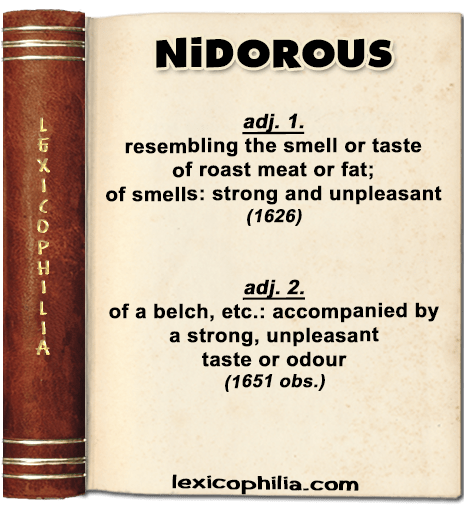
ETYMOLOGY
from Late Latin nidorosus (steaming, reeking), from Latin nidor (strong or unpleasant odour, etc.) + –osus (-ous)
EXAMPLE
“…Incense, and Nidorous Smells, (such as were of Sacrifices,) were thought to Intoxicate the Braine, and to dispose Men to Devotion: Which they may doe, by a kinde of Sadnesse, and Contristation of the Spirits, And partly also by Heating, and Exalting them. …”
From: Sylva sylvarum; or, A Naturall Historie
By Francis Bacon, 1626
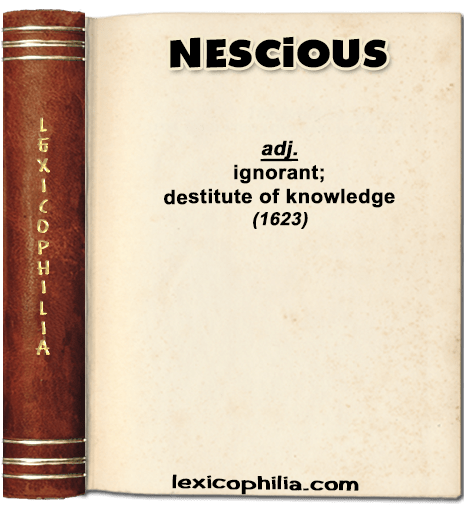
ETYMOLOGY
from Latin nescius (ignorant, not knowing),
from nescire (to be ignorant, not to know) + -ous
EXAMPLE
“… The third cause of the decay of Trade, in Malynes accompt, are Litigious Law-suits. To the Efficiency whereof, Malynes cannot altogether agree, but rather to the Remedie. But I shall willingly pardon him that: for he that is so ignorant in the Essentiall causes, must needs be nescious in the Efficients also. I would there were no cause, for their sakes whose case it is, to dispute this Causalitie. …”
From: The Circle of Commerce.
Or The ballance of trade in defence of free trade: opposed to Malynes little fish and his great whale, and poized against them in the scale.
By Edward Misselden, 1623

ETYMOLOGY
from down (in a descending direction) + steepy (full of steep places, steep)
EXAMPLE
“… All which notwithstanding, perceiving life to remaine in him, he tooke heart againe; and getting vp on his feet, all goared with bloud, and loaden with strokes, making way through the prease, came to a craggie and downe-steepie rocke, where vnable to goe any further, by one of his wounds, with both his hands he pulled out his guts, and tearing and breaking them, cast them amongst such as pursued him, calling and attesting the vengeance of God to light vpon them. …”
From: The Essayes, or Morall, Politike, and Millitarie Discourses of Lord Michaell de Montaigne
By Michel de Montaigne
Translated by John Florio, 1603

ETYMOLOGY
from Latin pabulasus abounding in pabulum (fodder);
from pabulum (food, nutrient) + –osus (-ous)
EXAMPLE
“… And although the ayre attracted may be conceived to nourish that invisible flame of life, in as much as common and culinary flames are nourished by the ayre about them; I confesse wee doubt the common conceit, which affirmeth that aire is the pabulous supply of fire, much lesse that flame is properly aire kindled: And the same before us, hath been denyed by the Lord of Verulam, in his Tract of life and death, & also by Dr. Jorden in his book of Minerall waters. …”
From: Pseudodoxia Epidemica, or, Enquiries into very many received tenents and commonly presumed truths
By Sir Thomas Browne, 1646
 Lexicophilia