Word of the Day: RHINOCERICAL

ETYMOLOGY
from rhinoceros + -ical

EXAMPLE (for adj. 1.)
“… Cheat. My lusty rustic, learn and be instructed. Cole is, in the language of the witty, money. The ready, the rhino ; thou shalt be rhinocerical, my lad, thou shalt.

Belf. Admirable, I swear ! Cole ! ready ! rhino ! rhinocerical ! Lord, how long may a man live in ignorance in the country. — And how much cole, ready, and rhino, shall I have? …”

From: The Squire of Alsatia. A comedy
By Thomas Shadwell, 1688

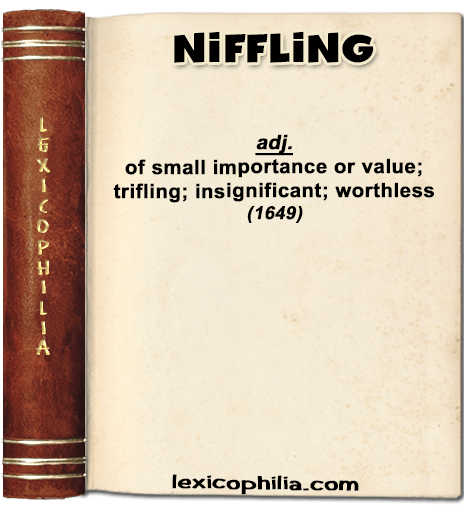
Word of the Day: NIFFLING

ETYMOLOGY
either from niffle (to act in a trifling manner) + ‑ing,
or from nifle (a trifle) + ‑ing 

EXAMPLE
“…There are some that are so forestalled with a strong self-conceit of their own light and love of self-will, that whatsoever bears not the stamp and superscription of their approved patrons, schools and institutions, is but as darkness and nifling shadows unto them, and ungrounded prejudice, cavilling superstition, and vain suspicion do so much possess them, that they reject it as not worth the reading over; …”

From: The Epistles of Jacob Boehme
Translated by J. Ellistone, 1649
Preface to the reader

Word of the Day: CORRECTIFY

ETYMOLOGY
from Latin correctus + -fy

EXAMPLE
“… It is not to be a Justice of Peace as you are, and palter out your time i’th’ penal Statutes. To hear the curious Tenets controverted between a Protestant Constable, and Jesuite Cobler; to pick Natural Philosophy out of Bawdry, when your Worship’s pleas’d to correctifie a Lady; nor ’tis not the main Moral of blind Justice, (which is deep Learning) when your Worships Tenants bring a light cause, and heavy Hens before ye, both fat and feeble, a Goose or Pig; and then you’ll sit like equity with both hands weighing indifferently the state o’th’ question. These are your Quodlibets, but no Learning, Brother. …”

From: The Elder Brother a comedie
By John Fletcher, Philip Massinger, 1637

Word of the Day: CAPER-WITTED

ETYMOLOGY
from caper (a frolicsome leap) + witted (relating to wit or intelligence)

EXAMPLE
“… I have stood by his Table often, when I was about the Age of Two and twenty Years, and from thence forward, and have heard learned Pieces read before him at his Dinners, which I thought strange; but a Chaplain of James Mantague, Bishop of Winton, told me, that the Bishop had read over unto him the four Tomes of Cardinal Bellarmine’s Controversies at those Respites, when his Majesty took fresh Air, and weighed the Objections and Answers of that sub∣tle Author, and sent often to the Libraries in Cambridge for Books, to examine his Quotations. Surely then, whatsoever any Caperwitted Man may observe, neither was the King’s Chastity stained, nor his Wisdom lull’d asleep, nor his Care of Government slackned, by Lodging in those Courts remote from London, where he was freer from Disturbances …”

From: Scrinia Reserata a memorial offer’d to the great deservings of John Williams, D. D.
By John Hacket, 1693

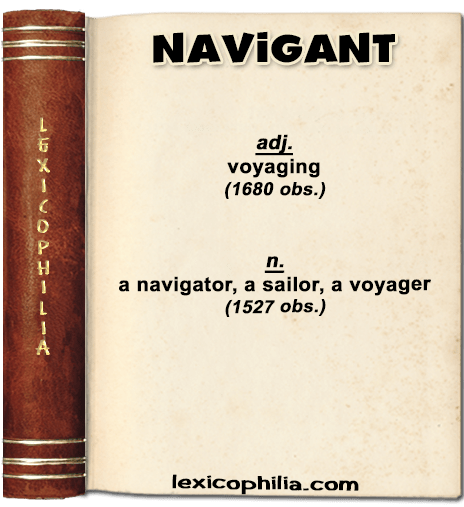
Word of the Day: NAVIGANT

ETYMOLOGY
adj.: from Latin navigant-navigans, present participle of navigare (to navigate)
n.: partly from French navigant, (navigator, seafarer) use as noun of present participle of naviguer (to navigate), and partly from Latin navigant-, navigans (seafarer) use as noun of present participle of navigare (to navigate)

EXAMPLE (for n.)
“… And now to declare something of the commodity and vtilitie of this Nauigation and discouerie: it is very cleere and certaine, that the Seas that commonly men say, without great danger, difficulty and perill, yea rather it is impossible to passe, that those same Seas be nauigable and without anie such danger, but that shippes may passe and haue in them perpetuall clerenesse of the day without any darkenesse of the night: which thing is a great commoditie for the nauigants, to see at all times round about them, as well the safegards as dangers, and how great difference it is betweene the commoditie and perils of other which leese the most part of euery foure and twentie houres the said light, and goe in darkenesse groping their way, I thinke there is none so ignorant but perceiueth this more plainely, then it can be expressed. …”

From: The Principal Nauigations, Voyages, Traffiques and Discoueries of the English Nation, made by sea or ouer-land, to the remote and farthest distant quarters of the earth, at any time within the compasse of these 1600. yeres
By Richard Hakluyt
A declaration of the Indies and lands discouered, and subdued vnto the Emperour, and the king of Portingal: And also of other partes of the Indies and rich countries to be discouered, which the worshipfull M. Robert Thorne merchant of London (who dwelt long in the citie of Siuil in Spaine exhorted king Henrie the eight to take in hand. a1527

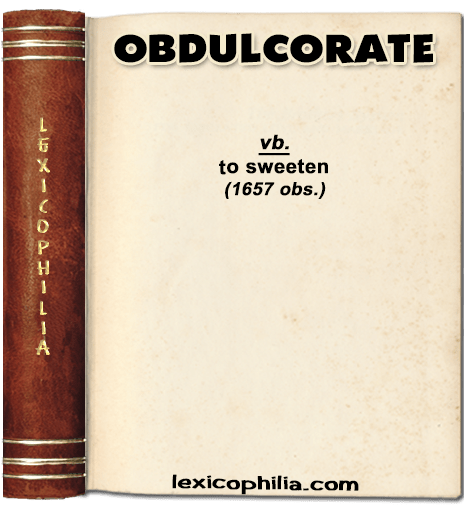
Word of the Day: OBDULCORATE

ETYMOLOGY
from ob- + Latin dulcorat-, past participial stem of dulcorare (to sweeten), 
from dulcor-em (sweetness), from dulcis (sweet)

EXAMPLE
“… Now election of Medicaments may be made from Odour, for this cause, because a sweet oppleasant smell refreshes the spirits, restores strength and vigour to them, exhilarates the principal members and parts, and corroborates their faculties. An ill and stinking smell on the contrary burthens and aggravates the head, vexes the heart, subverts the ventricle, infects the spirits, moves a loathing, causes grievous and laborious purgings, and oftentimes vomitings. And therefore such purging Medicaments are obdulcorated with cordial Electuaries, whereby their ingratefull odour is amended, and the principal parts fortressed against the malign quality of these Medicaments; for all odoriferous Spices are the fountain and principle of life. …”

From: A Medicinal Dispensatory, containing the whole body of physick discovering the natures, properties, and vertues of vegetables, minerals, & animals
By Jean de Renou
Translated by Richard Tomlinson, 1657

Word of the Day: KUMBIX

ETYMOLOGY
from Greek kimbix (tightfisted person)

EXAMPLE
“… for hee that saith unto a rich and great monied man, that he will be his broker, and helpe him to some usurers of whom he may take up mony at interest; or unto a sober person, who drinketh nothing but water, that he is a drunkard, or hath taken his wine too liberally; or he that calleth a liberall man, well knowen to spend magnificently, and ready to pleasure all men, a base mechanicall kumbix, and a pinching peni-father; or he who threatneth a famous advocate or counsellor at the barre, who hath a great name for lawe and eloquence in all courts of plea, and besides for policie and government is in high authoritie, that he will bring him to a non-sute, or overthrow him judicially, he (I say) ministreth matter of good spirit and laughter unto the partie whom he seemeth so to chalenge or menace. …”

From: The Philosophie, Commonlie called, The Morals
By Plutarch
Translated by Philemon Holland, 1603

Word of the Day: CUMATICAL

ETYMOLOGY
from Greek κῡµατ- (wave) + -ic + -al. after Latin cumatilis (sea-coloured, blue)

EXAMPLE
“… A Prince blew.
Crimson, i.e. Scarlet.
Cumatical colour, i.e. blew.
Flesh colour, a certain mixture of red white.
Gangran colour, i.e. divers colours together, as in a Mallards, or Pigeons neck.
…”

From: The Compleat Gentleman: fashioning him absolute in the most necessary and commendable qualities, concerning mind, or body, that may be required in a person of honor.
By Henry Peacham, 1661
An Exposition of Colours

Word of the Day: FIRE-FLAUGHT

ETYMOLOGY
from fire (n.) + flaught (a flash; a flash of lightning)

EXAMPLE (for n. 1.)
“… Bot lo, onon, a wonder thing to tell!
Ane huge bleys of flambys braid doun fell
Furth of the clowdis, at the left hand straucht,
In maner of a lychtnyng or
fyre flaucht,
And dyd alicht rycht in the sammyn sted
Apon the crown of fair Lavinias hed;
…”

From: The Æneid of Virgil
Translated by Gavin Douglas, a1522