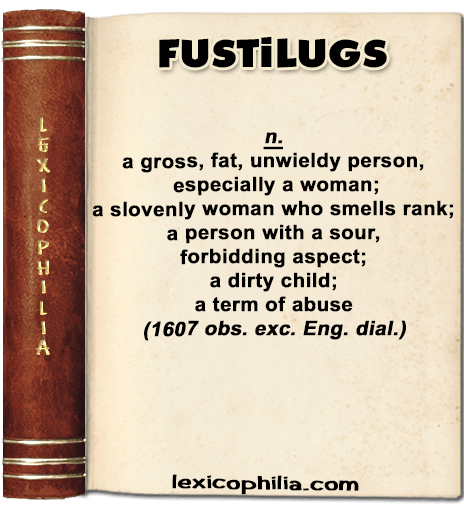
Word of the Day: FUSTILUGS

ETYMOLOGY
? from fusty (having an unpleasant or stuffy smell), + lug (something heavy and clumsy), in the sense of something heavy or slow

EXAMPLE
“… Whereupon the richest Babylonians intending to marry, buy the fairest and most beautifull virgins in the company, one out-bidding another in the bargain. The country swains contenting themselues though they haue not the fairest, take the woodden-fac’d wenches, and the ill-fauourd-foule-fustilugs for a small summe, …”

From: A World of Wonders,
Or an Introduction to a Treatise Touching the Conformitie of Ancient and Moderne Wonders.
By Henri Estienne
Translated by R.C., 1607
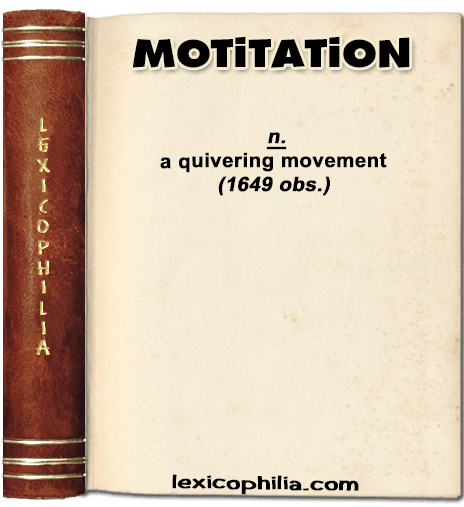
Word of the Day: MOTITATION

ETYMOLOGY
from Latin motitat-, past participial stem of motitare (to move),
from motare (to set in motion, to keep moving) + -itare (-itate) + -ion

EXAMPLE
“… because muscles in this, scarce otherwise then in other functions, are strained; & therefore you rest a trembling Head upon a cush∣on, you shall soon stay the trembling, and free it from that motitation. And hence it is that we know this motion of the Head is voluntary …”

From: Pathomyotamia, or, A dissection of the significative muscles of the affections of the minde
By John Bulwer, 1649

Word of the Day: JIGGALORUM

ETYMOLOGY
of uncertain origin; probably influenced by jig and jog

EXAMPLE
“… Even Humfrey King finds an excuse for his own mediocrity in that it is not the lowest: ‘I see my inferiours in the gifts of learning, wisdome, & vnderstanding, torment the Print daily with lighter trifles, and Iiggalorums, then my russet Hermit is, the which hath made me the bolder to shoulder in amongst the’…”

From: Halfe-penny-worth of Wit
By Humphrey King, 1613

Word of the Day: CLODPATE

ETYMOLOGY
from clod (lump) + pate (head)

EXAMPLE
“… VVHat Clod-pates, Thenot, are our Brittish swains,
How lubber-like they loll upon the plains?
No life, no spirit in ’em; every Clown
Soone as he layes his Hook and Tarbox down,
That ought to take his Reed, and chant his layes,
Or nimbly run the winding of the Maze,
Now gets a bush to roam himselfe, and sleepe;
Tis hard to know the shepheard from the sheepe.
…”

From: By Thomas Randall/Randolph
in: Annalia Dubrensia, vpon the yeerely celebration of Mr. Robert Dovers Olimpick Games vpon Cotswold-Hills, 1636
Edited by Alexander Grosart, 1877

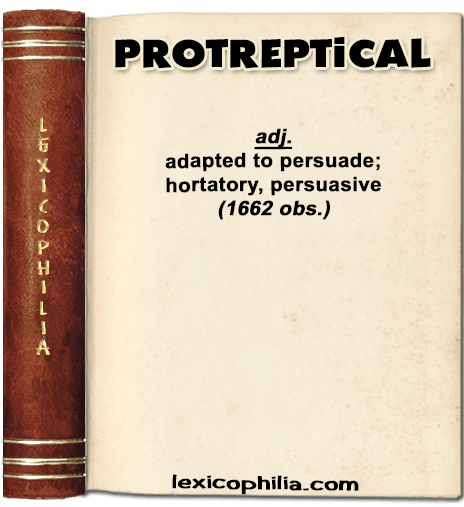
Word of the Day: PROTREPTICAL

ETYMOLOGY
from Latin protrepticus or its etymon ancient Greek προτρεπτικός (hortatory, instructive) < προ- (pro-) + Greek τρεπτικός (causing change in),
from Greek τρεπτός (liable to be turned or changed)
(from τρέπειν (to turn, direct the course of) + ‑τός)) + ‑ικός (‑ic) + -al

EXAMPLE
“… For the matter, we find, that these words are joyned with the antecedent Doctrine concerning the Excellency of Christ both as Prophet and Priest; and so it’s the second part of the whole, which is, 1. Doctrinal. 2. Practical. For, the former part is didascalical, this latter protreptical and more practical. But if we consider the immediate Connexion, then it will appear, that it’s in a more special manner joyned with the Doctrine of Christ’s Priest-hood, …”

From: An exposition of the Epistle to the Hebrewes 
By George Lawson, 1662

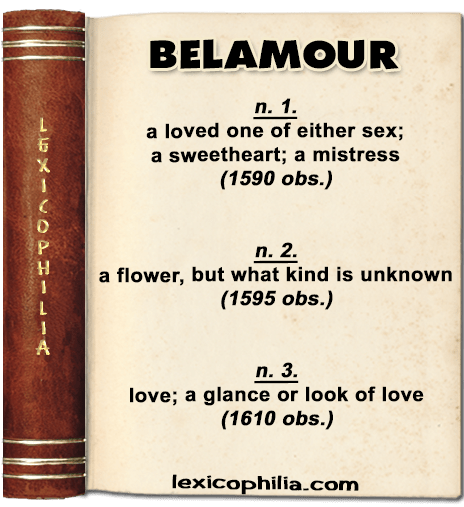
Word of the Day: BELAMOUR

ETYMOLOGY
from French bel (fair) + amour (love)

EXAMPLE (for n. 1)
“… Loe loe how braue she decks her bounteous boure,
  With silken curtens and gold couerlets,
  Therein to shrowd her sumptuous
Belamoure,
  Yet neither spinnes nor cardes, ne cares nor frets,
But to her mother Nature all her care she lets.
…”

From: The Faerie Queene
By Edmund Spenser, 1590

Word of the Day: HARE-HEARTED

ETYMOLOGY
from hare + hearted

EXAMPLE
“… Two right Hare-harted coward Fooles,
Would end their wrath with Cutlers tooles,
And two moft fhifting Knaues intends,
To make thofe Cowards louing friends:
One goes to th’one, and tell’s him tother,
Vowes he doth loue him as his Brother;
And would a Supper on him fpend :
That Cuppes of Sacke their ftrife might end, …”

From: A Fooles Bolt is Soone Shot
By Samuel Rowlands, 1614