Word of the Day: HESITATIOUS

ETYMOLOGY
from Latin hæsitationem, noun of action from hæsitare (to hesitate) + -ous

EXAMPLE
“… he did not advance with his Army as near as, as he might have done, nor did endeavor to enforce others, nor to be enforced himself to fight, but rather went out of his direct way, which he had taken to come to Vienna, and kept for the most part in strong and commodious seats, as between the two Rivers of Sava and Drava; and if a powerful and vain glorious Prince, who professed that he had undertaken that War meerly out of a desire of glory would make use of haesitatious counsels, where the consequences were so great and so heavie; …”

From:
Politick Discourses written in Italian by Paolo Paruta, a noble Venetian, cavalier and procurator of St. Mark;
Translated by the Right Honorable Henry, Earl of Monmouth, 1657

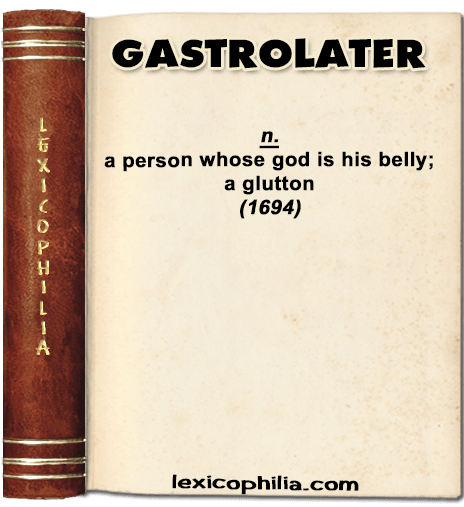
Word of the Day: GASTROLATER

ETYMOLOGY
from French gastrolatre,
from Greek γαστρ(ο)-, γαστήρ (belly) + -λατρος (serving)

EXAMPLE
“… At the Court of that great Master of Ingenuity, Pantagruel observ’d two sorts of troublesom and too officious Apparitors, whom he very much detested. The first, were call’d Engastrimythes; the others, Gastrolaters. …”

From: Pantagruel’s Voyage to the Oracle of the Bottle
Being the fourth and fifth books of the works of François Rabelais
Translated by Peter Anthony Motteux, 1694

Word of the Day: GNATHONIC

ETYMOLOGY
from Latin Gnathonicus,
from Gnathonem (gnatho),
from Latin Gnatho, the name of a parasite in the “”Eunuchus” of Terence

EXAMPLE
“… The gnathonick Parasite sweareth to all that this benefactor holdeth. The mercenary Pensioner will bow before he break. He, who only studieth to have the praise of some witty invention can not strick upon another anwile. …”

From: A Dispute Against the English-Popish Ceremonies, obtruded upon the Church of Scotland
By G. Gillespie, 1637

Word of the Day: PREALLABLE

ETYMOLOGY
from Middle French preallable (preceding, preliminary);
from preal(l)er (to precede);
from pre- aller (to go) + -able

EXAMPLE
… And it was not to bee modelled or directed by the patterne of regular and remisse friendship, wherein so many precautions of a long and preallable conversation, are required. This hath no other Idea than of it selfe, and can have no reference but to it selfe. …”

From:  The Essayes, or Morall, Politike, and Millitarie Discourses of Lord Michaell de Montaigne
Translated by John Florio, 1603
Of Friendship

Word of the Day: PRIDIAN

ETYMOLOGY
from Latin pridianus (relating to the previous day),
from pridie (adv. on the day before),
from pri- before + dies a day + -anus (-an)

EXAMPLE
“… This Gann, I take it, has similar likings, for I hear him occasionally at midnight floundering up the stairs (his boots lie dirty in the passage)—floundering, I say, up the stairs, and cursing the candlestick, whence escape now and anon the snuffers and extinguisher, and with brazen rattle disturb the silence of the night. Thrice a−week, at least, does Gann breakfast in bed—sure sign of pridian intoxication; and thrice a−week, in the morning, I hear a hoarse voice roaring for ‘my soda−water.’ How long have the rogues drunk soda−water? …”

From:  A Shabby Genteel Story,
And Other Tales.
By: William M. Thackeray, 1840
How Mrs. Gann received two lodgers.

Word of the Day: SINISTER-HANDED

ETYMOLOGY
from sinister:  from Old French  senestresinistre or Latin sinister (left, left-hand)

EXAMPLE
… That which still makes her mirth to flow,
Is our
sinister-handed woe,
Which downwards on its head doth go,
And, ere that it is sown, doth grow.
This makes her spleen contract,
And her just pleasure feast:
For the unjustest act
Is still the pleasant’st jest.
…”

From: Lucasta: Posthume Poems
Lucasta Laughing
By Richard Lovelace, a1657

Word of the Day: ASMATOGRAPHER

ETYMOLOGY
from Greek aσµατογράϕος (from ᾀ̑σμα, -µατ– (song, lyric) + -γράϕος writing, writer) + -er

EXAMPLE
” … (Title) 1639 Songs: – A Collection of Original Songs, by Oddibus, Funnybus, Asmatographer to the Court of Comus…”

From: Catalogue of the Singularly Curious, Very Interesting, and Valuable Library
of Edward Skegg,
Arranged by S. Leigh Sotheby, Auctioneer of Literary Property, and Works of Art,
1842

Word of the Day: OSCITATE

ETYMOLOGY
from Latin oscitat-, past participial stem of oscitare (to open (as a mouth)), 
also oscitari (to gape, yawn), from os mouth + citare (to move, actuate)

EXAMPLE
“… and if he will but imitate some drowsy people at church, by taking a sternutatory, he will arrive at the close without feeling fatigue or ascribing his heaviness to the writer; There are persons whose physical constitutions are so delicate that mere thoughts of taking snuff, (and medicines generally) produce the same effect as inhaling the powder itself: now, if the imagination of the reader has a similar influence over his system, he can have no disposition to oscitate while finishing the chapter; on the contrary, the greatest obstacle to his progress will arise from a disposition to sneeze. …”

From: Transactions of the Society of Literary and Scientific Chiffonniers;
Being Essays on Primitive Arts In Domestic Life.
The Spoon
By Hab’k O. Westman, 1844
Chapter X, Snuff taken with Spoons