Word of the Day: MARITORIOUS

ETYMOLOGY
humorously from Latin maritus (husband) + –orious

EXAMPLE
“…Tis grosse and fulsome: if your husbands pleasure
Be all your object, and you ayme at honour
In living close to him, get you from Court,
You may have him at home; these common put-ofs
For common women serve: “my honour! husband!”
Dames maritorious ne’re were meritorious:
Speak plaine, and say “I doe not like you, sir,
Y’are an ill-favour’d fellow in my eye,”
And I am answer’d
. …”

From: Bussy D’Ambois: a tragedie
By George Chapman, 1607

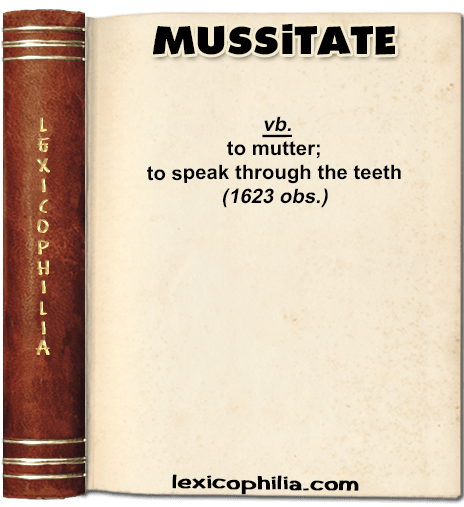
Word of the Day: MUSSITATE

ETYMOLOGY
from past participial stem of Latin mussitare (to mutter),
from mussare (to mutter) + –itare (-itate)


EXAMPLE
“…those I meane which are not Neutralizers (if any such heare mee this day) Neutralizers, I say, or Interim-ists; such as dare secretly mutter and mussitate; Rome and the Reformed Churches agree in the substance of Religion, that there is no fundamentall difference betwixt them and vs; and againe that they teach no Heresies; …”

From: A Sermon Preached at Paules Crosse Laying open the Beast, and his Marks
By Richard Sheldon, 1625

Word of the Day: VITUPERIOUS

ETYMOLOGY
from Old French vituperieus (implied in the adv. vituperieusement), 
or from late or medieval Latin vituperiōsus from vituperium (vitupery)


EXAMPLE
“…Muse I inuoke the vtmost of thy might,
That with an armed and auspitious wing,
Thou be obsequious in his doubtlesse right
Gainst the vile Athiests vituperious sting:
Where thou that gate industriously mai’st flie,
Which Nature striues but fainedlie to goe,
Borne by a power so eminent and hie,
As in his course leaues reason farre belowe,
To shew how Poesie (simplie hath her praise)
That from full Joue takes her celestiall birth,
And quicke as fire, her glorious selfe can raise
Aboue this base and euitable earth
…”

From: Moyses in a Map of his Miracles
By Michael Drayton, 1604

Word of the Day: TEMPORANEOUS

ETYMOLOGY
from Latin temporaneus (timely, opportune), from tempustempor- (time) + -ous


EXAMPLE
“…For the further clearing of which there are these two things required 
1. To shew how the necessary Functions of life may be conserved and kept up while the Soul is 
separate from the Body 
2. To consider what those things are which may cause a Temporaneous disunion and disjunction of 
the Soul from the Body First then it will not seem at all strange that the principal Functions of life 
should be performed for some time without the presence of the Soul to them who will admit of the 
principles of the Cartesian Philosophy …”

From: Melampronoea,
or, A discourse of the polity and kingdom of darkness together with a solution of the chiefest objections brought against the being of witches
By Henry Hallywell, 1681

Word of the Day: AGNATICAL


ETYMOLOGY
from agnaticus (agnatic – related through the male line) [from Latin agnatus (a relation by the father’s side) + -ic] + ‑al


EXAMPLE
“… There are but two waies by which hereditary or successive Monarchies do descend; the one is Lineal descent, the other Lineal, Agnatical, Cognatical or Collateral; or as we say, the one descends to the heire general, the other to the heire male. This latter by vertue of a Salique law takes place only in France; we will therefore see what may be said and objected against the former, and how the latter hath been observed in France, and of what Authority it is…”

From: Justice vindicated from the false fucus put upon it,
by Thomas White gent. Mr. Thomas Hobbs, and Hugo Grotius:
As also elements of power & subjection; wherein is demonstrated the cause of all humane Christian, and legal society
‘Of Inheritance and Succession’
By Roger Coke, 1660

Word of the Day: QUAGSWAG


ETYMOLOGY
from quag (of something soft or flabby: to quake) + swag (to move unsteadily, to sway)


EXAMPLE
“…Therefore Iohn Calfe her Cosen gervais once removed with a log from the woodstack, very seriously advised her not to put her selfe into the hazard of quagswagging in the Lee, to be scowred with a buck of linnen clothes, till first she had kindled the paper: this counsel she laid hold on, because he desired her to take nothing, and throw out, for Non de ponte vadit, qui cum sapientia cadit*: matters thus standing, seeing the Masters of the chamber of Accompts, or members of that Committee, did not fully agree amongst themselves in casting up the number of the Almanie whistles, whereof were framed those spectacles for Princes, which have been lately printed at Antwerp…”

*Non de ponte vadit, qui cum sapientia cadit = He who falls with wisdom does not go off the bridge

From: The second book of the works of Mr. Francis Rabelais, Doctor in Physick,
containing five books of the lives, heroick deeds, and sayings of Gargantua, and his sonne Pantagruel.
By François Rabelais
Translation by Thomas Urquhart, 1653

Word of the Day: IMPLUVIOUS


ETYMOLOGY
from im- + pluvious (characterized by rain, rainy) [from French pluvieux, or from Latin pluviosus (rain)]


EXAMPLE
“…Though (by the way) how that Expression should countenance an Impluvious state before the Flood, as the Latin Theory would make it, is not so clear and easie to be understood. For, if we consider, there was no Water upon that Earth, but what fell in Rain…”

From: Geologia: Or, A Discourse Concerning the Earth before the Deluge
By Erasmus Warren, 1690

Word of the Day: ADMINUTIVE


ETYMOLOGY
from Latin adminut-, past participial stem of adminuere (to lessen, to diminish),
from ad- (to) + minuere (to lessen)


EXAMPLE
“…Bellarmine bewails the business, that ever since we began to count and call the Pope Antichrist, his kingdom hath greatly decreased. And Cotton the Jesuite confesses, that the authority of the Pope is incomparably less then it was; and that now the Christian Church is but adminutive …”

From: A Commentary or Exposition Upon all the Books of the New Testament.
By John Trapp, 1656
‘A Commentary Upon the Revelation’

Word of the Day: REFRACTARIOUS


ETYMOLOGY
from Latin refractarius (obstinate, stubborn) + -ous


EXAMPLE
“…Thirdly, if we do well obserue the preposterous & disastrous studies of many schismaticall and refractarious spirits, their heate, their violence, description and vncharitablenes, how vnnaturally they do reiect & reuile their Mother, how passionately they doe blaspheme the Church, which God hath planted with his owne hand, and with what morosity they haue ab-alienated themselues from their Bretheren; they can by no pretext acquit themselues of great vndutifulnes vnto God, being so turbulent in his House, so disobedient to their Mother, & so farre exorbitant in all their courses; not much vnlike to mothes, that fret the cloth, wherein they breed; to water-boughes, which hurt the tree,…”

From: The Picture of a True Protestant:
or, Gods house and husbandry wherein is declared the duty and dignitie of all Gods children, both minister and people.
By Thomas Tuke, 1609

Word of the Day: PEEPY


ETYMOLOGY
from peep + -y


EXAMPLE (for adj. 1)
“…An individual of the latter kind is distinguished in his earliest petticoats – even before he has well left the nursery. He is then a poor, peepy wretch, with blear eyes, and one everlasting dingy night-cap. constantly sitting by the fire, to the great annoyance of the nurse, who frequently declares him to be more of an infant than even his younger brother the baby…”

From: Chambers Edinburgh Journal
Conducted by William Chambers, and Robert Chambers,
Volume I No. 49, Saturday, January 5, 1833,
‘The Domestic Man’