Word of the Day: EAR-DROPPER

ETYMOLOGY
from ear + dropper

EXAMPLE
“… But, that he was a Creature of the Duke’s, and commended to him by Bishop Williams, the Historian is strangely out again. It is possible an Ear-dropper might hear such things talk’d at Cock-pits and Dancing-schools, miserable Intelligence to thrust into an History …”

From: Scrinia Reserata a Memorial Offer’d to the Great Deservings of John Williams, D. D.
By John Hacket, a1670

Word of the Day: THRUMBLE

ETYMOLOGY
vb. 1: of uncertain origin
vb. 2, 3, 4: apparently from thrum (to press, to condense) + -le
vb. 5: apparently from thrum (to play on a stringed instrument) + -le

EXAMPLE (for vb.3)
“…PETER, quho was ever maist sudden, answers, and sayis: Thou art thrumbled and thrusted be the multitude, and ʒit thou speeris quha hes twitched thee, hee answers againe and he sayis, it is not that twitching that I speak of: It is ane vther kinde of twitching …”

From: Sermons vpon the Sacrament of the Lords Supper
By Robert Bruce, ?1591

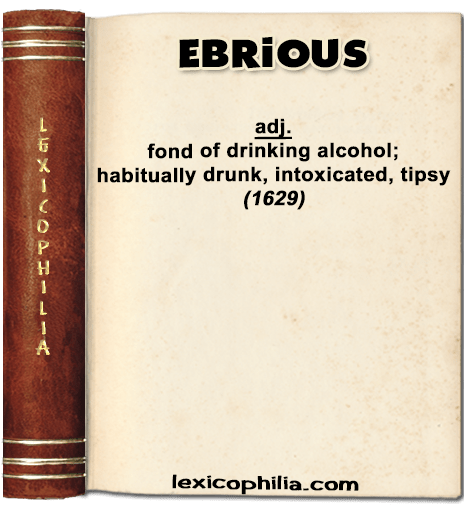
Word of the Day: EBRIOUS

ETYMOLOGY
from Latin ebrius (drunk intoxicated_ + -ous

EXAMPLE
“…This branded and illegall witnesse then, being at the very best a forraigner, doth only marre, not helpe their cause: The second was but an Anglo-Belgicus, a dissolute, ebrious and luxurious English-Dutchman…”

From: The Church of Englands Old Antithesis to New Arminianisme 
By William Prynne, 1629

Word of the Day: POET-SUCKER

ETYMOLOGY
from poet + sucker (a greenhorn, a simpleton)

EXAMPLE
“…But gi’ me the man can start up a Justice of Wit out of six-shillings beer, and give the law to all the poets and poet-suckers i’ town. Because they are the players’ gossips? ‘Slid, other men have wives as fine as the players’, and as well dressed. Come hither, Win. …”

From: Bartholmew Fayre, A Comedie
By Ben Jonson, 1631

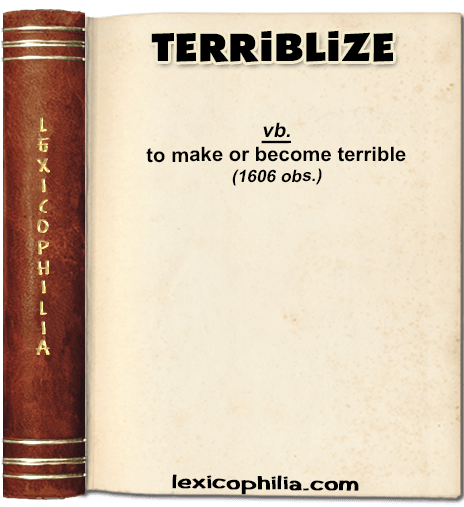
Word of the Day: TERRIBLIZE

ETYMOLOGY
from terrible + -ize

EXAMPLE
“…Both Camps appoach, their bloudy rage doth rise,
And even the face of Cowards 
terriblize;
New Martial heat inflames their mindes with ire,
Their bloud is moov’d, their heart is all on fire.
Their cheerfull limbs (seeming to march too slowe).
Longing to meet, the fatall drums out-goe;
And even already in their gesture fight:
Th’ iron-footed coursers, lusty, fresh, and light,
…”

From: Du Bartas his Deuine Weekes and Workes translated
By Guillaume de Salluste Du Bartas
Translated by Josuah Sylvester, 1606

Word of the Day: MOTABLE

ETYMOLOGY
from late Latin motabilis (mobile, moving), from Latin motare (to set in motion, keep moving) (from mot-, past participial stem of movere (to move)) + -abilis (-able)

EXAMPLE
“…The heat had, also, made the whole atmosphere tremulous and visible, so that the outline of towers, turrets, and majestic edifices of stone and marble, was fluttering and motable as if an etherial sea of some subtle fluid, with trembling waves and a constant, rippling motion, was flowing and dancing over it. …”

From: The Ladies’ Companion
A Monthly Magazine Embracing Every Department of Literature
Volume XIV, Printed 1841
‘The English Family; Or, Who Are They? ‘
A Sketch by Joseph Holt Ingraham

Word of the Day: FOGGISH

ETYMOLOGY
adj. 1.: from fog (fat, bloated) + -ish
adj. 2.: from fog (cloud of small water droplets that is near ground level) + -ish

EXAMPLE (for adj. 1.)
“…He that lyueth after the rules of phisike lyueth wretchedly. As thoughe it were an happynes and felicitie, the body to be swolen and stretched out with surfettyng, to be brasted with the pleasure of the body, to waxe foggyshe with drinkyng of good ale, & to be sepulte and drowned in slepe …”

From: Declamatio in Laudem Nobilissimæ Artis Medicinæ.
= A declamacion in the prayse and co[m]me[n]dation of the most hygh and excellent science of phisyke
By Desiderius Erasmus
Translated out of Latin into English, ?1537

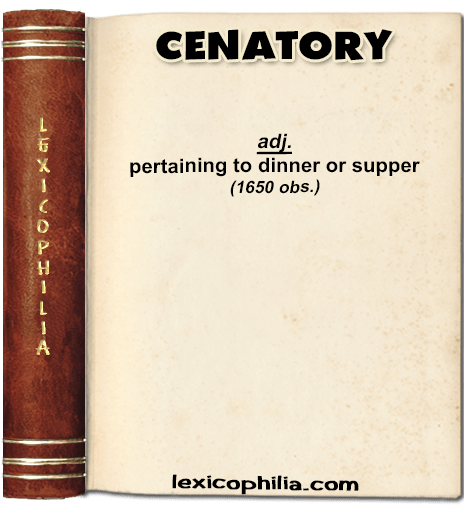
Word of the Day: CENATORY

ETYMOLOGY
from Latin cenatorius (pertaining to dinner)

EXAMPLE
“…The consent of the Jews with the Romans in other ceremonies and rites of feasting, makes probable their conformity in this. The Romans washed, were anointed, and wore a cenatory garment: and that the same was practised by the Jews, is deduceable from that expostulation of our Saviour with Simon, that he washed not his feet, nor anointed his head with oyl: the common civilities at festival entertainments: and that expression of his concerning the cenatory or wedding garment; and as some conceive of the linnen garment of the young man or St. John; which might be the same he wore the night before at the last Supper. …”

From: Pseudodoxia Epidemica:
Or, Enquiries into Very many Received Tenents and And Commonly Presumed Truths
By Thomas Browne, 1650