Word of the Day: GALACTOPOTE

ETYMOLOGY
from Latin galactopota (milk-drinker); from Greek γαλακτοπότης (milk drinker)

EXAMPLE
“…Moreover, it not only satiates the country people with abundance of milk and cheese, but also garnishes the tables of the elegant with agreeable and numerous dishes. To some nations, indeed, which are intirely destitute of corn, it furnishes their whole sustenance: hence it is, that very many of the Nomades and Getae are called Galactopotae (milk-drinkers). …”

From: L. Junius Moderatus Columella Of Husbandry
By Lucius Junius Moderatus Columella, 1745

Word of the Day: LINGUACIOUS

ETYMOLOGY
from Latin linguaci-linguax (loquacious, talkative) (from lingua tongue + -ax [-acious]) + -ous

EXAMPLE
“…These and such like starting-holes and subtilties have made of Physick a Meander, a Wildernesse, and wild labirynth of incertainty and unstable formalities. We desire the linguacious Chymistry of these heads to tell us, how many bitter things there are in taste, which neverthelesse (according to the edict of that rule) are not hot at all?  …”

From: Matæotechnia Medicinæ Praxeōs, The Vanity of the Craft of Physick
By Noah Biggs, 1651

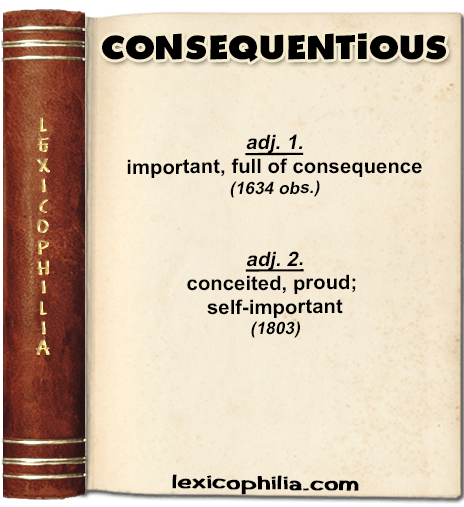
Word of the Day: CONSEQUENTIOUS

ETYMOLOGY
from. obs. French consequentieux, from Latin consequentia: + -ous

EXAMPLE
“…Now when the politicke Ambassadour, had wrought Prince Temeriske, as he desired, he then perswades with Abbas, that the Georgians hated him, that their King had entertained discourse with the Grand Signior, and sought but an aduantage to betray his trust, that if his words seemed of no moment, the matter was not consequentious, and his employment carried him, to other ends then forreigne Obiects. …”

From: A Relation of some Yeares Trauaile begunne anno 1626. Into Afrique and the greater Asia
By Thomas Herbert, 1634

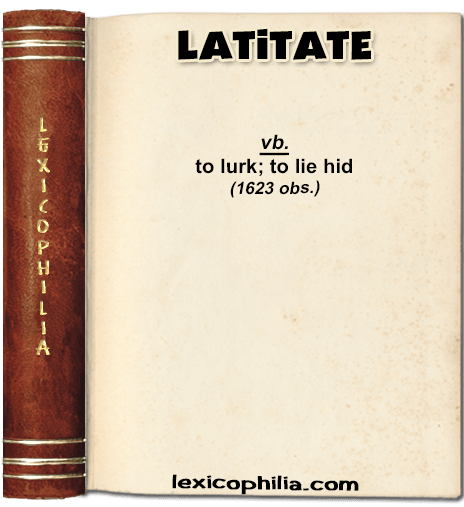
Word of the Day: LATITATE

ETYMOLOGY
from Latin latitat-, participial stem of latitare (to lie hid)

EXAMPLE
“…According to the statement of Townsend, a gardener and discharged servant of Sheriff Lax, but which was afterwards proved to be highly coloured, and in parts wholly false, one of the sheriffs had fled to the Recorder’s bed-room and taken refuge behind the state bed; and other aldermen were latitating in the upper bed-rooms. …”

From: Modern State Trials
By William Townsend, 1850
Trial at Bar of Charles Pinney, Esq. Mayor of Bristol,
On a Criminal Information for Neglect of Duty, in the Court of King’s Bench,
October 25, 26, 27, 29, 30, 31, and November 1, 1832

Word of the Day: REELING-RIPE

ETYMOLOGY
from reeling (moving with a swaying or staggering motion) + ripe (adj.)

EXAMPLE
“…  SEBASTIAN He is drunk now. Where had he wine?
ALONSO And Trinculo is reeling ripe. Where should they
 Find this grand liquor that hath gilded ’em?
 ⌜To Trinculo.⌝ How cam’st thou in this pickle?
TRINCULO  I have been in such a pickle since I saw you
 last that I fear me will never out of my bones. I
 shall not fear flyblowing
. …”

From: The Tempest
By William Shakespeare, a1616

Word of the Day: CLUNCH-FISTED

ETYMOLOGY
from clunch (to clench) + fist + -ed

EXAMPLE
“…He (that is, He that will confesse Abraham to have paid no other tithes then, Heb. 7. 4.) delivers to the world, Abraham to Godward, to have been piteously penurious. That of his dues to Religion he was a niggardly Micher: That he was an Abraham clunchfisted, and all that this way went he thought it onely wast: that the good child Judas, that he did, he did learn of his Father Abraham, Quorsum perditio haec?…”

From: A Discourse of Proper Sacrifice
By Edward Dering, 1644

Word of the Day: VINOMADEFIED

ETYMOLOGY
from Latin vinum (wine) + madefieri (to be soaked) + -ed

EXAMPLE
“…The Prince unwilling to miss of his mark, and not having in all the quivers of his reason one shaft wherewith to hit it, resolved to interpose some authority with his argumentations, and where the foxes skin could not serve, to make use of the Lyons: to the prosecuting of which intent, he with his vinomadefied retinue, resolved to press in upon the Page, and, maugre his will, to get up staires, and take their fortune in the quest of the Chamber they aimed at: for albeit the stradling as wide as he could, of pretty Pomponacio at the door whereat they made account to force their passage, did for a while retard their designe, …”

From: Εκσκυβαλαυρον, Ekskybalauron: or, The Discovery of a Most Exquisite Jewel, more precious then diamonds inchased in gold, the like whereof was never seen in any age
By Thomas Urquhart, 1652

Word of the Day: QUADRAGENARIOUS

ETYMOLOGY
from Latin quadragenarius (forty years old) + -ous

EXAMPLE
“…Tis my fancy that, having won for himself a fortune, he went on in the same resistless way and won for himself a wife: “taking the biggest,” as usual, by cutting out valiantly from under the guns of a dozen rivals some stout buxom widow suited to his estate and to his medium years – one of those plumply mellow quadrigenarious bodies who especially appeal to the vigorous and well-salted emotion which with sailor-men stands for love …”

From: Harper’s New Monthly Magazine, February, 1895
New York Colonial Privateers’, By Thomas A. Janvier

Word of the Day: EXPLORATE

ETYMOLOGY
adj.: from Latin exploratus past participle of explorare (to explore)
vb.: from Latin explōrāt- past participial stem of explorare (to explore)

EXAMPLE
“…The consideration whereof (most iudicious Men) though I looke not to be of that weigh with you, as to moue you ac­tually to implant your selfs in our Catholicke Church; yet since you are wyse, learned, and loth (no dowbt) to commit any such explorate errours, as the force of Naturall Reason and your owne Consciences may freely check; I am in good hope, that the serious perusall of the poynts aboue disputed, will at least preuayle thus far with diuers of you; …”

From: The Converted Jew
By John Clare, a1628

Word of the Day: DEROGANT

ETYMOLOGY
from Latin derogantem, present participle of derogare (to derogate)

EXAMPLE
“…If they could foresee future things, they would bragge themselues equall to God: But Secret things belong to GOD, reuealed to vs. The other is both arrogant in man, and derogant to God. And Greg. sayes well: If such a Starre be a Mans Destenie, then is Man made for the Starres, not the Starres for Man. The Diuels know not future euents: and will these boast it? …”

From: The Sacrifice of Thankefulnesse
A sermon preached at Pauls Crosse
By Thomas Adams, 1616