
ETYMOLOGY
from Latin pentaglottos, pentaglottus (that is in five languages), from penta- + Greek γλῶττα (tongue) + ‑ical
EXAMPLE
Lexicophilia does not have a pentaglottical dictionary, but it does have a monoglot one.
ETYMOLOGY
from Latin pentaglottos, pentaglottus (that is in five languages), from penta- + Greek γλῶττα (tongue) + ‑ical
EXAMPLE
Lexicophilia does not have a pentaglottical dictionary, but it does have a monoglot one.

ETYMOLOGY
from Greek ὁµόδοξος (of the same opinion),
from ὁµο- (homo-) + δόξα (opinion)
EXAMPLE
“…so likewise does the like Catholick Condemnation (from and by all the rest of the Christian Orders) reach the Church of Rome, as well as the Homodox Idolatry of the Cacodox Arians and Socinians.…”
From: Athenæ Britannicæ:
Or, A Critical History of the Oxford and Cambrige Writers and Writings.
By Myles Davies, Part II, 1716
ETYMOLOGY
from Greek ἀκυρολόγος (akyrologos) (incorrect in speech);
from ἀ (not) + κῦρος (authority) + λόγος (speech) + -ical
EXAMPLE
for adverb form – (‘acyrologically – incorrectly as regards the use of words’)
“…He saith, (but Magisterially without the least proof) that the Apostle speaks Acurologically and abusively; and by sanctified, means quasi, as if they were sanctified…”
From: Plain Scripture Proof of Infants Church-Membership and Baptism
By Richard Baxter, 1651
ETYMOLOGY
from Greek καταμειδιᾶν [katameidian] (to despise) + ‑ate
EXAMPLE
Politicians who make false, unrealistic promises are unethical, unscrupulous, immoral, and deceitful. Catamidiate them.
ETYMOLOGY
in 16th–17th century France: apparently, a fanciful creation of Rabelais
EXAMPLE
“…My counsel to you in that case, my friend, is that you marry, quoth Hippothadee; for you should rather choose to marry once than to burn still in fires of concupiscence. Then Panurge, with a jovial heart and a loud voice, cried out, That is spoke gallantly, without circumbilivaginating about and about, and never hitting it in its centred point…”
From: Gargantua and Pantagruel, Book III.
By Francois Rabelais
Translation by Sir Thomas Urquhart and Peter Antony Motteux, 1693

ETYMOLOGY
apparently from pan- (all) + guts (the belly, stomach)
EXAMPLE
“…”Odzbodkins! You won’t spoil our sport,’ cried her husband. “Your crotchets are always coming in like a fox into a hen-roost.”
“I have work in hand that must be done,” replied his wife.
“Panguts!” she exclaimed, raising her voice and her fist at the same time, “what do you do? lazying about here like a mud-turtle nine days after it’s killed…”
From: Margaret: A Tale of the Real and Ideal, Blight and Bloom
By Sylvester Judd, 1845
ETYMOLOGY
perhaps representative (with some change of sense) Old English fedels (fatted bird),
the Germanic base of feed (vb.) + the Germanic base of ‑els
EXAMPLE
(for n. 2)
“…It will be of a pretty little Infant: O how heartily I shall love it! I do
already dote upon it; for it will be my dainty Fedle-darling, my genteel Dilli-minion …”
From: The third book of the Works of Mr. Francis Rabelais
Translation by Thomas Urquhart. 1693
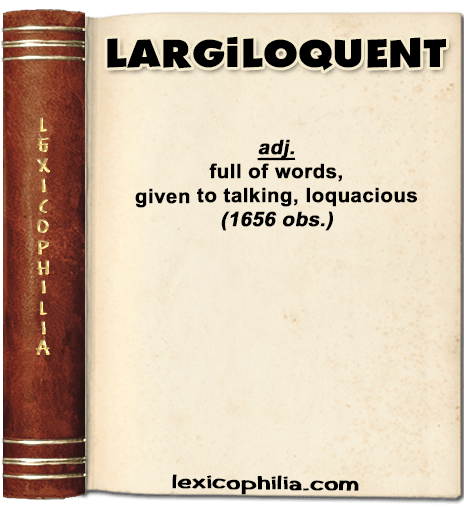
ETYMOLOGY
from Latin largiloquus (talking copiously, garrulous) + -ent
EXAMPLE
“…I secretly admired and still admire the ease and smoothness with which she could pour forth her torrent floods of largiloquent Celtic rhetoric…”
From: Rosalba: The Story of Her Development
By Olive Pratt Rayner (Pseudonym), Grant Allen, 1899

ETYMOLOGY
from Greek αὐτεξούσιος (free will) + -ous
EXAMPLE
“…For First, as to Moral Evils, (which are the Chiefest) there is a Necessity that there should be Higher and Lower Inclinations in all Rational Beings Vitally United to Bodies, and that as Autexousious or Free-willed, they should have a Power of determining themselves more or less, either way…”
From: The True Intellectual System of the Universe
By Ralph Cudworth, 1678

ETYMOLOGY
from Latin emacitas, from emacem (fond of buying), from emere (to buy)
EXAMPLE
“…I found, however, that this gentleman was a little inflicted with the disease of emacity, or itch for buying bargains above-mentioned…”
From: Flowers of Literature
Edited by Francis William Blagdon, Francis Prévost, 1806
 Lexicophilia