Word of the Day: BUCCULENT


ETYMOLOGY
from Latin bucculentus, from bucca (cheek)


EXAMPLE
“… The Royal Game of Goose or the Yorkshire Tragedy, which form the common ornaments of our cottages, are superseded in theirs by some marvellous legend redolent of beatitude; and instead of the Amazonian Trull, or the weather-beaten Admiral which frowns from the bowsprit of a British man-of-war, they carve on their prows the fair image of some bucculent Cherub, or some semi-anatomized Saint …”

From: The British Critic
Volume XIX. January-June, 1823
‘Blunt’s Vestiges of Ancient Manners in Italy’
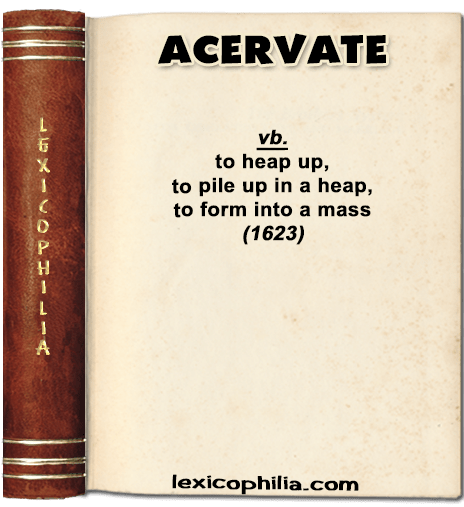
Word of the Day: ACERVATE


ETYMOLOGY
from Latin acervāt- past participial stem of acervare (to make into heaps, to pile up),
from acervus (a heap)


EXAMPLE
“…The mass of burning embers, by which the oven had been heated, was not, as he pretended, fairly swept out. Those that were well ignited were acervated (heaped up) into one corner; and the steak, so far from being left to the action of the heated air of the oven, was put between two tin dishes, and was embedded in the mass of the burning embers in the corners. …”

From: Arcana of Science and Art
Or, An Annual Register of Popular Inventions and Improvements
Printed by John Limbird, 1830
‘Chemical Science. The Fire King’

Word of the Day: TACENT


ETYMOLOGY
from Latin tacentem, present participle of tacere (to be silent)


EXAMPLE
“…And although he was much angred thereat, yet he seemed to be glad: and because he would obliege him further, he went vvith all his Court. Great was the resort thither of Ladies & Knights, and at the Kings entrance there was a fair Tragedy, whose subject I will be tacent of.…”

From: The Loves and Adventures of Clerio & Lozia.: A Romance
By Antoine Du Périer
Translation by F. Kirkman, 1652

Word of the Day: HOMODOX


ETYMOLOGY
from Greek ὁµόδοξος (of the same opinion),
from ὁµο- (homo-) + δόξα (opinion)


EXAMPLE
“…so likewise does the like Catholick Condemnation (from and by all the rest of the Christian Orders) reach the Church of Rome, as well as the Homodox Idolatry of the Cacodox Arians and Socinians.…”

From: Athenæ Britannicæ:
Or, A Critical History of the Oxford and Cambrige Writers and Writings.
By Myles Davies, Part II, 1716

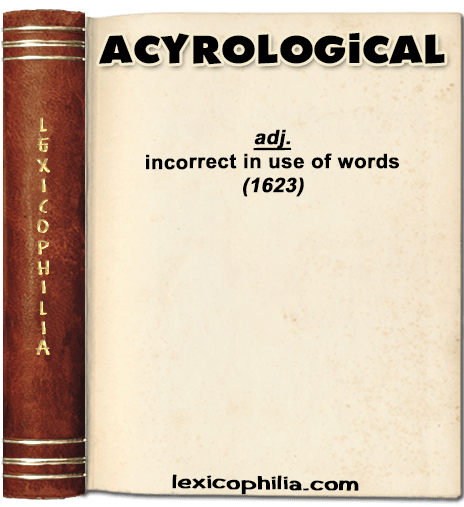
Word of the Day: ACYROLOGICAL


ETYMOLOGY
from Greek ἀκυρολόγος (akyrologos) (incorrect in speech);
from ἀ (not) + κῦρος (authority) + λόγος (speech) + -ical


EXAMPLE
for adverb form – (‘acyrologically – incorrectly as regards the use of words’)

“…He saith, (but Magisterially without the least proof) that the Apostle speaks Acurologically and abusively; and by sanctified, means quasi, as if they were sanctified…”

From: Plain Scripture Proof of Infants Church-Membership and Baptism
By Richard Baxter, 1651

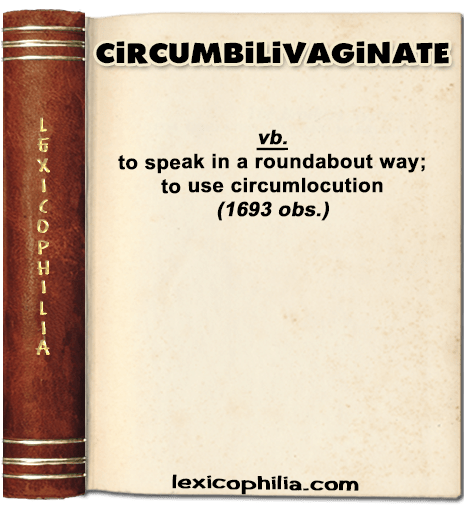
Word of the Day: CIRCUMBILIVAGINATE


ETYMOLOGY
in 16th–17th century France: apparently, a fanciful creation of Rabelais


EXAMPLE
“…My counsel to you in that case, my friend, is that you marry, quoth Hippothadee; for you should rather choose to marry once than to burn still in fires of concupiscence. Then Panurge, with a jovial heart and a loud voice, cried out, That is spoke gallantly, without circumbilivaginating about and about, and never hitting it in its centred point…”

From: Gargantua and Pantagruel, Book III.
By Francois Rabelais
Translation by Sir Thomas Urquhart and Peter Antony Motteux, 1693

Word of the Day: PANGUTS


ETYMOLOGY
apparently from pan- (all) + guts (the belly, stomach)


EXAMPLE
“…”Odzbodkins! You won’t spoil our sport,’ cried her husband. “Your crotchets are always coming in like a fox into a hen-roost.”
“I have work in hand that must be done,” replied his wife.
Panguts!” she exclaimed, raising her voice and her fist at the same time, “what do you do? lazying about here like a mud-turtle nine days after it’s killed
…”

From: Margaret: A Tale of the Real and Ideal, Blight and Bloom
By Sylvester Judd, 1845

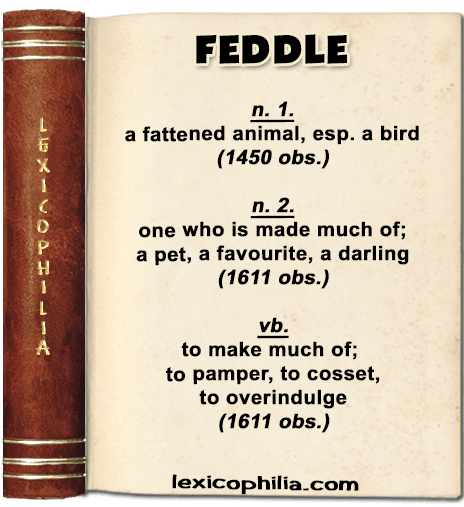
Word of the Day: FEDDLE


ETYMOLOGY
perhaps representative (with some change of sense) Old English  fedels (fatted bird),
the Germanic base of feed (vb.) + the Germanic base of ‑els


EXAMPLE
(for n. 2)
“…It will be of a pretty little Infant: O how heartily I shall love it! I do
already dote upon it; for it will be my dainty Fedle-darling, my genteel Dilli-minion
…”

From: The third book of the Works of Mr. Francis Rabelais
Translation by Thomas Urquhart. 1693