ETYMOLOGY
from Latin obgannire (to speak menacingly, to mutter or growl) + -ate
EXAMPLE
As the night went on, and the more wine she consumed, she started to ramble and obganiate herself.
ETYMOLOGY
from Latin obgannire (to speak menacingly, to mutter or growl) + -ate
EXAMPLE
As the night went on, and the more wine she consumed, she started to ramble and obganiate herself.
ETYMOLOGY
from Latin confragosus (broken, rough, uneven),
from Latin confringere and fragosus, from stem frag- of frangere (to break)
EXAMPLE
“…But, what appeared most stupendous to me, was the rock of St. Vincent, a little distance from the towne, the precipice whereof is equal to any thing of that nature I have seene in the most confragose cataracts of the Alpes, the river gliding between them at an extraordinary depth. Here, we went searching for diamonds, and to the Hot Wells, at its foote…”
From: The Diary of John Evelyn
27 June 1654

ETYMOLOGY
from Latin desinentem, present participle of desinere (to leave off, close),
from de- + sinere (to leave)
EXAMPLE
“… In front of this sea were placed six tritons, in moving and sprightly actions, their upper parts human, save that their hairs were blue, as partaking of the sea-color: their desinent parts fish, mounted above their heads, and all varied in disposition. From their backs were borne out certain light pieces of taffata, as if carried by the wind, and their music made out of wreathed
shells…”
From: The Masque of Blackness in Characters Two Royall Masques
By Benjamin Jonson, 1608
ETYMOLOGY
irregular from indulge or Latin indulgere + -ate
EXAMPLE
“…Sergius Oratus was the first that made pits for them about his house here; more for profit, then to indulgiate his gluttony. For by such devices he purchased much riches…”
From: A Relation of a Journey Begun an Dom. 1610
By George Sandys, 1615
ETYMOLOGY
from Latin fatiloquus (prophesying, prophetic) + -ist
EXAMPLE
“…Fate, and Fatories, and Fatiloquists, and Fooles, all taken from talking they know not what …”
From: Πῦς-μαντία. The Mag-astro-mancer,
Or The Magicall-Astrologicall-Diviner posed, and puzzled
By John Gaule, 1652

ETYMOLOGY
from Latin rhonchus (a snoring) + sonans, p. pr. of sonare (to sound)
EXAMPLE
“…Out marches the paleontologist Collett,
And with his little hammer
And scientific grammar
First knocks a mammoth tooth,
To put into his grip-sack;
Then constructs an awful name
By means of which to skip back
With a great rhonchisonant fury, on
The epochs carboniferous and Silurian…”
From: Biographical and Historical Record of Vermillion County, Indiana, 1888
ETYMOLOGY
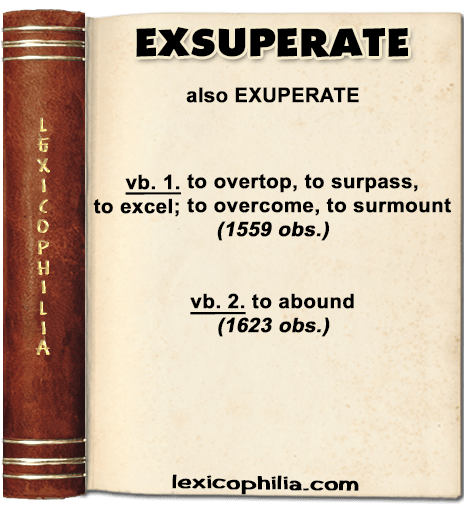
from Latin ex(s)uperat- ppl. stem of ex(s)uperare,
from ex- + superare (to rise above), from super (above)
EXAMPLE
“…And if bewtie breed such blisfulnesse
Euamouring both God and man
Good Lady let no wilfulnesse
Exuperate your bewtye then
To slaye the hertes that yeld & craue
ladye ladye
The graunt of your goodwil to haue
My deare ladye…”
From: The Panges of Loue and Louers Fittes
By William Elderton, 1559
ETYMOLOGY
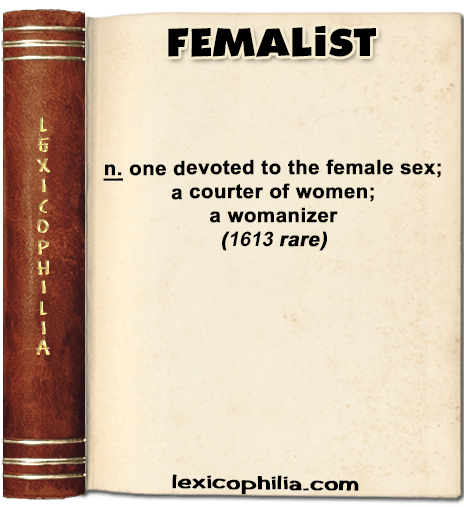
from female + -ist
EXAMPLE
“…Beauty can turn the rugged face of War,
And make him smile upon delightful Peace,
Courting her smoothly like a femalist.
I grow a slave unto my potent love,
Whose power change hearts, make our fate remove…”
From: The Insatiate Countesse: A Tragedie
By John Marston and William Barksted, 1613

ETYMOLOGY
adjective: from Latin decurtatus, pa. pple. of decurtare (to cut off, curtail)
verb: from participial stem of Latin decurtare + -ate
EXAMPLE
“…hee sendes for his Barber to depure, decurtate, and spunge him, whome hauing not paide a twelmonth before, he now raines downe eight quarter angels into his hande…”
From: Lenten Stuffe
By Thomas Nashe, 1599
ETYMOLOGY
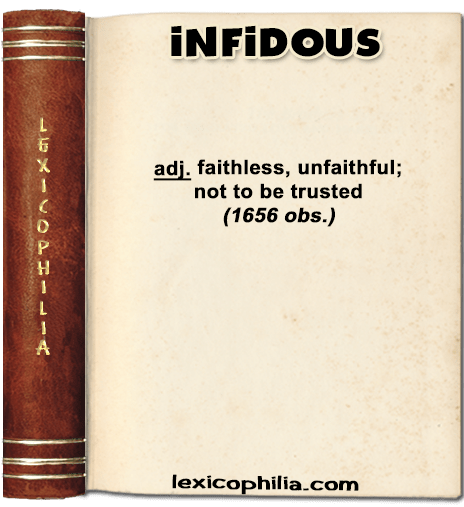
from Latin infīdus (untrue, disloyal) + -ous
EXAMPLE
“…The Arabian Interpreters are also miserably out, in rendring Tabaxir Spodium, and Spodium Burnt Ivory: for Tabaxir is the succe or concreted liquor of certain Trees, or very crass and tall Reeds, which by the agitation of the wind, and their mutual collision, sometimes conflagrate; from which burning, Avicenna mendicated his Spodium, or rather Tabaxir, which his infidous Interpreter Clusius calls his Spodium. But we get not this Tabaxir from India, nor the ashes of these burnt Canes from Arabia…”
From: A Medicinal Dispensatory, containing the whole body of physick discovering the natures, properties, and vertues of vegetables, minerals, & animals
By Jean de Renou
Translated by Richard Tomlinson, 1657
 Lexicophilia