Word of the Day: VAGITATE


ETYMOLOGY
from medieval Latin vagitare, from Latin vagari (to wander)


EXAMPLE
“…But we must consider, that they euermore kept the coast, and crept by the shores, which made the way exceeding long. For before the vse of the Compasse was knowne, it was impossible to vagitate athwart the Ocean; and therefore Salomons ships could not finde Peru in America…”

From: The History of the World
By Sir Walter Raleigh, 1614
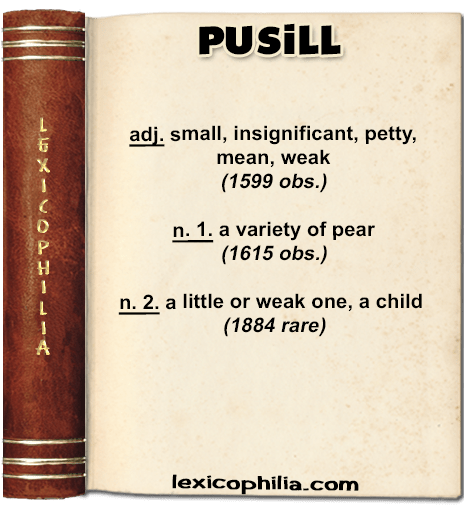
Word of the Day: PUSILL


ETYMOLOGY
from: a) Middle French pusillepuzilpusil (very small, weak),
b) Latin pusillus (very small, insignificant, petty) from pusus (boy) + -illus 


EXAMPLE
“…And to amase her weake, and pusill minde,
In creepe through crannies of imagination.
Deformd Idean formes, and phansies blinde.
Sent foorth by hir sicke sences, instigation.
Like staringe greisly fendes, threatninge invasion.
Presenting to her heart, the homely iarres.
And houshold cares, accurringe nuptiall warres…”

From: Eustathia, or the Constancie of Susanna
By Robert Roche, 1599

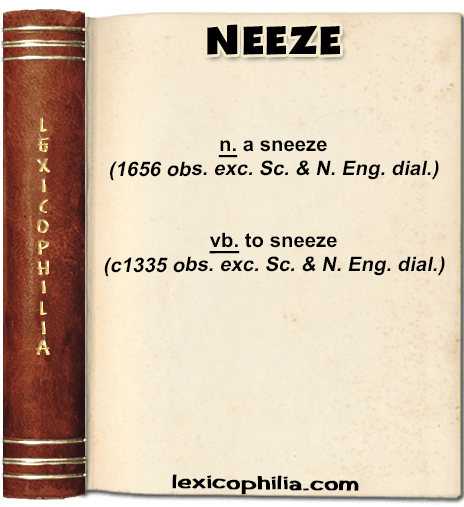
Word of the Day: NEEZE


ETYMOLOGY
From Oxford English Dictionary: either from early Scandinavian (compare Old Icelandic hnjósa , Norwegian nyse , †njosa , Old Swedish niusa (Swedish nysa ), Danish nyse ), or the reflex of an unattested Old English word from the same Germanic base, as is perhaps suggested by the number of cognates in other West Germanic languages: Middle Dutch niesen (Dutch niezen ), Middle Low German nēsen , neysen , neesen , etc., Old High German niesan , niosan , niusan (German niesen)


EXAMPLE (for noun)
“…Soto was in an exteam Agony for his Master: Lamia was grieved and her Hand-Maids heavie, but the Inchantress soon recovered him by watering his Visnomy with her warm Urine (the customary way (it seems) of that Countrey to revive the enfeebled) which not onely illuminated his dim eyes, but circumgyring about his weasand, enforced him to a manly neese, so that within a little time (to their great comfort) he sate up, calling for some Wine, which being brought, he drank a hearty draught to the Inchantress, though one might perceive (with half an eye) wrath and disdain in Capitall Characters on his front; which Lamia perceiving, administred this Julip to allay his fiery Choller….”

From: Don Zara del Fogo; A Mock-Romance
By Samuel Holland, 1656

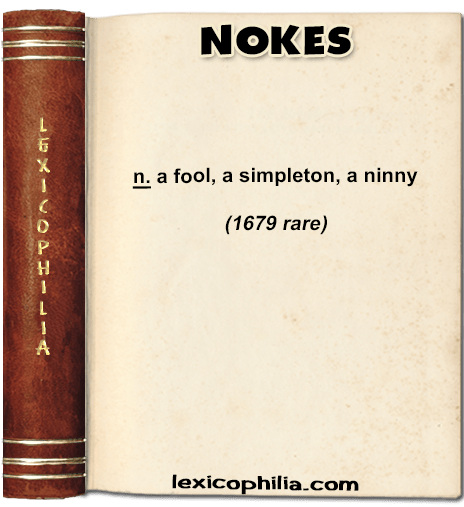
Word of the Day: NOKES


ETYMOLOGY
of uncertain origin


EXAMPLE
“…Foster could make an Irish Lord a Nokes,
And Betty Morris had her City Cokes.
A Woman’s nere so ruin’d, but she can
Be still reveng’d on her Undoer Man:
How lost so e’re, she’ll find some Lover more
A lewd abandon’d Fool, then she’s a Whore…”

From: Artemisa to Cloe.
A letter from a lady in the tovvn to a lady in the country; concerning the loves of the tovvn.
John Wilmot Rochester, 1679

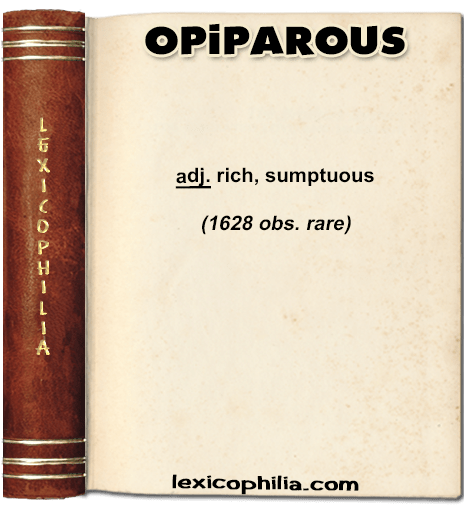
Word of the Day: OPIPAROUS


ETYMOLOGY
from Latin opiparus (richly furnished, sumptuous),
from opem (wealth, means) + parāre (to prepare, furnish, equip) + -ous


EXAMPLE
“…With sweet odours and perfumes, generous wines, opiparous fare, &c., besides the gallantest young men, the fairest virgins, puellae scitulae ministrantes, the rarest beauties the world could afford, and those set out with costly and curious attires…”

From: The Anatomy of Melancholy
By Democritus Junior (Robert Burton)
The Cure of Melancholy. Memb. IV. Exercise Rectified of Body and Mind

Word of the Day: THRENETIC


ETYMOLOGY
from Greek θρῆνος (funeral lament)


EXAMPLE
“…Threnetic odes are also ascribed to Sappho, among which a lament of Adonis is alluded to; but these poems are not classed under any separate head; and in an extant passage, she plainly intimates that his gloomier style of composition was little to her taste…”

From:  A Critical History of the Language and Literature of Ancient Greece
By William Mure, Volume III, 1850
Biography of Lyric Poets. Sappho, 600 B.C.

Word of the Day: NISEY


ETYMOLOGY
of unknown origin;
perhaps from nice (obsolete adj. foolish, stupid senseless)


EXAMPLE
“…Susan, I this Letter send thee,
Let not sighs and tears attend thee,
We are on the Coast of France;
Taking prizes from those Nizeys,
my sweet Jewel to advance.
Since we London have forsaken, five rich
Prizes have we taken,
Two of them Nantz Brandy Wine;
Chests of money, my sweet Honey! with
rich silks and sattin fine…”

From: The Roxburghe Ballads
Love and Loyalty:
Or, A Letter from a Young-man on Board of an English Privateer, to his beloved Susan in the City of London.
To the Tune of, Tender Hearts of London City
c1689

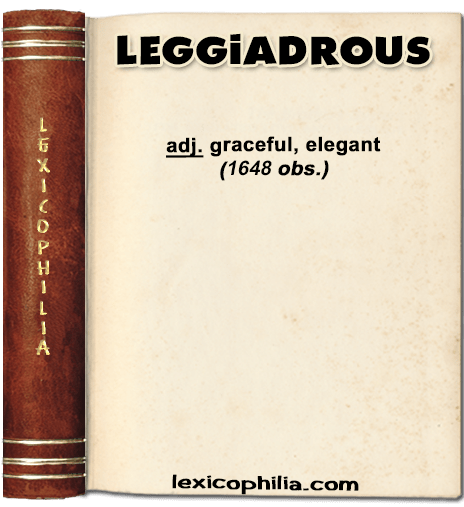
Word of the Day: LEGGIADROUS


ETYMOLOGY
from Italian leggiadro (elegant, graceful) + -ous


EXAMPLE
“…Her Motions and her Gestures travers’d are
By thy attending thoughts, and ravish’d thou
Think’st silver Venus through her limpid sphere
Swims with less gagliardise, and knows not how
So well to justify her Stile, and prove
Her self the Queen of soft leggiadrous Love…”

From: Psyche, or, Loves Mysterie
By Joseph Beaumont, 1648

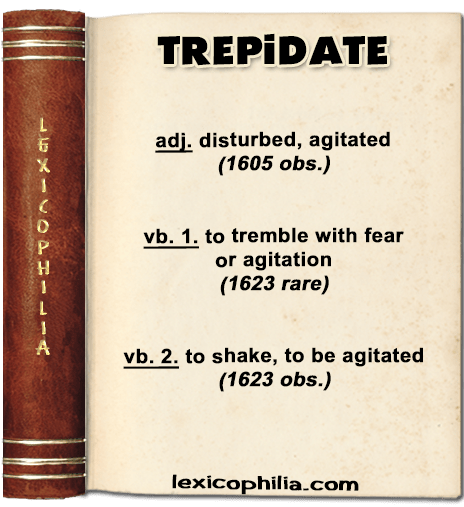
Word of the Day: TREPIDATE


ETYMOLOGY
adj.: from Latin trepidatus, past participle of trepidare
vb.: participial stem of trepidare (to hurry, bustle, be agitated or alarmed)


EXAMPLE
“…The celestiall spheres in continuall volubilitye..their diurnall or daylye course from the East to the West, their retrograde and vyolent motion from the West to the East, their trepidat motion from the South to the North…”

From: A Confutation of Atheisme
By John Dove, 1605