Word of the Day: INCOLIST


ETYMOLOGY
from Latin incolere (to inhabit) + -ist


EXAMPLE
“…which maladyes much molest the Germanes, and Septentrionall incolists; the like whereof hapned upon Caesars Souldiers when they came beyond Rhene, who there finding a River, drunk of the water, which within two dayes caused their teeth to fall out, and resolved the joynts of their knees, but the herb Britannica will help such as are thus infested…”

From: A Medicinal Dispensatory
Composed by the Illustrious Renodaeus,
Englished and Revised by Richard Tomlinson, 1657
Section 6. Of Fruits. Chapter XVII.

Word of the Day: MULTISCIOUS


ETYMOLOGY
from Latin multisciusmultus (much) + scius (knowing), from scire (to know)


EXAMPLE
“…His somatic structure was procere and feateous; and his ostent, debonair. Multiscious in vitilitigation, omnipercipient, pansophical, emissitious, and obversant with anthroposophy, he was without dubitancy, a dabster…”

From: Letters to Squire Pedant, in The East
By Lorenzo Altisonant, an Emigrant to the West 
By Samuel Klinefelter Hoshou. 1870
No. IX. Rixationville, July 7, 1843

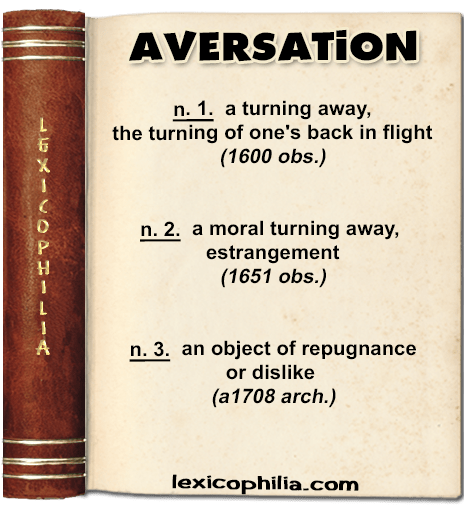
Word of the Day: AVERSATION


ETYMOLOGY
rom Latin aversationem, noun of action from aversat-


EXAMPLE
“…He can bear glory to their fleet, or shut up all their toils In his one suff’rance on thy lance.” With this deceit she led, And, both come near, thus Hector spake: “Thrice have I compassed This great town, Peleus’ son, in flight, with aversation That out of fate put off my steps; but now all flight is flown, The short course set up, death or life. Our resolutions yet Must shun all rudeness, and the Gods before our valour set For use of victory;…”

From: The Whole Works of Homer in his Iliads and Odysses
Translated by George Chapman, 1616

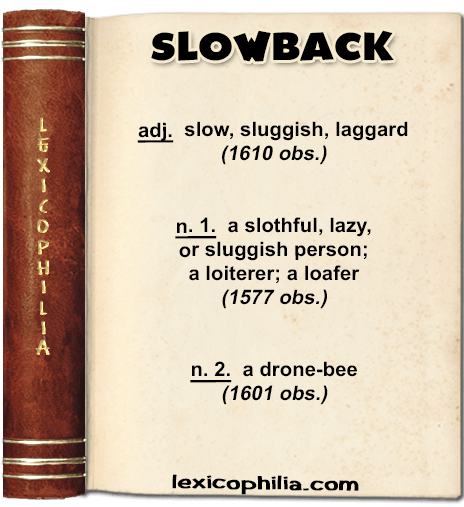
Word of the Day: SLOWBACK


ETYMOLOGY
from slow (adj.) + back (n.)


EXAMPLE
“…For God doth not assiste slouthfull persons and idle slowbackes. Now I call those needelesse occupations, whiche idle and ill disposed people do vse, thereby to be troublesome to their neighbours and to deceiue other men, exercising, I confesse, an occupation, but such an one as is vtterly vnlawfull & vnprofitable to all men…”

From: Fiftie Godlie and Learned Sermons Diuided into Fiue Decades
By Heinrich Bullinger, 1577

Word of the Day: PREHEND


ETYMOLOGY
from Latin prehendere (to grasp, seize, catch), variant of præhendere
from præ, (pre-) + a second element; sometimes perhaps aphetic from apprehend


EXAMPLE
“…but he lay not longe ther, but was delyveryd with-owt punyshment & styll Inioyed his beneffysis; they were greatly blamed that prehended hym and comitted hym…”

From: Political, Religious, and Love Poems
By John Stowe, a1605
Edited by Frederick James Furnivall, 1866

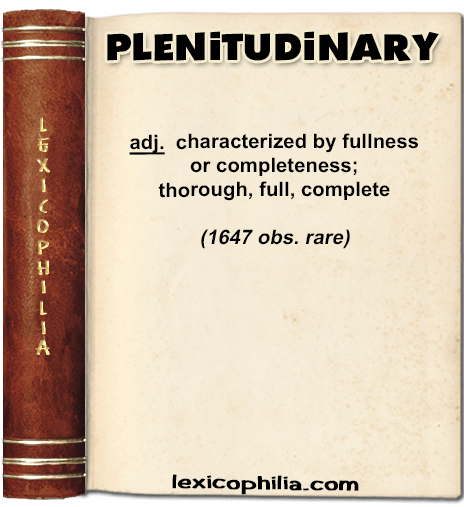
Word of the Day: PLENITUDINARY


ETYMOLOGY
from Latin plenitudinarius (full, complete, plenary),
from Latin plenitudin-plenitudo (abundance, fullness, fullness of shape, thickness, full amount, the whole) + -arius (-ary)


EXAMPLE
“…and a strange kind of Government must that needs be, wherein the Servants Throne is above his Masters, and a Subject shall have a plenitudinary power beyond that which his Lord and King had, or, as the times then were, was capable of …”

From: An Historical and Political Discourse of the Laws & Government of England from the First times to the End of the Reign of Queen Elizabeth
By Nathaniel Bacon, 1647

Word of the Day: APPROPINQUE


ETYMOLOGY
from Latin appropinquāre (to approach),
from ad (to), and propinquus, from prope (near)


EXAMPLE
“…The knotted bloud within my hose,
That from my wounded body flows,
With mortal Crisis doth portend
My dayes to appropinque an end.
I am for action now unfit,
Either of fortitude or wit…”

From: Hudibras, Written in the Time of the Late Wars
By Samuel Butler, 1663
Canto III. The Argument