Word of the Day: LABEFACTATE

ETYMOLOGY
from Latin labefactat-, past participial stem of labefactāre (to make unsteady, to loosen, to undermine)
frequently of labefacere  (to weaken, to impair)

EXAMPLE
“…The judgement seates of Bishops are meerely externall to the Church which they governe: But, Presbyteries and Synods are Courts internall, for the onely members whereof they consist, are the Comissioners of the Churches which they govern; these Churches they represent, the minde and desire of these Churches they doe propose, unto these Churches they give account of all their administration, they confirme and establish the rights of Congregations, they doe not abolish nor labefactate any of them…”

From: A dissuasive from the errours of the time wherein the tenets of the principall sects, especially of the Independents, are drawn together in one map, for the most part in the words of their own authours, and their maine principles are examined by the touch-stone of the Holy Scriptures
– Robert Baillie, 1645
Word of the Day: RAG-MANNERED

ETYMOLOGY
from rag + mannered (having manners of a specified kind)

EXAMPLE
“…Let us now take a Turn or two with Sir Tunbelly’s Heiress of 1500 pounds a year. This Young Lady swears, talks smut, and is upon the matter just as rag-manner’d as Mary the Buxsome. ‘Tis plain the Relapser copyed Mr. Durfey’s Original, which is a sign he was somewhat Pinch’d…”

From: A Short View of the Immorality, and Profaneness of the English Stage:
Together with the sense of antiquity upon this argument 
– Jeremy Collier, 1698

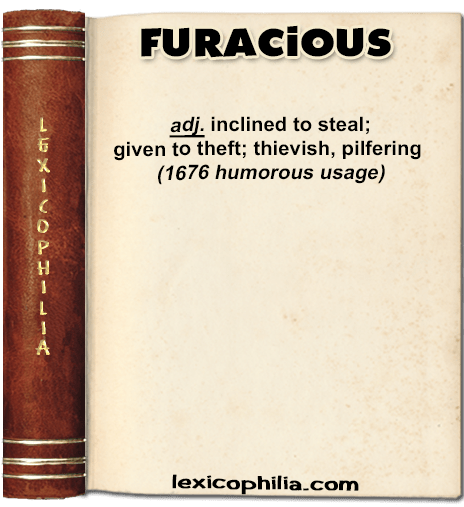
Word of the Day: FURACIOUS

ETYMOLOGY
from Latin furaci- (nominative furax),
from furari (to steal) + -ous

EXAMPLE
“…This amazing, and indeed murderous villany of the Irishman brought them all to their wit’s ends how to defend themselves from the ruin therein threatened unto them; and whatever methods were proposed, it was feared that there could be no stop given to his furacious exorbitancies any way but one; he could not be past stealing, unless he were past eating too…”

From: Magnalia Christi Americana
Or, The Ecclesiastical History of New-England 
– Cotton Mather, 1702

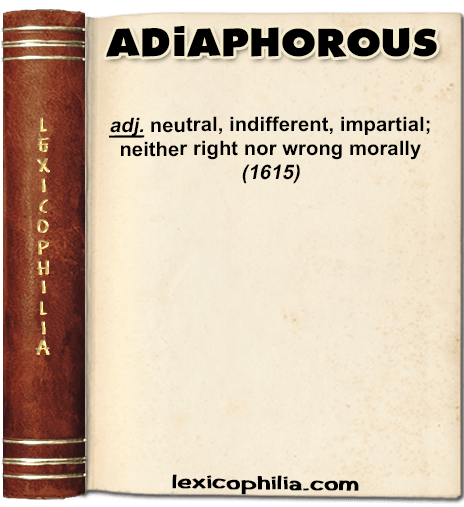
Word of the Day: ADIAPHOROUS

ETYMOLOGY
from Greek ἀδιάϕορ-ος (indifferent) + -ous

EXAMPLE
“…From all which may be inferred, that dissentions among the protestantes are not merely personall, or but pointes adiaphorous, indifferent, being as it were but peccant humors, and not true or formed diseases in their church, but they do concerne most profound doubtes of their religion, since otherwaies they would neuer anathematize, or condemne one an other with such acerbity of wordes…”

From: Whyte Dyed Black
Or A discouery of many most foule blemishes, impostures, and deceiptes
– Thomas Worthington, 1615

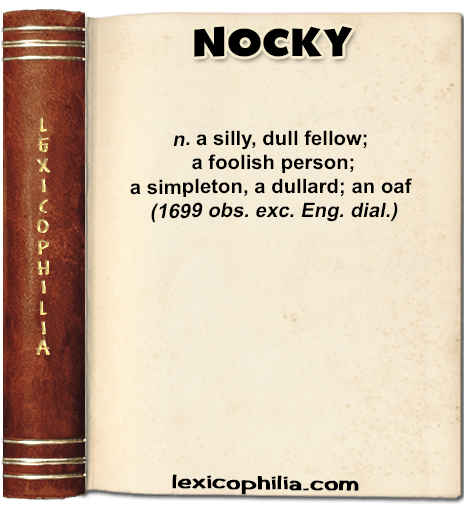
Word of the Day: NOCKY

ETYMOLOGY
of unknown origin

EXAMPLE
“…Was there ever less head in a brainless world?” said Johns. “Here, simple Nocky, I’ll do it.” He leapt off, and with much puffing climbed the post, striking a match when he reached the top, and moving the light along the arm, the lad standing and gazing at the spectacle…”

From: The English Illustrated Magazine
1883-1884
Interlopers at the Knap. I. 

Word of the Day: BIGOTICAL

ETYMOLOGY
from bigot -ical 

EXAMPLE
“…Or is any thing the more excellent and Venerable, because it exceeds all Understanding? Is he to be deemed the fittest subject for Religion, who is most Bigotical and carelesly credulous? Are we to put off Humane Nature that we may become Religious?…”

From: A discourse of the use of reason in matters of religion shewing that Christianity contains nothing repugnant to right reason, against enthusiasts and deists
– George Rust, translated Henry Hallywell, a1670

Word of the Day: FRIGIDIOUS

ETYMOLOGY
irregular from frigid + -ious

EXAMPLE
“…Like curelesse cures, past and repast repaire:
Frigidious Ianus two-fold frozen face,
Turnes moyst Aquarius into congeal’d yce:
Though by the fires warme side the pot haue place
…”

From: All the workes of Iohn Taylor the water-poet
Beeing sixty and three in number
Anagrams and Sonnets, 1630