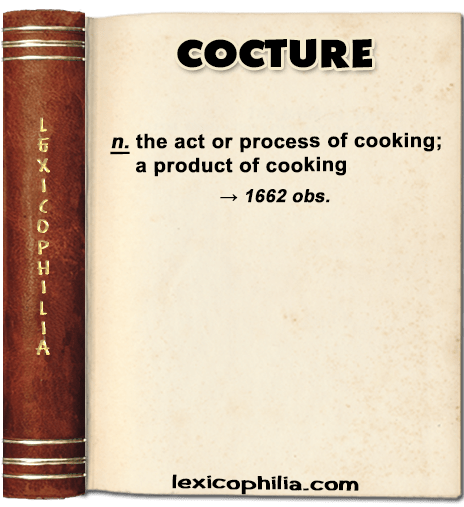
Word of the Day: COCTURE

ETYMOLOGY
from Latin coctura (a cooking)

EXAMPLE
“… For truly, whatsoever is cast into the stomack, digestion being at length finished, is transchanged, and far separated from boyling and other
coctures, after whatsoever degree prepared. …”

From: Oriatrike or, Physike Refined
By Jean Baptiste van Helmont
Translated by John Chandler, 1662

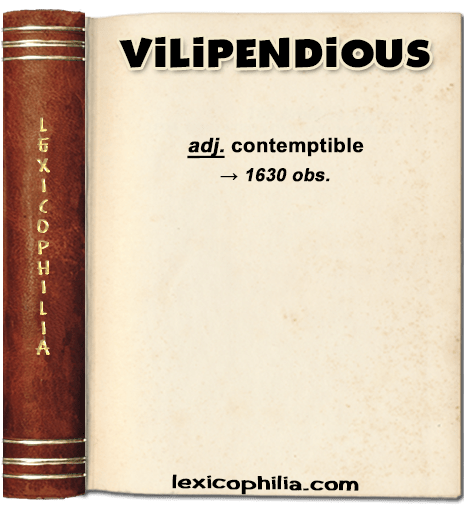
Word of the Day: VILIPENDIOUS

ETYMOLOGY
from vilipend (vb.) + -ious;
from French vilipender, or from Latin vilipendere, from vilis (vile, worthless) + pendere (to consider, esteem)

EXAMPLE
“… And thou ignoble horse-rubbing peasant, that by the borrowed title of a Lord (being but a vilipendious mechanicall Hostler, hast laid this insulting insupportable command on me: the time shall come, when thou shalt cast thy anticke authority, as a snake casts her skin; and then thou for an example to future posterities shalt make an vnsauory period of thy maleuolent dayes in litter and horse-dongue …”

From: All the vvorkes of Iohn Taylor the water-poet Beeing sixty and three in number
By John Taylor, 1630

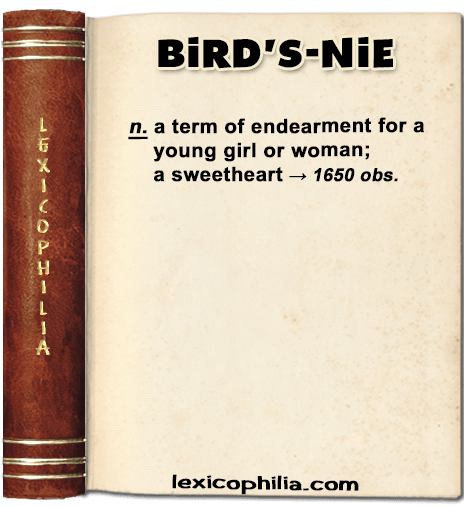
Word of the Day: BIRD’S-NIE

ETYMOLOGY
from the genitive of bird + nye for eye, as in my nye = myn eye;
possibly an alteration of pigsney (a sweetheart, a term of endearment)

EXAMPLE
“… Oh Mistris May, come to bed Sweet-heart come, my Duck, my Birds-nye; Zblood, I must goe to Salisbury to morrow, bring me my Boots quickly; Zounds, will not the Rogues bring me more Money; Zblood, that Cock’s worth a Kings Ransome, a runs, a runs, a thousand pound to a Hobby-horse; Rub, Rub, Rub, a pox Rub a whole hundred Rubs; …”

From: The last vvill and testament of Philip Herbert, burgesse for Bark-shire, 1650

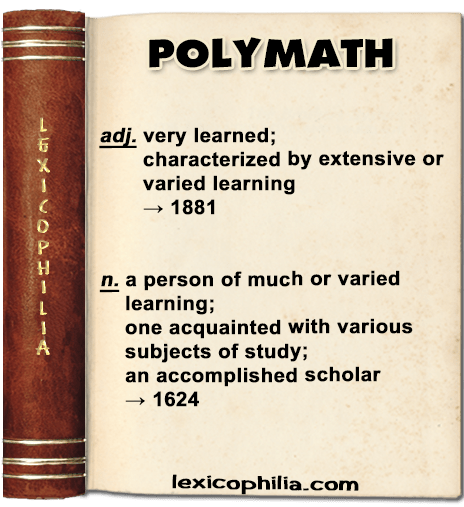
Word of the Day: POLYMATH

ETYMOLOGY
from Greek πολυµαθής (having learnt much), from πολυ- (poly-, much) + μάθη (learning) from the base of µανθάνειν (to learn)

EXAMPLE (for n.)
“… To be counted writers, scriptores ut Salutentur, to be thought and held Polumathes and Polyhistors, apud imperitum vulgus ob ventosæ nomem artis, to get a paper-kingdom: nulla spe quæstus sed ampla famæ, in this precipitate, ambitious age, nunc ut est sæculum, inter immaturam eruditionem, ambitiosum et præceps (’tis Scaliger’s censure); and they that are scarce auditors, vix auditores, must be masters and teachers, before they be capable and fit hearers. …”

From: The Anatomy of Melancholy 
By Robert Burton, 1624

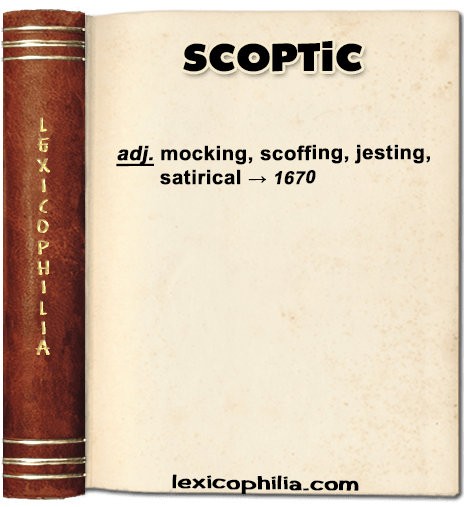
Word of the Day: SCOPTIC

ETYMOLOGY
from Greek σκωπτικός, from σκώπτειν (to mock, jeer)

EXAMPLE
“… Againft these Books, the ‘Learned employed their Learning, and the Witty employed their Wit. Celsus, Porpbyrius, Jamblichus, Hierocles, and other Philosophers, endeavoured to dispute them out of the world, Symmachus and Libanius, and other Rhetors to declaim them away. Julian and Lucian and other Scoptick wits, endeavoured to jeer and droll away the credit of them. …”

From: Sermon Against the Anti-scripturists
By Seth Ward, 1670

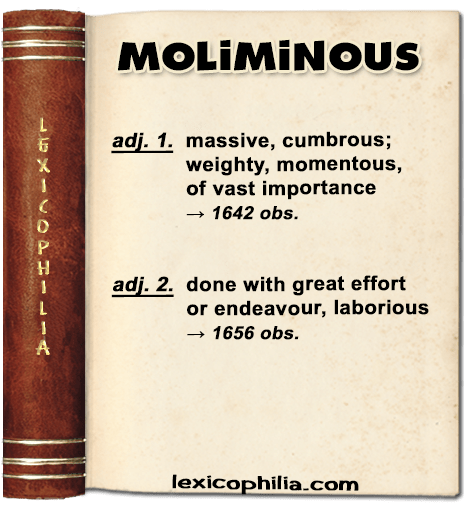
Word of the Day: MOLIMINOUS

ETYMOLOGY
from Latin molimin- molimen (effort); (from moliri (to make an effort, undertake, attempt)) + -ous

EXAMPLE (for adj. 1.)
“… In all great distresses the body of the people was ever constrained to rise, and by the force of a Major party to put an end to all intestine strifes, and make a redresse of all publique grievances, but many times calamities grew to a strange height, before so combersome a body could be raised; and when it was raised, the motions of it were so distracted and irregular, that after much spoile and effution of bloud, sometimes onely one Tyranny was exchanged for another: till some way was invented to regulate the motions of the peoples moliminous body, I think arbitrary rule was most safe for the world, but now since most Countries have found out an Art and peaceable Order for Publique Assemblies, whereby the people may assume its owne power to do itselfe right without disturbance to it selfe, or injury to Princes, he is very unjust that will oppose this Art and order. …”

From: Observations upon some of His Majesties late answers and expresses
By Henry Parker, 1642

PRONUNCIATION
moh-LIM-uh-nuhss

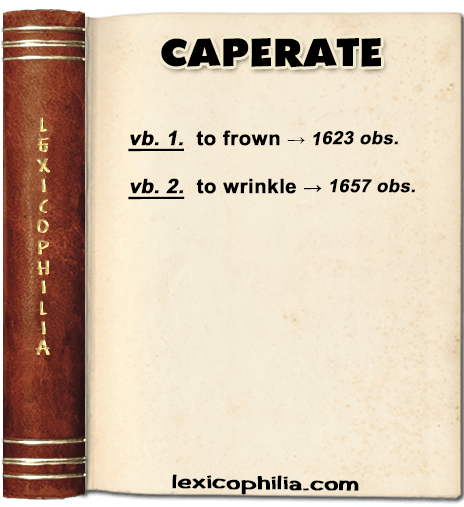
Word of the Day: CAPERATE

ETYMOLOGY
from Latin caperat- participial stem of caperare (to frown)

EXAMPLE (for vb. 2.)
“… the first is called a Limmon which is turbinated with an oblong effigies, is colorated herbaceously, and turgid with a more acid acerb and frigid succe, corticated with a thinner pill, and not so amare as an Orenge: the second is the more vulgar Citron, very like the former, but its colour is more luteous, its pill more crasse, rugous and caperated, and it selfe more crasse, odorate, medicative and convenient for antidotes: the third is greatest called Pom-Citron, orbiculated like a melon, with a thick carnous pill, somtimes aequalling a mans nayle in crassitude, with a concolorated superficies, which we call Poncerium, Citroniatum, Assyrian Apple, and Adams Apple, all which names seem to be deflected from the Tree, and as they are alike in Idea, so also in facultyes. …”

From: A Medicinal Dispensatory, containing the whole body of physick discovering the natures, properties, and vertues of vegetables, minerals, & animals
By Jean de Renou
Translated by Richard Tomlinson, 1657
Of Limmons, Citrons.

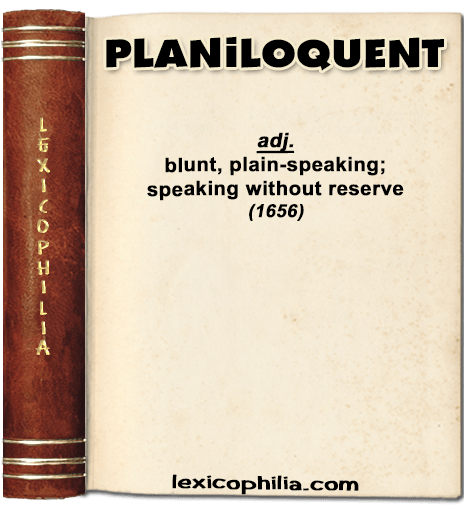
Word of the Day: PLANILOQUENT

ETYMOLOGY
from Latin planiloquus (plain-speaking) (from planus [plain] + -loquus (from loqui [to speak])) + -ent

EXAMPLE
“… Dear Editor: Please continue your piperitious, planiloquent polemics against those omphaloskeptical, onychophagic, uxoravalent, philalethic, laodicean, opisthoporeiac, equivorous, kakorrhaphiophobiac, megalomaniacal, porlockian, contortuplicate, acritochromatic, and tragomaschaliac pseudoacademicians.
Cordially
Dr. Panos D. Bardis
Editor, Social Sciences …”

From: Maledicta (International Journal of Verbal Aggression, Volume 1 Number 2)
In Defense of Anticacademoidism
Edited by Reinhold Aman, 1978

Word of the Day: MULCIBLE

ETYMOLOGY
from Latin mulcibilis, from mulcere (to soothe) + -ibilis (-ible)

EXAMPLE
“… But now, partly through the ineffable quality of rich comedy, which was so much the constitution of Elliston, and partly from Miss Warren’s mulcible nature, which, to do her justice, was unrivalled, and all this aided by the pacific disposition of the clerk of the “long-room,” peace was tolerably restored. …”

From: Memoirs of Robert William Elliston, 
Comedian, 1774-1810
By George Raymond, 1844