Word of the Day: SICCICATE

ETYMOLOGY
irregularly from Latin siccus or siccare

EXAMPLE
“… Thirdly, when you put forth your horses to run at grasse all, or the most part of Summer, during which time the scorching heats wil so siccicate and dry the planks, which will cause them to warp, and the pinnes which holdeth them down to the joyces will rot, and so the planks give way, especially when horses (who not being handled in some moneths before) becomming wild, rammage, and unruly, are newly brought into the Stable, who feeling the planks to move, yeeld, and give way under them, will fall from starting thereat, to slinging, leaping, bounding and plunging, till they have dislocated the planks, and thereby have endangered both themselves, the residue of their fellowes, and those who might come to their help and succour, which is a thing very frequent in a flore of this nature: …”

From: The Compleat Horseman and Expert Ferrier In two bookes. The first, shewing the best manner of breeding good horses, with their choyce, nature, riding and dyeting … The second, directing the most exact and approved manner how to know and cure all maladies and diseases in horses;
By Thomas de Grey, 1639
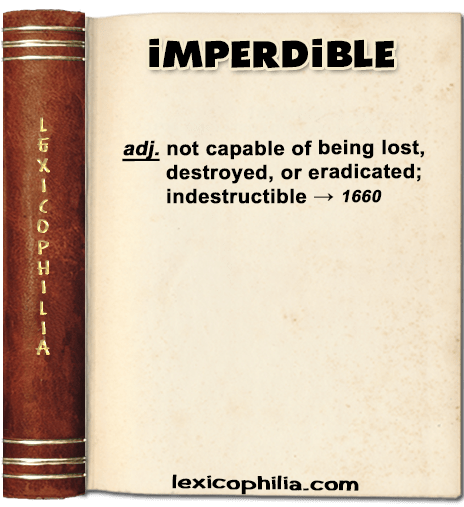
Word of the Day: IMPERDIBLE

ETYMOLOGY
from Latin imperdibilis; from im- + perdere (to lose) + -ibilis (-ible)

EXAMPLE
“… Most men are erroneous in the apprehension of their Felicity, Honour, Glory and Riches being their ordinary objects, are but smoaky substances to make it solid and imperdible; all these are daily subject to casualties: for what with difficulty we have acquired in a year, may by an unexpected accident of fortune be lost in a day, and often times by the same means, we projected to mount the throne of our felicity, we inevitably fall into the abiss of disgrace. …”

From: The Idea of the Lavv Charactered from Moses to King Charles.: Whereunto is added the Idea of Government and Tyranny
By John Heydon, 1660

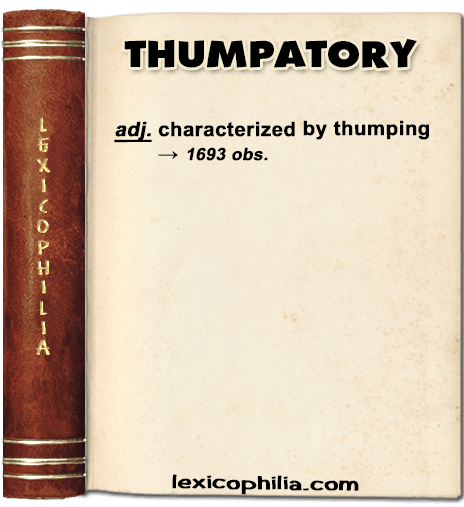
Word of the Day: THUMPATORY

ETYMOLOGY
from thump + –atory (a thing relating to)

EXAMPLE
“… Then scrubbing and swindging a little with his left Hand alongst, and upon the uppermost in the very bought of the Elbow of the said dexter Arm, the whole Cubit thereof by leisure fair, and softly, at these thumpatory warnings, did raise and elevate it self even to the Elbow, and above it, on a suddain did he then let it fall down as low as before: and after that, at certain intervals and such spaces of time, raising and abasing it, he made a shew thereof to Panurge …”

From: The Third Book of the Works of Mr. Francis Rabelais, Containing the Heroick Deeds of Pantagruel the Son of Gargantua,
By François Rabelais
Translated by Thomas Urquhart and Peter Anthony Motteux, 1693

Word of the Day: FRANTLING

ETYMOLOGY
of unknown origin

EXAMPLE
“… croaking of Ravens, screeching of Owls, whicking of Pigs, gushing of Hogs, curring of Pigeons, grumbling of Cushet-doves, howling of Panthers, curkling of Quails, chirping of Sparrows, crackling of Crows, nuzzing of Camels, wheening of Whelps, buzzing of Dromedaries, mumbling of Rabets, cricking of Ferrets, humming of Wasps, mioling of Tygers, bruzzing of Bears, sussing of Kitnings, clamring of Scarfes, whimpring of Fullmarts, boing of Buffalos, warbling of Nightingales, quavering of Meavises, drintling of Turkies, coniating of Storks, frantling of Peacocks, clattering of Mag-pyes, murmuring of Stock-doves, crouting of Cormorants, cigling of Locusts, charming of Beagles, guarring of Puppies, snarling of Messens, rantling of Rats, guerieting of Apes, snuttering of Monkies …”

From: The Third Book of the Works of Mr. Francis Rabelais, Containing the Heroick Deeds of Pantagruel the Son of Gargantua,
By François Rabelais
Translated by Thomas Urquhart & Peter Anthony Motteux, 1693

Word of the Day: MELLISONANT

ETYMOLOGY
from Latin mell-, mel (honey) + sonant-, sonans, present participle of sonare (to sound)

EXAMPLE
“… And rise up Sir Iocastus, our deare Knight.
Now hang the hallowed bell about his neck,
We call it a
mellisonant Tingle Tangle,
(Indeed a sheep-bell stolne from’s own fat wether.)
The ensigne of his knighthood. Sir Iocastus,
Wee call to mind we promis’d you long since
The President of our Dances place; we are now
Pleas’d to confirme it on you: give him there
His Staffe of Dignity.
…”

From: Poems with the Muses Looking-Glasse: and Amyntas
By Thomas Randolph, 1638

Word of the Day: BORBOROLOGY

ETYMOLOGY
from Greek βόρβορος (filth) + -λογία (discoursing)

EXAMPLE
“… Evil words are not winde, as most imagine, but the devils drivell, that leaves a foul stain upon the speaker, and oft sets the like upon the hearer. Shun obscene borborology (saith one) and unsavoury speeches: thou losest so much of thine honesty and piety, as thou admittest evil into thy tongue. …”

From: A Commentary or Exposition upon all the Epistles, and the Revelation of John the Divine
By John Trapp, 1647

Word of the Day: TAUTOLOGIZE

ETYMOLOGY
from tautology (unnecessary repetition of the same word, phrase, idea, argument, etc.; the saying of the same thing twice in different words), (from late Latin tautologia, from Greek ταὐτολογία, from ταὐτολόγος) + -ize

EXAMPLE
“… Although I am not ignorant that there be some which make two kindes of these Serpents, because of the two names rehearsed in the title, yet when they haue laboured to describe them seuerally, they can bring nothing or very little wherein their story doth not agree, so as to make twaine of them, or to handle them asunder, were but to take occasion to tautologize , or to speake one thing twice. …”

From: The Historie of Serpents. Or, The Second Booke of Liuing Creatures
By Edward Topsell, 1608

Word of the Day: NANNICOCK

ETYMOLOGY
of uncertain origin;
possibly from Nanny, pet-form of the female forenames Anne and Agnes with suffix ‑cock 

EXAMPLE
“… Hee that doth wonder at a Weathercocke,
And plaies with euery feather in the winde,
And is in loue with euery
Nannicocke;
Yet scarcely knowes an Orange by the Rinde:
When euery Foole is found out in his Kinde,
How is it possible but he should passe,
For a poore silly simple witted Asse?
…”

From: Pasquils Fooles-Cap sent to such (to keepe their weake braines warme) as are not able to conceiue aright of his mad-cap,
By Nicholas Breton, 1600

Word of the Day: PERENDINATE

ETYMOLOGY
from Latin perendinat-, past participial stem of perendinare (to defer until the day after tomorrow, to postone for a day) from perendinus ((the day) after to-morrow), from perendie (on the day after to-morrow) + -inus, or from peren- + din- (day)

EXAMPLE (for vb. 1.)
The chairman of the board perendinated the meeting so that all members would be able to attend.

Word of the Day: AMICITIAL

ETYMOLOGY
from Latin amicitia (friendship), (from amicus (friend)) + -al

EXAMPLE
“… What M. Ellis denyeth to be the question.
1. He saith it is not meant of the essential onenesse.
Answ. But this is meant, and is the foundation of the other.
2. It is not (saith he) meant of engagement to mutual care one of another.
Answ. Not
amicitial or fraternal only, but authoritative, the greater part to regulate the lesse. …”

From: A Vindication of the Essence and Unity of the Church Catholike Visible, and the priority thereof in regard of particular churches in answer to the objections made against it
By Samuel Hudson, 1650

PRONUNCIATION
am-uh-SISH-uhl