
ETYMOLOGY
from Latin ninguidus (snowy, covered in snow), from ninguis (snow) + -idus (-id)
EXAMPLE
The ninguid trees were beautiful, but the roads were a complete slushy mess.
ETYMOLOGY
from Latin ninguidus (snowy, covered in snow), from ninguis (snow) + -idus (-id)
EXAMPLE
The ninguid trees were beautiful, but the roads were a complete slushy mess.
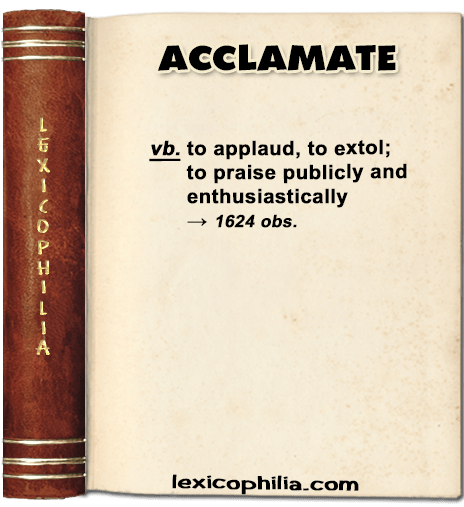
ETYMOLOGY
from Latin acclamat-, past participial stem of acclamare (to praise publicly and enthusiastically, to applaud)
EXAMPLE
“… that but for shame hee had drawne the Roman legions out of Britain, and so timorous of weapons, that Tiridates riueted his sword to the sheath thereof, for his assurance (because hee would not vnknightly yeeld to goe vngirt, though it were vpon condition, to receiue the diadem of Armenia) was now notwithstanding, with as shrill, and ioyous showts acclamated Imperator, as if in person hee had conquered Armenia by the sword….”
From: Nero Caesar, or, Monarchie Depraved
By Edmund Bolton, 1624
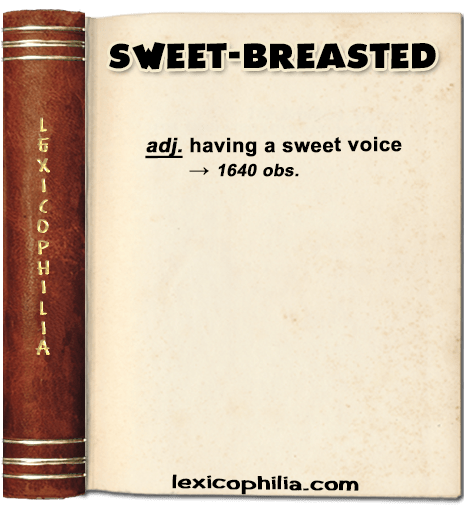
ETYMOLOGY
from sweet + breasted (breast = a person’s singing voice, obs.)
EXAMPLE
“… I like his feather well: a proper man,
Of good discourse, fine conversation,
Valiant, and a great carrier of the businesse,
Sweet breasted, as the Nightingale, or Thrush:
Yet I must tell you; you forget your selfe,
My Lord Vitellies love, and maintenance
Deserves no other Jack ith’ box, but he:
What though he gather’d first the golden fruit,
And blew your pigges-coat up into a blister,
When you did wait at Court upon his mother;
Has he not wel provided for the barne?
Beside, what profit reap I by the other?
If you wil have me serve your pleasure, Lady,
Your pleasure must accommodate my service; …”
From: Comedies and Tragedies written by Francis Beaumont and John Fletcher, 1647
“Love’s Cure, or The Martial Maid“, a1640
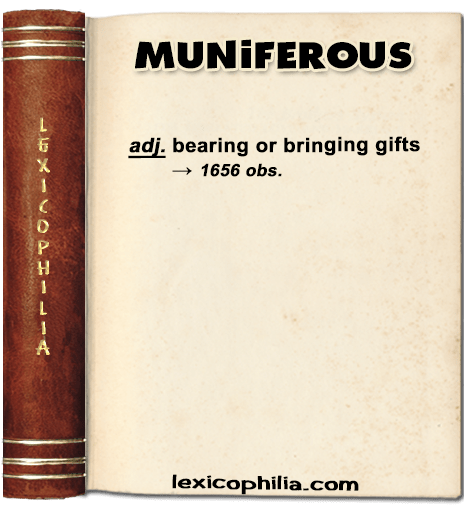
ETYMOLOGY
from Latin munifer (from munus (gift) + -fer (bearing)) + -ous
EXAMPLE
“The orphanage welcomed the muniferous visitors, who arrived with clothes, gifts, and enough food for the entire winter.”
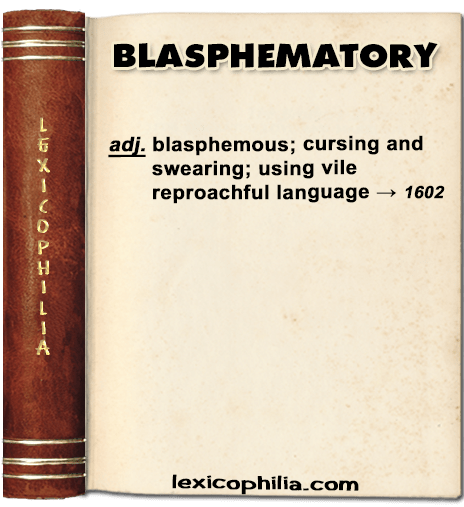
ETYMOLOGY
from Latin blasphematorius, from blasphemator (from blasphemat-, past participial stem of blasphemare (to blaspheme)) + -ius
EXAMPLE
“… But againe I renounce and abiure now and for euer, both her and all her doctrine; in so much as that it is against the expresse word of God, blasphematory, Apostatique, superstitious, and as farre from the meaning of Christe our true maister, as darkenesse from light, as falshood from trueth, & vice from vertue: most humbly beseeching almighty GOD (thorough the entralls of his mercy, and through the most precious bloude which his sonne Iesus Christ hath shed for me) that he will not lay to my charge the faults of my youth nor iudge me according to the sinnes of my ignorance; but rather pursuing his mercy begunne in me, he will pardon all my offences committed by me either in works, words or thoughts, and in others, through examples and wicked superstitious doctrines: …”
From: The Confession and Publike Recantation of Thirteene Learned Personages,
Translated out of the French and Dutch printed copies, by I.M., 1602
ETYMOLOGY
from participial stem of Latin lallare (to sing la-la or lullaby);
when it first entered English, it denoted a “childish utterance”
EXAMPLE
“She tended to lallate whenever she wanted something from him.“
ETYMOLOGY
from Latin notandum, (neuter singular of notandus, gerundive of notare (to note)
EXAMPLE
“… These former notandums having beene premised, we need not dwell long upon answering of objection, for by them the way is opened already, and that which before hath beene delivered will not need any more then application. …”
From: The Prerogative of Man, or, His soules immortality, and high perfection defended, 1645
PRONUNCIATION
noh-TAN-duhm

ETYMOLOGY
from Latin cess- participial stem of cedere (to yield) + -ive
EXAMPLE
“… Yet there is a Diversity in Softness by Argentrive, and in Softness by Sulphur: because Softness by Sulphur is Cessive, but Softness by Argentrive is Extensive. And this must necessarily be proved by Sight; seeing We see Bodies of much Argentrive, to be of much Extension; but Bodies of little, of little. …”
From: The Works of Geber
By Jabir ibn Haiyan
Translated by Richard Russell, 1678
ETYMOLOGY
from Latin gamicus or from Greek γαµικός (of or for marriage) + -al
EXAMPLE
“… Humane Laws are threefold, viz. Secular, Temporal, or Civil, such are the Laws of every Country; or Gamacal , viz. the Laws of the Husband; or Paternal, viz. the Laws of Parents to their Children. …”
From: Justice vindicated from the false fucus put upon it, by Thomas White gent. Mr. Thomas Hobbs, and Hugo Grotius: As also elements of power & subjection;
By Roger Coke, 1660
ETYMOLOGY
from Latin nocivus (harmful, injurious), (from nocere (to hurt)) + -ous
EXAMPLE
“…Phisitions which prescribe a remedy
To each disease & bodies maladie;
That know what is nocivous & what good,”
When it is fit to bath, to purge, let bloode;
Although they know the nature & the power
Of every simple, every hearbe, & flower,
With Solomon, which from the cedar tall
Vnto the hisope spreading on the wall,
Knew every growing plant, flower, hearbe, or tree,
With their true vse & proper qualitie; …”
From: The Times’ Whistle: Or, A New Daunce of Seven Satires, and Other Poems
Compiled by R.C., c1616
Published for the Early English Text Society, 1871
 Lexicophilia