ETYMOLOGY
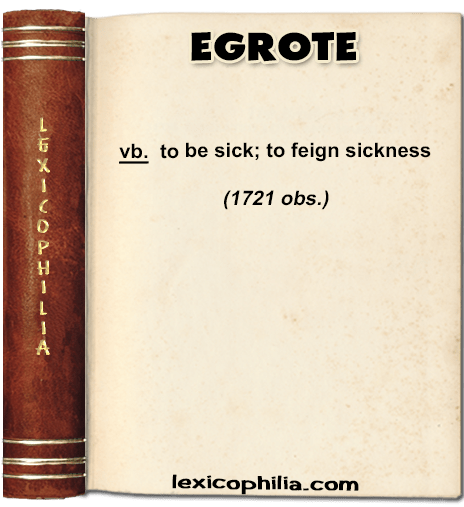
from Latin ægrotare, from ægrotus (sick)
EXAMPLE
Cecil egroted to impress the new lady doctor.
ETYMOLOGY
from Latin ægrotare, from ægrotus (sick)
EXAMPLE
Cecil egroted to impress the new lady doctor.
ETYMOLOGY
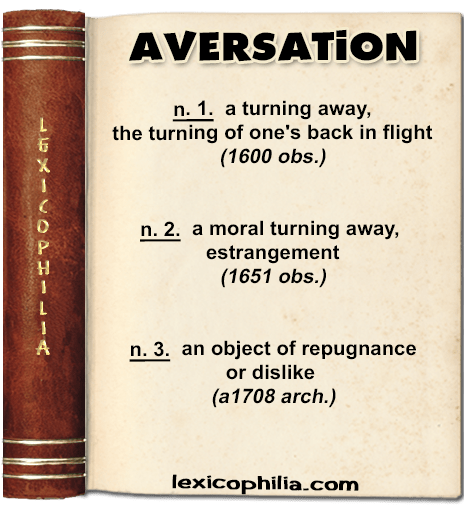
rom Latin aversationem, noun of action from aversat-
EXAMPLE
“…He can bear glory to their fleet, or shut up all their toils In his one suff’rance on thy lance.” With this deceit she led, And, both come near, thus Hector spake: “Thrice have I compassed This great town, Peleus’ son, in flight, with aversation That out of fate put off my steps; but now all flight is flown, The short course set up, death or life. Our resolutions yet Must shun all rudeness, and the Gods before our valour set For use of victory;…”
From: The Whole Works of Homer in his Iliads and Odysses
Translated by George Chapman, 1616
ETYMOLOGY
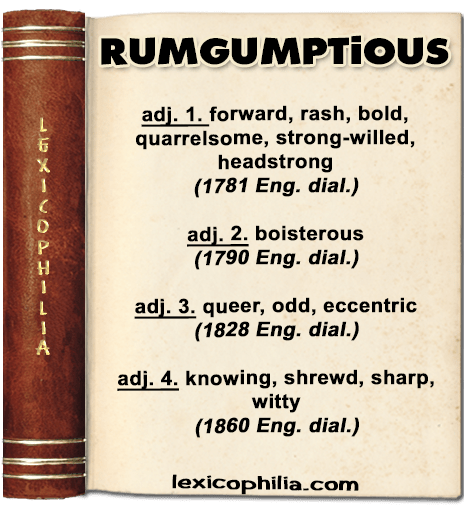
from rumgumption (good sense, shrewdness)
EXAMPLE
“…who’d have thought of that?–he’s a turning rumgumtious, and no mistake. Howsomdever, I must turn it over in my mind, and be even with him, somehow–I owes him one for that. I say, admiral…”
From: Varney the Vampire
By Thomas Peckett Prest, 1847

ETYMOLOGY
from clapper (the tongue of a bell; a talkative person’s tongue) + tongue
EXAMPLE
“…She has an e’e, she has but ane,
The cat has twa the very colour;
Five rusty teeth, forbye a stump,
A clapper tongue wad deave a miller:
A whiskin beard about her mou’,
Her nose and chin they threaten ither;
Sic a wife as Willie had,
I wadna gie a button for her!…”
From: The Scots Musical Museum
By James Johnson, 1792
Sic A Wife as Willie had – Robert Burns

ETYMOLOGY
from Latin amnicola (growing beside a river)
(from amnis (river) + -cola (inhabitant, worshipper)) + -ist
EXAMPLE
“…society without seleection, constitutional bumpers, and stale anecdotes, I determined to explore the banks of the Liffey, and to search among the amnicolists for that entertainment which eluded my pursuit in the urbanity of the capital…”
From: Hibernian Magazine
By Robert Jephson, 1782
ETYMOLOGY
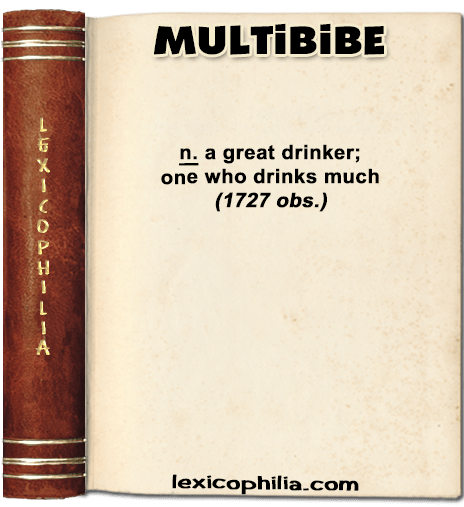
from Latin multibibus, from multi- + -bibus drinking, bibĕre to drink
EXAMPLE
Now and then I turned aside to avoid some noisy multibibe as he reeled homewards.

ETYMOLOGY
– a stiver was a small coin (originally silver) of the Low Countries:
applied to the nickel piece of 5 cents of the Netherlands
EXAMPLE
“…as, according to a very nice calculation, that cutaneous reservoir, vulgarly called the breeches-pocket, and notorious for its unaffected sympathy with the animal spirits, will be stiver-cramped: I shall then indulge them with a touch of the sublime!…”
From: The Life and Extraordinary Adventures of James Molesworth Hobart
By N. Dralloc, 1794
ETYMOLOGY
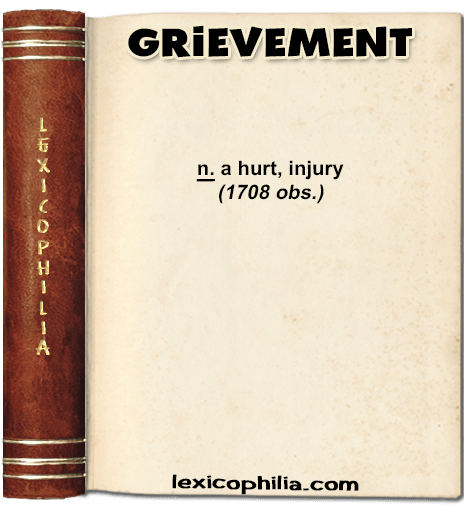
from grieve + -ment
EXAMPLE
“…The manner of his Marching forth,
Some Authors tell us, and his Worth,
His Stature, Courage, Strength and Age,
His Armour and his Equipage,
His Warlike Feats in former Days,
Perform’d in Scotch and Gallick Frays,
His Battels won and great Atchievments,
Wounds, Bruises, Bangs, and other Grievments;
Which Happen’d oft to be his Fate,
For no Man’s always Fortunate:
All which I leave to Ancient story;
Now see the end of all his Glory…”
From: England’s Reformation from the time of King Henry VIII to the End of Oates’s Plot,
A Poem in Four Canto’s
By Thomas Ward, 1708
ETYMOLOGY
of unknown origin;
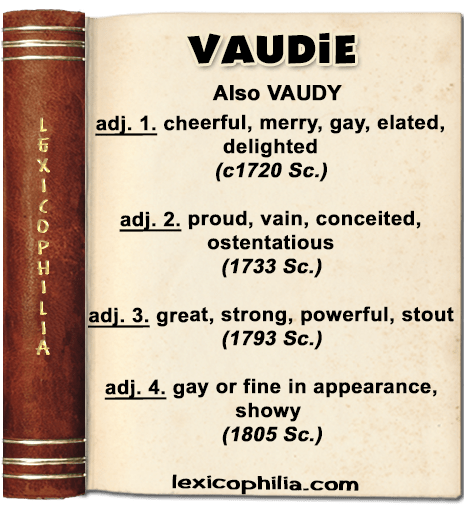
possibly an altered form of vandie, vauntie
EXAMPLE
“…How lang shall our land thus suffer distresses,
Whilst traitors, and strangers, and tyrants oppress us!
How lang shall our old, and once brave warlike nation,
Thus tamely submit to a base usurpation?
Thus must we be sad, whilst the traitors are vaudie,
Till we get a sight of our ain bonnie laddie…”
From: Jacobite Songs, 1871
How Lang Shall Our Land
By William Meston,
ETYMOLOGY
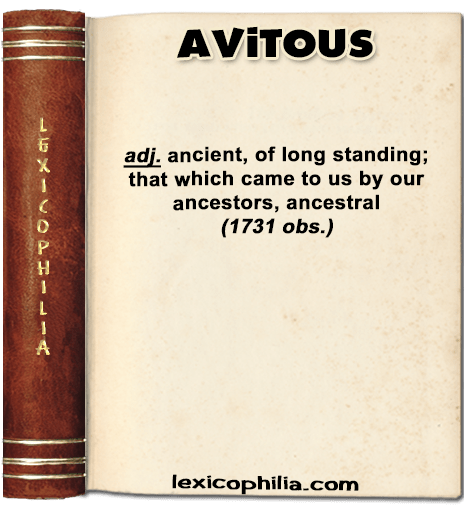
from Latin avītus of or pertaining to the avus (grandfather) + -ous
EXAMPLE
“…Being a leucothiop, he was not even a mediocrist, but a mere polypragmatical hafter or barrator. His inscience of avitous justicements, and of lexicology, his perissology and battology, imparted to his tractation of his cause, an imperspecuity which rendered it immomentous to the juratory audients…”
From: Letters to Squire Pedant in the East
Letter No. IX, 1843
By Lorenzo Altisonant (pseudonym Samuel Klinefelter Hoshour),
an Emigrant to the West, 1856
 Lexicophilia