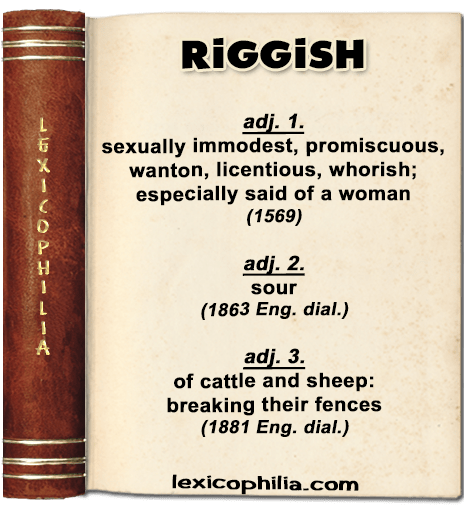
Word of the Day: RIGGISH

ETYMOLOGY
of uncertain origin
n. 1. possibly from rig (a wanton girl or woman)

EXAMPLE (for adj. 1.)
“… As it is to be seene, namely at Rome, what reuenues and rents, that great and soueraign ruffian getteth by his whoores. And afterward of the drouning and killing of children, and secretly murthering, and casting in corners and ditches, as is vsually practised amongst these riggish and lecherous prelates. …”

From:  Jan van der Noot’s Theatre, wherein be represented the miseries that follow the Voluptuous Worldings
By Jan van der Noot
Translated by Theodore Roest, 1569

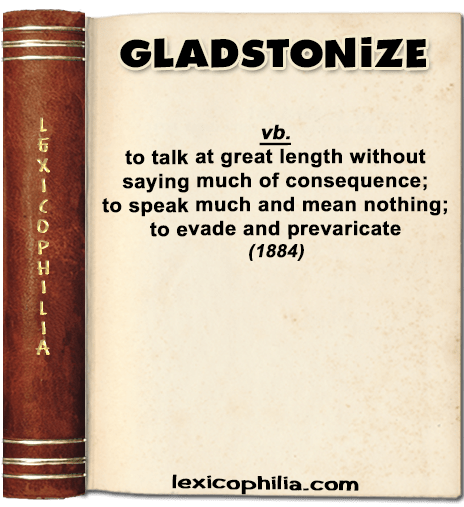
Word of the Day: GLADSTONIZE

ETYMOLOGY
from the alleged characteristics of British Prime Minister, William Ewart Gladstone, 1809-1898

EXAMPLE
“… Before the capitalist proprietors woke up to our game and cleared us out, the competition of the Star, which was immensely popular under what I may call the Fabian regime, had encouraged a morning daily, the Chronicle, to take up the run¬ nings and the Star, when it tried to go back, found that it could not do so further than to Gladstonize its party politics. …”

From: Fabian Tract No. 41
The Fabian Society: It’s Early History
By G. Bernard Shaw, 1892

Word of the Day: ERGOPHOBIA

ETYMOLOGY
from Greek ἔργον (work) + -phobia

EXAMPLE
“… to which might be added ergophobia, or mobid shrinking from active effort of every sort, etc. But these expressions add very little to definiteness of description. …”

From: Essentials of the Principles and Practice of Medicine
A Handbook for Students and Practitioners
By Henry Hartshorne, 1881
Part I, Principles of Medicine. Section I. General Pathology
Neuro-Pathology

Word of the Day: FRIMPLE-FRAMPLE

ETYMOLOGY
of obscure origin;
possibly from frample (to put in disorder)

EXAMPLE
“… This is the laund that bigs the winds; winds big the cloods; 
the cloods, the weit, the weit, the grun; an antrin steer 
o syle an rain. Thon
frimple-frample watter rowin 
frae Kenmore tae Dundee is cried the River Tay. 
…”

From: Wild Mushrooms: Writings
By Kate Armstrong, 1993

Word of the Day: GIG-LAMPS

ETYMOLOGY
from gig (a light two-wheeled one-horse carriage) + lamp

EXAMPLE (for n. 1.)
“… A “Wo-ho-ho, my beauties!” brought the smoking wheelers upon their haunches; and Jehu, saluting with his elbow and whip finger, called out in the husky voice peculiar to a dram-drinker, “Are you the two houtside gents for Hoxfut?” To which Mr. Green replied in the affirmative; and while the luggage (the canvas-covered, ladylike look of which was such a contrast to that of the other passengers) was being quickly transferred to the coach-top, he and Verdant ascended to the places reserved for them behind the coachman. Mr. Green saw at a glance that all the passengers were Oxford men, dressed in every variety of Oxford fashion, and exhibiting a pleasing diversity of Oxford manners. Their private remarks on the two new-comers were, like stage “asides,” perfectly audible.

“Decided case of governor!” said one.

“Undoubted ditto of freshman!” observed another.

“Looks ferociously mild in his gig-lamps!” remarked a third, alluding to Mr. Verdant Green’s spectacles.

And jolly green all over!” wound up a fourth. …”

From: The Adventures of Mr. Verdant Green
By Cuthbert Bede, (real name Edward Bradley), 1853

Word of the Day: BY-WIPE

ETYMOLOGY
from by- + wipe (sarcastic reproof or rebuff)

EXAMPLE (for n. 1.)
“… Wherefore should ye begin with the devil’s name, descanting upon the number of your opponents? Wherefore that conceit of Legion with a by-wipe? Was it because you would have men take notice how you esteem them, whom through all your book so bountifully you call your brethren? We had not thought that Legion could have furnished the Remonstrant with so many brethren. …”

From: Animadversions upon the Remonstrants Defence Against Smectymnuus
By John Milton, 1641

Word of the Day: PLISKY

ETYMOLOGY
of obscure origin

EXAMPLE (for n. 1.)
“… They ‘re fly’d at the heart, it’l be a black Bargain for poor Scotland: for the Engleses are owr auld farren for us, and there’s little Ground to think, they ‘ll gee
us a seen Vantage wee their will, they neer liked us sae well; and its naе forgotten yet, the foul
Plisk they play’d us about our Caledonia Business; …”

From: The Scottish Antiquary Or Northern Notes and Queries
Volume XII, January 1898
A Copy of a Letter from a Country Farmer To His Laird, a Member of Parliament, 1706

Word of the Day: QUISBY

ETYMOLOGY
of uncertain origin;
possibly from quiz (n.) + -by

EXAMPLE
“… Alibi. What wou’d I do then?
Air. Aye, Sir, what wou’d you do then?
Soph. Cou’dn’t he push a little feeble old quisby like you down into a chair?
Alibi, How, pray?
Soph. Shew him how, Robin?
Air. Why there – (puts him into a chair) Just that way
Alibi. Well, now Old Quisby’s down in the chair – what wou’d he do then?…”

From: The Toy
By John O’Keeffe, 1789

Word of the Day: JIMJAMS

ETYMOLOGY
a reduplicated term, of which the elements are unknown;
from the mid 16th century – in the singular, originally denoted a knickknack or small article

EXAMPLE (for n. 1)
“… Andy Collins, an Irishman, who has lived alone in his cabin, about a mile below us, for a year or more, has been a hard drinker ever since we have known him. He bought his rum by the gallon and kept soaked all the time. Tuesday night he had a bad attack of the jim-jams, and his nearest neighbor, O’Neil, heard him yelling and shrieking like all possessed. …”

From: The Diary of a Forty-Niner
By Chauncey Canfield, 1906
Chapter XVI, February 1, 1852