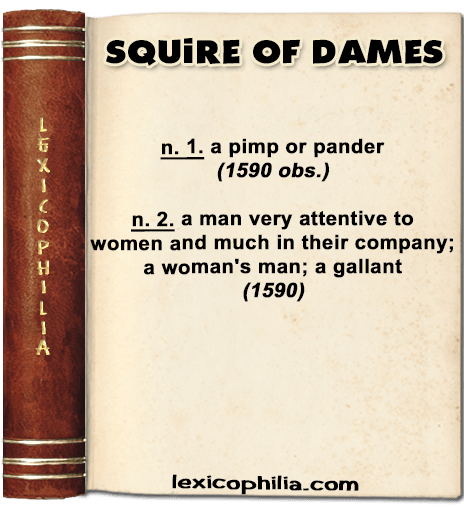
Word of the Day: SQUIRE OF DAMES

ETYMOLOGY
from squire

EXAMPLE
“…Me, silly wretch, she so at vantage caught,
After she long in wait for me did lie,
And meant unto her prison to have brought,
Her loathsome pleasure there to satisfy;
That thousand deaths me lever were to die
Than break the vow that to fair Columbell
I plighted have, and yet keep steadfastly.
As for my name, it mistreth not to tell;
Call me the Squire of Dames, that me beseemeth well
…”

From: The Faerie Queene
By Edmund Spenser, 1590

Word of the Day: NOVITIOUS

ETYMOLOGY
from Latin novitius, from novus (new)

EXAMPLE
“…I know many great and ancient families have been subject to eclipses and interruptions, which some mistaking for their primeve original, have erroneously accounted those families mean and novitious which have been truly ancient and ennobled…”

From: The Autobiography and Correspondence of Sir Simonds D’Ewes (a1650)
Edited by James Orchard Halliwell, 1845

Word of the Day: MALTWORM

ETYMOLOGY
from malt + worm

EXAMPLE
“…And Kytte, my wyfe, that as her lyfe
Lovethe well good ale to seke,
Full ofte drynkythe she that ye maye se
The teares ronne downe her cheke.
Then dothe she troule to me the bolle
As a goode malte-worme sholde,
And say, “Swete harte, I have take my parte
Of joly goode ale and olde
…”

From: The Poetical Works of John Skelton (1843)
Drinking Song (I Cannot Eate But Lytyll Meate)

Word of the Day: VAUDIE

ETYMOLOGY
of unknown origin;
possibly an altered form of vandievauntie

EXAMPLE
“…How lang shall our land thus suffer distresses,
Whilst traitors, and strangers, and tyrants oppress us!
How lang shall our old, and once brave warlike nation,
Thus tamely submit to a base usurpation?
Thus must we be sad, whilst the traitors are vaudie,
Till we get a sight of our ain bonnie laddie
…”

From: Jacobite Songs, 1871
How Lang Shall Our Land
By William Meston,

Word of the Day: INIMICITIOUS

ETYMOLOGY
from Latin inimīcitia unfriendliness, enmity + -ous

EXAMPLE
“..The first is the nocent, and inimicitious crea­tures, which are here enu­merated to be seven; first the Wolfe, secondly the Leopard, thirdly the yong Lyon, fourthly the Beare, fiftly the Lyon, sixtly the Aspe, seventhly the Cockatrice …”

From: The True Euangelical Temper
By John Jackson, 1641

Word of the Day: QUILKIN

ETYMOLOGY
? from Celtic Cornish kwilken (a frog)

EXAMPLE
“…And yet ’tis the bestest thing as could fall ‘pon the gal. Er was lookin’ for the cheel in a month or so, they do say., Poor sawl! – so cold as a quilkin now, and the unborn baaby tu…”

From: Lying Prophets
A Novel, By Eden Phillpotts, 1896
Chapter Eight, The Destination of Joan

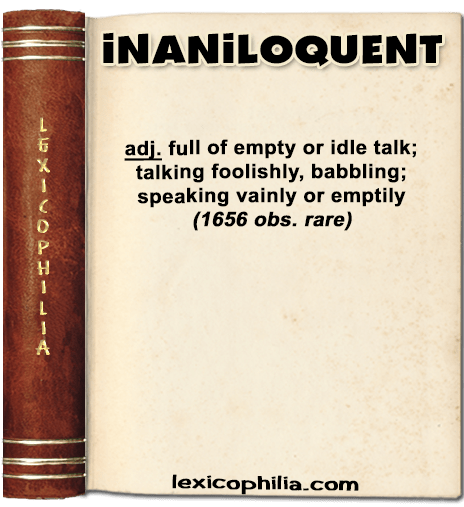
Word of the Day: INANILOQUENT

ETYMOLOGY
from Latin inanis (inane) + loquentem, pres. pple. of loquī (to speak)

EXAMPLE
“…But that is just the beginning. Beginning of the elegantly inaniloquent disassembling of bourgeois literary sensibilities vis-a-vis the text…”

From: The Politics of Style in the Fiction of Balzac, Beckett and Cortazar
By Mark Richard Axelrod, 1992
Beckett’s Metarrhetoric

Word of the Day: SUPERSTITIATE

ETYMOLOGY
from superstiti- + -ate 

EXAMPLE
“…Wherefore I will say to such, as one wiser than Solomon said to the Jews, when they superstitiated the gift, in counting it more honourable than the altar, ‘Ye fools, and blind, for whether is greater, the gift, or the altar that sanctifieth the gift?…”

From: The Saints’ Privilege and Profit
Or, The Throne of Grace
By John Bunyan, a1688