Word of the Day: DESINENT


ETYMOLOGY
from Latin desinentem, present participle of desinere (to leave off, close),
from de- + sinere (to leave)


EXAMPLE
“… In front of this sea were placed six tritons, in moving and sprightly actions, their upper parts human, save that their hairs were blue, as partaking of the sea-color: their desinent parts fish,  mounted above their heads, and all varied in disposition. From their backs were borne out certain light pieces of taffata, as if carried by the wind, and their music made out of wreathed
shells…”

From: The Masque of Blackness in Characters Two Royall Masques
By Benjamin Jonson, 1608
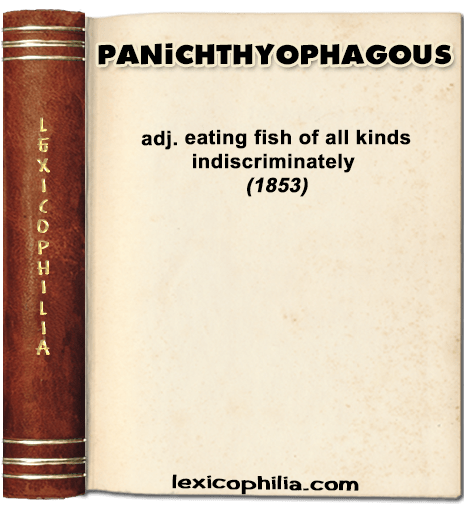
Word of the Day: PANICHTHYOPHAGOUS


ETYMOLOGY
from Greek πᾶν, pan, (“all”, “of everything”, “involving all members” of a group)
+ from Latin ichthyophagus,
from Greek ἴχθυοϕάγος  from Greek ἰχθυο- (fish-) + -ϕάγος (eating),
from ϕαγεῖν (to eat) + -ous


EXAMPLE
“…The caranx, trachurus, or bastard mackerel, probably corresponds with the individual so called by Oppian and Athenaeus. It abounds in the Mediterranean, and is a dry coarse fish, fit only for hungry boatmen and panichthyophagous puss…”

From: Fraser’s Magazine for Town and Country
Volume 47, March 1853
The Caranx

Word of the Day: FLANTITANTING


ETYMOLOGY
a reduplicated formation on flanting (flaunting)


EXAMPLE
“…An old Doctor of Oxford shewd me Latine verses of his in that flourishing flantitanting goutie Omega fist, which he presented unto him (as a bribe) to get leave to playe, whe hee was in the heighth or prime of his Puer es cupis atque doceri…”

From: Have with You to Saffron-Walden Or, Gabriell Harveys Hunt is Up
By Thomas Nashe, 1596

Word of the Day: RHONCHISONANT


ETYMOLOGY
from Latin rhonchus (a snoring) + sonans, p. pr. of sonare (to sound)


EXAMPLE
“…Out marches the paleontologist Collett,
And with his little hammer
And scientific grammar
First knocks a mammoth tooth,
To put into his grip-sack;
Then constructs an awful name
By means of which to skip back
With a great rhonchisonant fury, on
The epochs carboniferous and Silurian…”

From: Biographical and Historical Record of Vermillion County, Indiana, 1888

Word of the Day: TOBACCONALIAN


ETYMOLOGY
from tobacco, after bacchanalian


EXAMPLE
“…As we passed on, the number of promenaders increased, but scarcely a lady was now to be seen. Every other gentleman we met was enveloped in a cloud, not of bacchanalian, but tobacconalian incense, which gave a peculiar atmosphere to the Levee…”

From: The South-West
By Joseph Holt Ingraham, 1835

Word of the Day: SPLENDICANT


ETYMOLOGY
from present pple. of Latin splendicare to shine


EXAMPLE
“…and yet cast into a curious desire to vnderstand and knowe what should be the reason and cause that the purple humiditie in the touch of hir bodie, in the smoothnes of hir hand should be as white as pure milke: and by what meanes that nature had bestowed in hir faire bodie the fragrant sweetnes of Arabia. And by what industrie in hir starrie forehead pampynulated with threds of gold aptly disposed, she had infixed the fairest part of the heauens, or the splendycant Heraclea…”

From: Hypnerotomachia: The Strife of Loue in a Dreame
By Francesco Colonna
Translated by Robert Dallington, 1592

Word of the Day: CLAPPER-TONGUE


ETYMOLOGY
from clapper (the tongue of a bell; a talkative person’s tongue) + tongue


EXAMPLE
“…She has an e’e, she has but ane,
The cat has twa the very colour;
Five rusty teeth, forbye a stump,
A clapper tongue wad deave a miller:
A whiskin beard about her mou’,
Her nose and chin they threaten ither;
Sic a wife as Willie had,
I wadna gie a button for her!…”

From: The Scots Musical Museum
By James Johnson, 1792
Sic A Wife as Willie had – Robert Burns

Word of the Day: SUSPECTUOUS


ETYMOLOGY
from Latin suspectus (u-stem) (suspect n.) + -ous


EXAMPLE
“…I thynke as our Cytezens be suspectuous and full of coniectoures; so dyd hee feare the comodyte of the place, and woulde eschewe the occasyon …”

From: The goodli history of the moste noble and beautyfull Ladye Lucres of Scene in Tuskane, and of her louer Eurialus verye pleasaunt and delectablevnto ye reder
By Pope Pius II, 1553