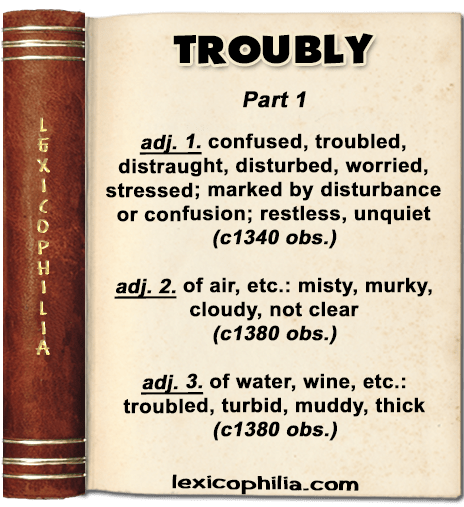
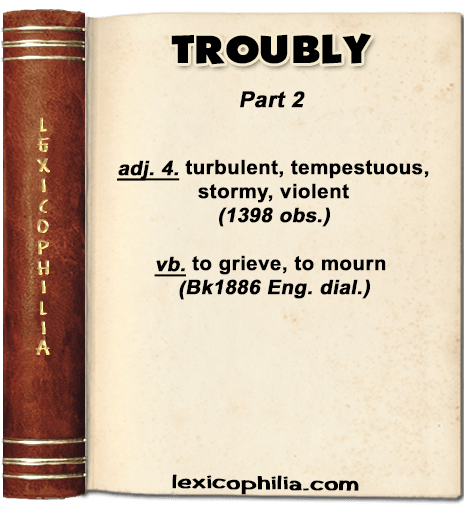
Word of the Day: TROUBLY

ETYMOLOGY
from trouble (n.) + -y or -ly 

EXAMPLE (for adj. 1.)
“…Mvsyng vpon the restles bisynesse
Which that this troubly world hath ay on honde,
That othir thyng than fruyt of byttirnesse
Ne yeldeth nought, as I can vndirstonde,
At Chestre ynnë, right fast be the stronde,
As I lay in my bed vp-on a nyght,
Thought me bereft of sleep with force and myght
…”

From: De Regimine Principum (The Governance of Kings and Princes)
By Thomas Hoccleve. c1412

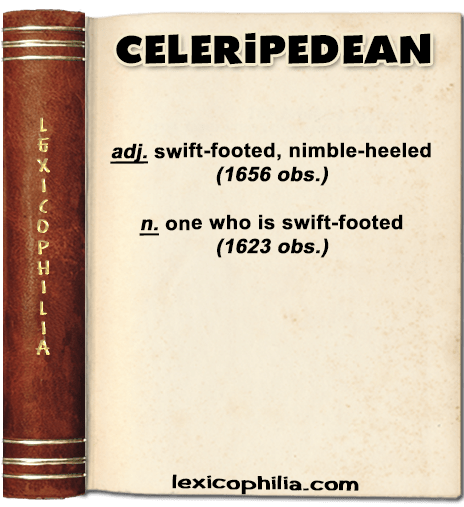
Word of the Day: CELERIPEDEAN

ETYMOLOGY
from Latin celeripedem (swift-footed),
(from celer (swift) + pedem (foot)) + -ean

EXAMPLE
“…with a decutient shrug of his stooped shoulders, as tho to desarcinate himself of funebrous thoughts, departed at a pace very different from the celeripedean gait of pristine years …”

From: American Speech, Volume 2
Edited by Arthur Garfield Kennedy, Kemp Malone, Louise Pound, William Cabell Greet, 1927

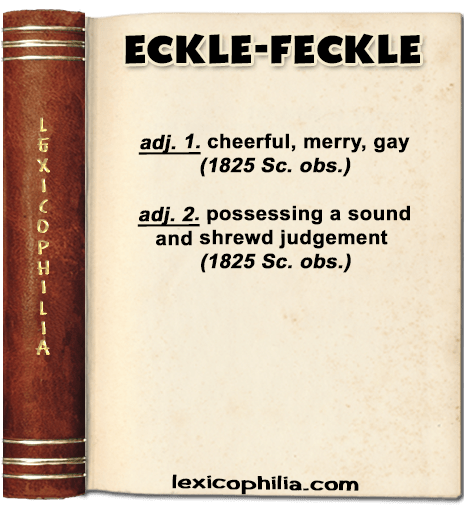
Word of the Day: ECKLE-FECKLE

ETYMOLOGY
of obscure origin;
perhaps allied to eekfow (blithe, having an affable demeanour)

EXAMPLE
“…I ne’er weas ca’ad a crankous kimmer,
A crabbed, craiken, crack-brained limmer.
Auld grannie ay was eckle feckle
Nor hogry mogry, nor kenspeckle –
Ay ready for a couthie clacky,
A pint o’ yill, a bit o’ baccy
…”

From: Willie Wabster’s Wooing and Wedding on the Braes of Angus
By Dorothea M. Ogilvy, Julia O. Robertson, 1873

Word of the Day: QUILLER

ETYMOLOGY
n. 1. : from quill (a small pipe or tube)  + -er
n. 2. : from quill (to form into small cylindrical plaits or folds resembling a quill) + -er

EXAMPLE
“…Epi. O sir your chinne is but a quyller yet, you will be most maiesticall when it is full fledge. But I maruell that you loue Dipsas that olde Crone…”

From: Endimion, The Man in the Moone
By John Lyly, 1591

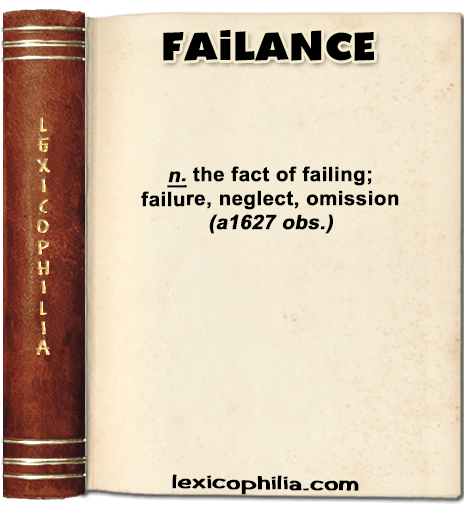
Word of the Day: FAILANCE

ETYMOLOGY
from Old French faillance, from faillir (to almost do something, to fail)

EXAMPLE
“…but when you come to Exercise the whole company ioyned, you may at some times for your owne satissaction in the more ready & gracefull performance of them, command the Postures to bee done by the whole number at once, with such pawse betweene euery Posture, as may afford you meanes to discerne any faylance therein: but whensoeuer you skirmish you shall vse no more of direction then,
1. Make Ready.2. Present.3. Giue Fyre
…”

From: The Compleat Gentleman, fashioning him absolute in the most necessary & commendable qualities concerning minde or bodie that may be required in a noble gentleman
By Henry Peacham, 1627

Word of the Day: HAND-WHILE

ETYMOLOGY
Middle English, from Old English handhwīl, 
from handhond (hand) + hwīl (while);
originally alluding to the short span of a handbreadth

EXAMPLE
“…Thou semste (quoth the spider) a costerde monger.
Conscience euery handwhile thou doste cry.
I muste (quoth the flie) se sum token stronger.
Ere I can suppose you of that mistery.
I call not for conscience more comonly.
Then you speake of it seelde, flie I tolde the erste.
Cause why: that conscience at laste ende shulde be perste
…”

From: The Spider and the Flie
A Parable of the Spider and the Flie
By John Heywood, 1556