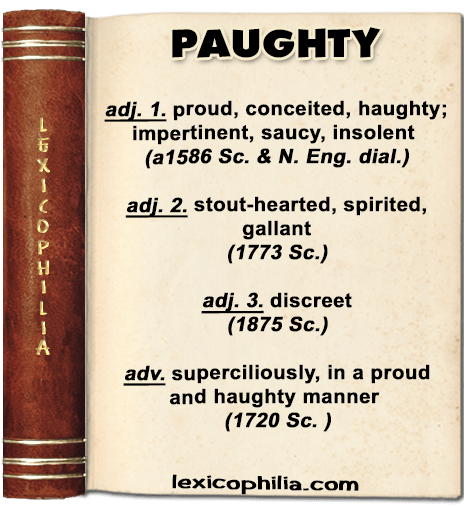
ETYMOLOGY
of unknown origin
EXAMPLE
“…With hart and mynd I luif humilitie
And pauchtie pryde richt sair I do detest…”
From: Maitland Folio Manuscript a1586
Edited by Sir William Alexander Craigie, 1919
ETYMOLOGY
of unknown origin
EXAMPLE
“…With hart and mynd I luif humilitie
And pauchtie pryde richt sair I do detest…”
From: Maitland Folio Manuscript a1586
Edited by Sir William Alexander Craigie, 1919

ETYMOLOGY
from Latin librārius (concerned with books) + -ous
EXAMPLE
“…Garniston. Exactly, This is the illustration and the measure of what you rightly consider our progress in this matter. The acted Shakespearian drama, now attracts crowds of studious people.
Warnford. Or librarious people, at any rate. I don’t say it isn’t the same thing: only I prefer my own word…”
From: MacMillan’s Magazine
Vol. L, May 1884, to October
The Consolations of Pessimism: A Dialogue

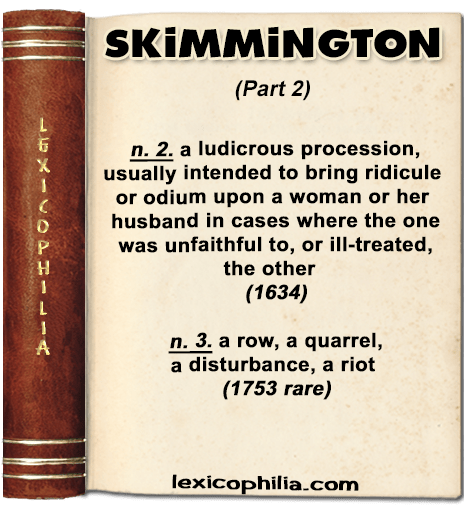
ETYMOLOGY
possibly from skimming + -ton as in simpleton, with the object of simulating a personal name
EXAMPLE
“…And then, if they meere with such dull Lubbers as these Drones are; they may may with lesse blame borrow a point of the Law, and enjoy their longing. Yet when they haue it, let them vse poore Skimmington as gently as they may especially in publike, to hide his shame…”
From: The Feminine Monarchie,
Or the Historie of Bees
By Charles Butler, 1623

ETYMOLOGY
from what (pronoun, adj., & adv.), after whereabout(s
EXAMPLE
“…I wish you were as much in intercourse with the Colonial Office as with the Treasury, for then you might know all of my goings on, and whatabouts and whereabouts from Henry Taylor…”
From: Selections from the Letters of Robert Southey
By Robert Southey, a1843
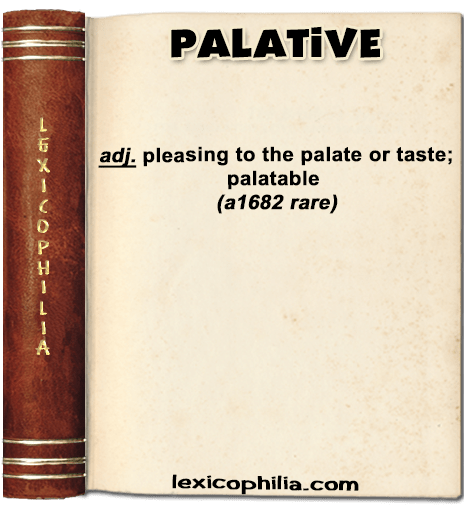
ETYMOLOGY
from Latin palātum palate + -ive
EXAMPLE
“…Punish not thy self with Pleasure; Glut not thy sense with palative Delights; nor revenge the contempt of Temperance by the penalty of Satiety…”
From: Christian Morals
By Sir Thomas Browne, a1682
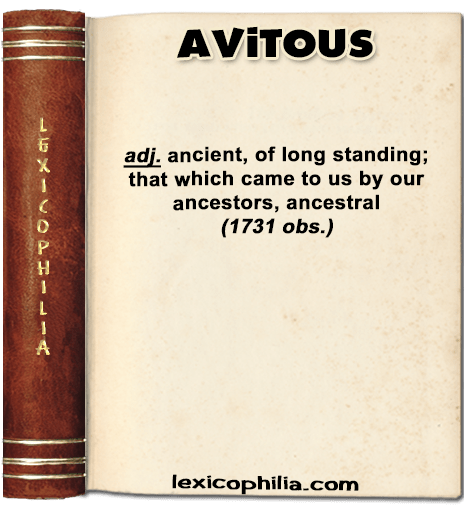
ETYMOLOGY
from Latin avītus of or pertaining to the avus (grandfather) + -ous
EXAMPLE
“…Being a leucothiop, he was not even a mediocrist, but a mere polypragmatical hafter or barrator. His inscience of avitous justicements, and of lexicology, his perissology and battology, imparted to his tractation of his cause, an imperspecuity which rendered it immomentous to the juratory audients…”
From: Letters to Squire Pedant in the East
Letter No. IX, 1843
By Lorenzo Altisonant (pseudonym Samuel Klinefelter Hoshour),
an Emigrant to the West, 1856
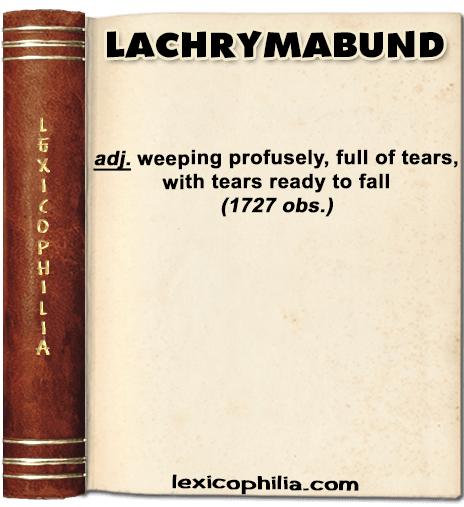
ETYMOLOGY
from Latin lacrimābundus (weeping, in tears),
from lacrimāre (to shed tears) + -bundus
EXAMPLE
“…that I must soon inevitably succumb, unless you most charitably applicate the balsamic lenitives of complyance to your most agonized,
and lachrymabund slave,
TIMOTHY BLUNDERBUSS…”
From: The Adventures of Jerry Buck
By John Slade, 1754

ETYMOLOGY
from Latin fluctisonus; fluctus (wave) + sonus (sound)
EXAMPLE
“…Flash! White raw human waves make a fluctisonous roar!…”
From: G Day, Please God, Get Me Off the Hook
By Neil Baker, 2010

ETYMOLOGY
from Greek λόγος (logos) (word)
EXAMPLE
“…by the various ravishments of the excellencies whereof, in the frolickness of a jocound straine beyond expectation, the logofascinated spirits of the beholding hearers and auricularie spectators, were so on a sudden seazed upon in their risible faculties of the soul…”
From: Εκσκυβαλαυρον (Ekskybalauron);
Or, The Discovery of a Most Exquisite Jewel, More Precious Then Diamonds Inchased in Gold
By Thomas Urquhart, 1652
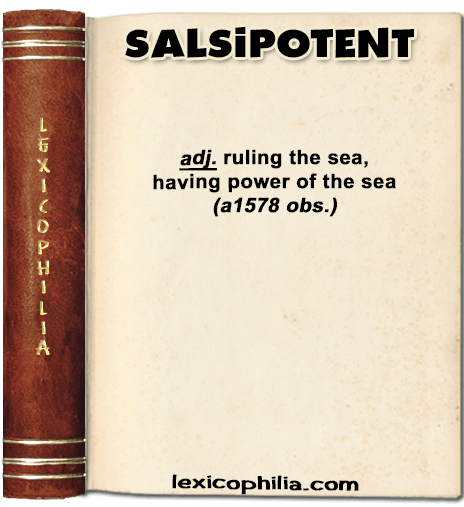
ETYMOLOGY
from Latin salsipotentem, a false reading for salipotentem,
from salum (salt water) + potentem (having great authority or influence)
EXAMPLE
“…whearunto he made hiz fish to swim the swifter, and hy then declared: how the supream salsipotent Monarch Neptune, the great God of the swelling Seaz, Prins of profunditees, and Soouerain Segnior of all Lakez, freshwaterz, Riuerz, Créekes, and Goolphs…”
From: A Letter whearin part of the Entertainment vntoo the Queenz Maiesty at Killingwoorth Castl in Warwik Sheer
By William Patten, a1578
 Lexicophilia