Word of the Day: QUAERITATE

ETYMOLOGY
from Latin quaeritāre (to search for, to seek, to ask,
from quaerere (to ask, inquire) + –itare (-itate)

EXAMPLE
“…for Carpenters seeke to the Trunk of its Tree; Dyers to its barke; Boyes to its fruit; Apothecaryes quaeritate its Medicinall use, which Mithridates knew…”

From: A Medicinal Dispensatory:
Containing the Whole Body of Physick
By Jean de Renou
Translated by Richard Tomlinson, 1657

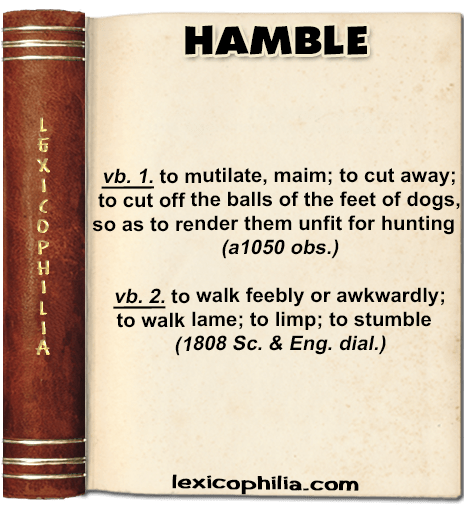
Word of the Day: HAMBLE

ETYMOLOGY
from Old English hamelian (to mutilate);
from an adjective appearing on Old High German as hamal (maimed, mutilated), whence mod.German hammel (a castrated sheep)

EXAMPLE
“…sume hi man bende, sume hi man blende,
sume man hamelode and sume heanlice hattode
…”

(…Some did they bind, some did they blind,
Some did they hamstring, some did they scalp
…)

From: The Anglo-Saxon Chronicle

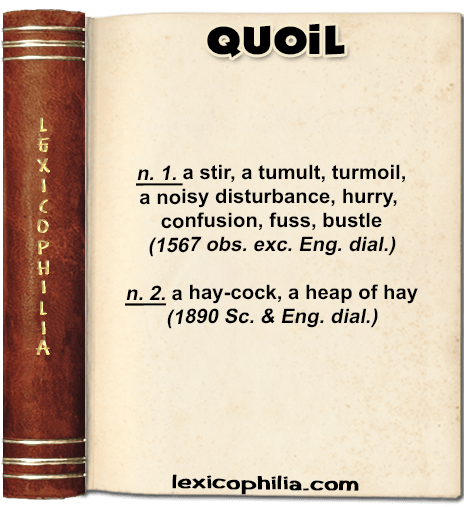
Word of the Day: QUOIL

ETYMOLOGY
obsolete or dialect form of ‘coil

EXAMPLE
“…I haue seene them, which haue seene such hurly burlies about a couple (that were no Fathers of the Church neither) Aristotle and Ramus, or els sake the Vniuersities, such a quoil with pro and con, such vrging of Ergoes, til they haue gone from Art togither by the eares, and made their conclusions end with a Clunchfist, right like the old description of Logicke…”

From: Plaine Perceuall, the Peace-maker of England
By Richard Harvey, 1590

Word of the Day: GABBERIES

ETYMOLOGY
from French gaberie (mockery, jest, deceit)

EXAMPLE
“…Those high-priced, verbose air- beaters, who think their gabberies are the centers of gravity for the entire universe, ought to be sent away back to sit down until they can learn to stand by the pledges in the platform of their party …”

From: The Literary Digest
Volume XXVI, March 1903
Territorial Press on Statehood Failure