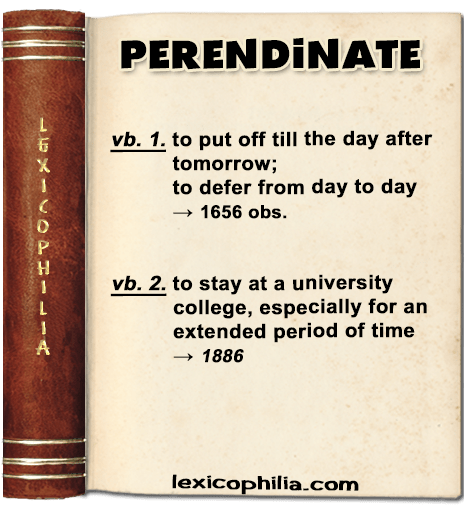
Word of the Day: PERENDINATE

ETYMOLOGY
from Latin perendinat-, past participial stem of perendinare (to defer until the day after tomorrow, to postone for a day) from perendinus ((the day) after to-morrow), from perendie (on the day after to-morrow) + -inus, or from peren- + din- (day)

EXAMPLE (for vb. 1.)
The chairman of the board perendinated the meeting so that all members would be able to attend.
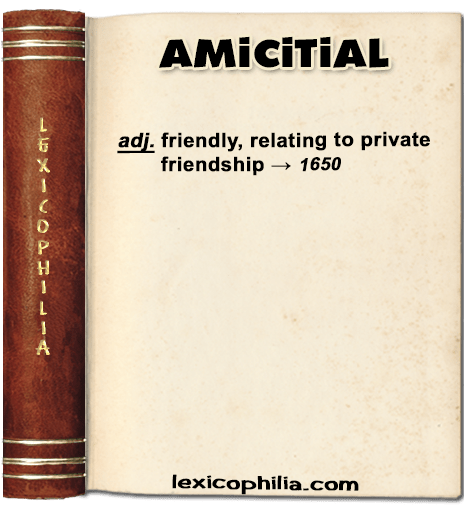
Word of the Day: AMICITIAL

ETYMOLOGY
from Latin amicitia (friendship), (from amicus (friend)) + -al

EXAMPLE
“… What M. Ellis denyeth to be the question.
1. He saith it is not meant of the essential onenesse.
Answ. But this is meant, and is the foundation of the other.
2. It is not (saith he) meant of engagement to mutual care one of another.
Answ. Not
amicitial or fraternal only, but authoritative, the greater part to regulate the lesse. …”

From: A Vindication of the Essence and Unity of the Church Catholike Visible, and the priority thereof in regard of particular churches in answer to the objections made against it
By Samuel Hudson, 1650

PRONUNCIATION
am-uh-SISH-uhl

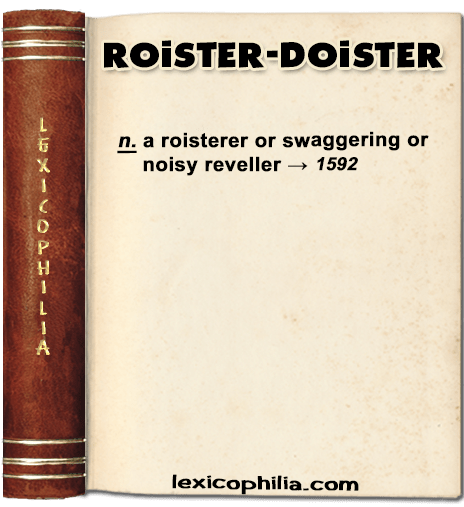
Word of the Day: ROISTER-DOISTER

ETYMOLOGY
from the name of the chief character (Ralph Royster Doyster) in Nicholas Udall’s comic play, based upon roister (a boisterous or noisy reveller), written about 1533

EXAMPLE
“… The terriblest tearmes may be repayed-home with aduauntage: I haue knowen the raylingest Sophister in an Vniuersity, sett non plus: and haue seene the mad-braynest Roister-doister in a countrey, dashte out of countenaunce. …”

From: Foure Letters, and Certaine Sonnets especially touching Robert Greene, and other parties, by him abused
By Gabriel Harvey, 1592

Word of the Day: VECTITORY

ETYMOLOGY
from Latin vectitare freq. of vectare (to carry, convey)

EXAMPLE
“… Heaven forbid that, in this country, which enjoys the blessing of a regular Government, the bodies of Turks should be applied to vectitory purposes, but I can assure you that, with a party of my friends, I lately sailed to Richmond on a kepper-salmon and a flitch of Wiltshire bacon, which formed an admirable raft. …”

From: The Examiner
A Sunday Paper, on Politics, Domestic Economy, and Theatricals, for the Year 1822
To the Editor of The Traveller, Whitchall, Jan 1, 1822

Word of the Day: WOOL-BIRD

ETYMOLOGY
from wool + bird (the offspring or young of animals, obs.)

EXAMPLE
“… With all the natural timidity of the hare whom he thus particularised, I was proceeding to help him, when Echo inquired if he should send me the breast of a swiss; and the facetious Eglantine, to increase my confusion, requested to be allowed to cut me a slice off the wing of a wool bird. …”

(Note: swiss = a pheasant)

From: The English Spy: an original work, characteristic, satirical and humorous, comprising scenes and sketches in every rank of society
By Charles Molloy Westmacott, 1825

Word of the Day: COCTURE

ETYMOLOGY
from Latin coctura (a cooking)

EXAMPLE
“… For truly, whatsoever is cast into the stomack, digestion being at length finished, is transchanged, and far separated from boyling and other
coctures, after whatsoever degree prepared. …”

From: Oriatrike or, Physike Refined
By Jean Baptiste van Helmont
Translated by John Chandler, 1662

Word of the Day: VILIPENDIOUS

ETYMOLOGY
from vilipend (vb.) + -ious;
from French vilipender, or from Latin vilipendere, from vilis (vile, worthless) + pendere (to consider, esteem)

EXAMPLE
“… And thou ignoble horse-rubbing peasant, that by the borrowed title of a Lord (being but a vilipendious mechanicall Hostler, hast laid this insulting insupportable command on me: the time shall come, when thou shalt cast thy anticke authority, as a snake casts her skin; and then thou for an example to future posterities shalt make an vnsauory period of thy maleuolent dayes in litter and horse-dongue …”

From: All the vvorkes of Iohn Taylor the water-poet Beeing sixty and three in number
By John Taylor, 1630

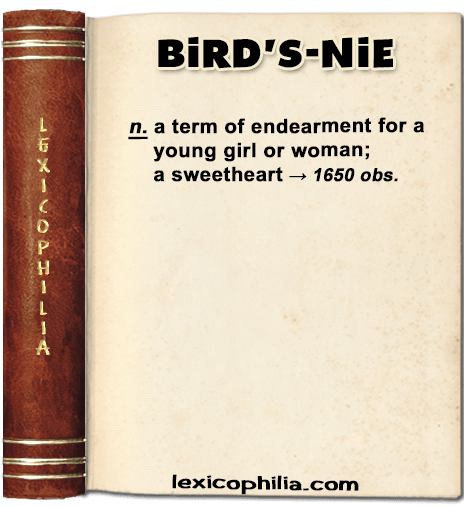
Word of the Day: BIRD’S-NIE

ETYMOLOGY
from the genitive of bird + nye for eye, as in my nye = myn eye;
possibly an alteration of pigsney (a sweetheart, a term of endearment)

EXAMPLE
“… Oh Mistris May, come to bed Sweet-heart come, my Duck, my Birds-nye; Zblood, I must goe to Salisbury to morrow, bring me my Boots quickly; Zounds, will not the Rogues bring me more Money; Zblood, that Cock’s worth a Kings Ransome, a runs, a runs, a thousand pound to a Hobby-horse; Rub, Rub, Rub, a pox Rub a whole hundred Rubs; …”

From: The last vvill and testament of Philip Herbert, burgesse for Bark-shire, 1650

Word of the Day: SWONG

ETYMOLOGY
from Old Norse svangr, related to svangi (swange,  groin), from swaŋgw-, perhaps identical with swaŋgw-, grade-variant of swiŋgw- (to swing – to scourge, whip, flog, beat)

EXAMPLE
“… Þe hungri in god he made stronge,
And þe riche he lette al
swonge.
Þe folk of Israel haþ vndurfonge
Þe child þat heo abide longe; …”

From: The minor poems of the Vernon MS
Published for the Early English Text Society, 1892-1901
La estorie del Euangelie, a1300

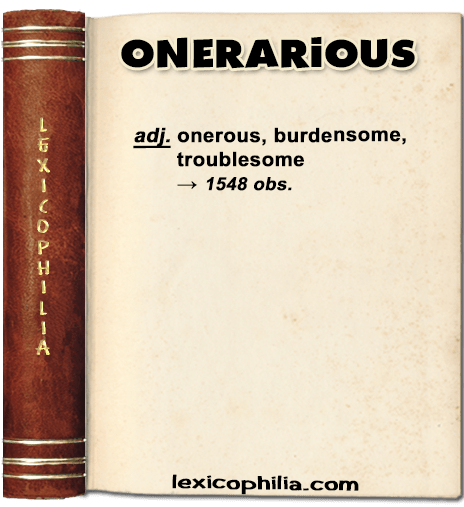
Word of the Day: ONERARIOUS

ETYMOLOGY
from Latin onerarius (suitable for carrying a burden or cargo) + -ous

EXAMPLE
“… For that he emongest all gouernors, chiefly did remembre that a kyng ought to bee a ruler with wit, grauitie, circumspeccion, diligence and constancie, and for that cause to haue a rule to hym comitted, not for an honor, but for an onorarious charge and daily burden, and not to looke so muche on other mennes liuynges, as to consider and remembre his owne doynges and propre actes. …”

From: The vnion of the two noble and illustrate famelies of Lancastre [and] Yorke 
By: Edward Hall, 1548