Word of the Day: JENTACULAR

ETYMOLOGY
from Latin ientaculum (breakfast); (from ientare (to breakfast)) + -ar

EXAMPLE
“… I wonder that you did not, under this head, acquaint us with that wise injunction, which you have caused to be promulgated within your dominions, against the consumption of tea and coffee; a fashionable vice, which tends only to squandring away money, and mispending the morning, since (as you once ingeniously express’d it) nothing more can be expected from those jentacular confabulations. …”

From: Terræ-filius; or, the secret history of the University of Oxford
By Nicholas Amhurst, 1721
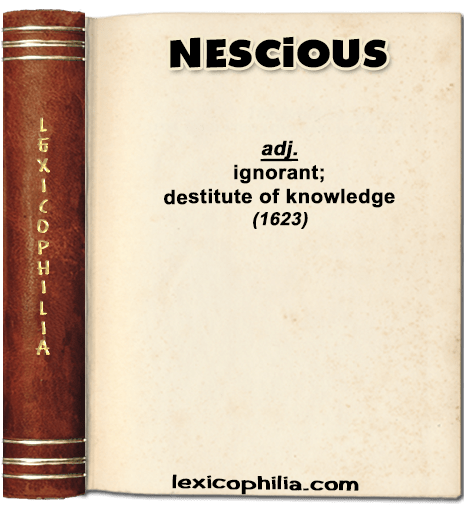
Word of the Day: NESCIOUS

ETYMOLOGY
from Latin nescius (ignorant, not knowing),
from nescire (to be ignorant, not to know) + -ous

EXAMPLE
“… The third cause of the decay of Trade, in Malynes accompt, are Litigious Law-suits. To the Efficiency whereof, Malynes cannot altogether agree, but rather to the Remedie. But I shall willingly pardon him that: for he that is so ignorant in the Essentiall causes, must needs be nescious in the Efficients also. I would there were no cause, for their sakes whose case it is, to dispute this Causalitie. …”

From: The Circle of Commerce.
Or The ballance of trade in defence of free trade: opposed to Malynes little fish and his great whale, and poized against them in the scale. 
By Edward Misselden, 1623

Word of the Day: RUMBUSTICAL

ETYMOLOGY
possibly an alteration of rumbustious (boisterous, unruly);
or perhaps an alteration of obsolete English robustic (robust, robustious), 
from robust + -ic + -al

EXAMPLE
“… I will, your worship: but I am glad his honour, the Major, is not to be jocum tenus for your worship, he’s so much upon the roguish order with the women, now and ten. I did not care to mention it to your worship before; but as true as I’m alive he was a little rombustical to our Bridget, no longer ago than last Sunday was se’night, as she was coming home from church. …”

From: The Flitch of Bacon; a comic opera
By Henry Bate Dudley, 1779

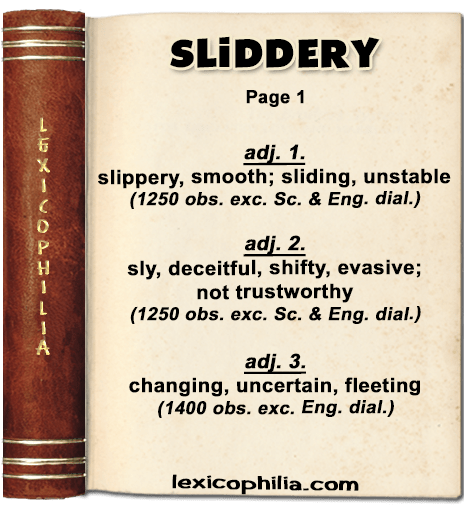
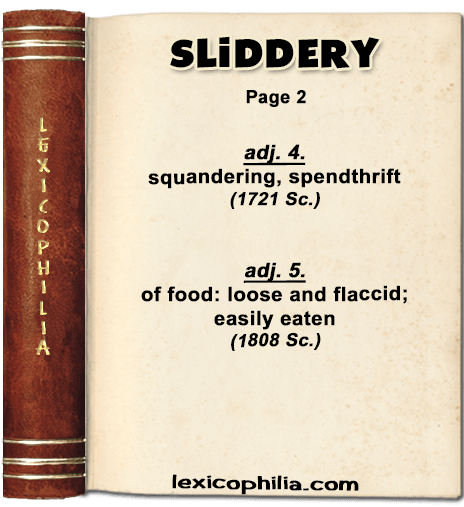
Word of the Day: SLIDDERY

ETYMOLOGY
from slidder (to slide, to slip) + -y

EXAMPLE (for adj. 3)
“… Full slyddrie is the sait that thay on sit,
And for thair fault till Hell sune sall thay flit,
For suddanlie thay sall die with mischeif,
Thair distructioun salbe without releif.
…”

From: A compendious book of godly and spiritual songs : commonly known as ‘The gude and godlie ballatis’
By John Wedderburn , Robert Wedderburn
Reprinted from the edition of 1567
Edited by Alexander Ferrier Mitchell, 1897
Quam bonus Deus Israell. Psal. lxxiij

Word of the Day: LIP-LICK

ETYMOLOGY
from lip + lick

EXAMPLE
“… Thee gay boy kindlye playing, thee knowne lads phisnomye taking:
That when Queene Dido shal col the, and smacklye bebasse thee,
When quaffing wynebols, when bancquets deyntye be serued,
When she shal embrace thee, when
lyplicks sweetlye she fastneth;
That then thow be suer, too plant thy poysoned hoat looue.
…”

From: Thee first foure bookes of Virgil his Aeneis
Translated intoo English heroical verse by Richard Stanyhurst, 1582

Word of the Day: TIRELING

ETYMOLOGY
apparently from tire (to diminish, give out, come to an end, obs.) + -ling

EXAMPLE
“… So as they gazed after her a while,
Lo where a griesly Foster forth did rush,
Breathing out beastly lust her to defile:
His
tyreling iade he fiercely forth did push,
Through thicke and thin, both ouer banke and bush
In hope her to attaine by hooke or crooke,
That from his gorie sides the bloud did gush:
Large were his limbes, and terrible his looke,
And in his clownish hand a sharp bore speare he shooke.
…”

From: The Faerie Queene
By Edmund Spenser, 1590

Word of the Day: OMNINESCIENT

ETYMOLOGY
from omni- combining form of Latin omnis (all) + nescient from Latin nescientem
pres. pple. of nescire (to be ignorant), from ne (not) + scire (to know)

EXAMPLE
“… The appeal is generally from those who know something to those who know less – and at last to those who are omni-nescient. …”

From: A Report of Proceedings at a Public Meeting of the Merchants, Bankers, and Traders of the City of London, held at the London Tavern, on Wednesday, Dec. 3, 1851
For a Reform of the Board of Customs
Part II. Chapter II. Appeals

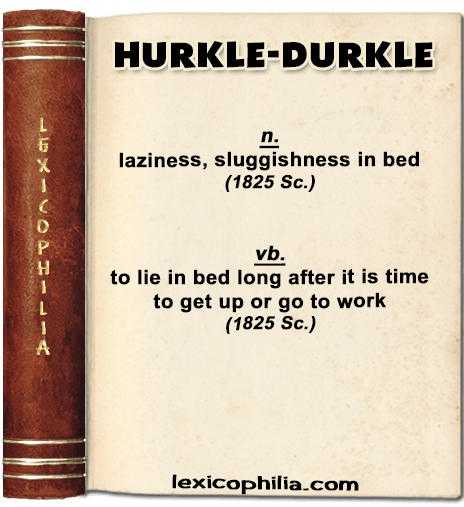
Word of the Day: HURKLE-DURKLE

ETYMOLOGY
from hurkle (to crouch, to stoop, to squat down)

EXAMPLE
“… Lang after peeping greke o’day,
In Hurkle Durkle Habbie lay,
Gae tae yer wark, ye dernan murkle,
And ly nae there in Hurkle Durkle. …”

Note: the phrase ‘in hurkle durkle‘ = in indolence

From: Supplement to the Etymological Dictionary of the Scottish Language
By John Jamieson, 1825

Word of the Day: JOCOCIOUS

ETYMOLOGY
compound of jocose and facetious

EXAMPLE
“… “Yes, you have, you saucy baggage, and I will have them again from your ruddy lips,” at the same time smacking them with great glee. The girl was glad to find the ‘squire so jococious, and particularly too, as he gave her a shilling, and a chuck under the chin. …”

From: The Child of Providence
Or, The Noble Orphan, A Novel
By Miss H. L. Porter, 1820