Word of the Day

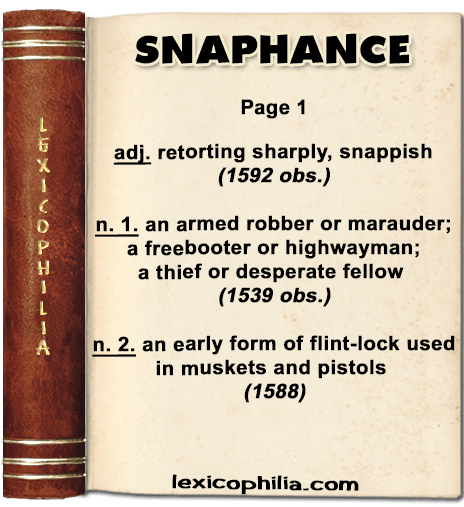
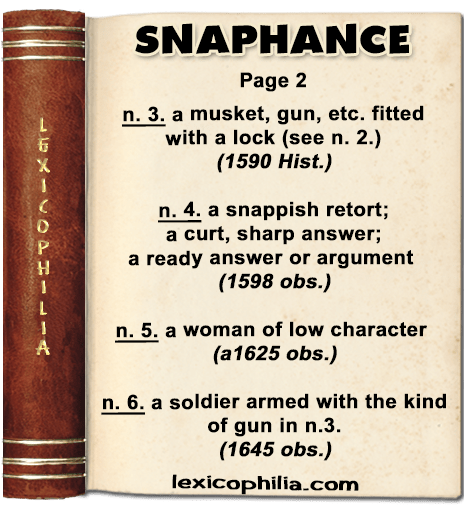
Word of the Day: SNAPHANCE

ETYMOLOGY
From OED: Of Continental origin, representing Dutch and Flemish snaphaan (in Kilian snap-haen ), Middle Low German snaphân , Low German snapphân , German schnapphahn (†-han ),
from snappen , schnappen (snap v.) + haan, hahn (cock).
It is not quite clear whether the sense is ‘snapping cock’ or ‘cock-snapper’ (i.e. cock-stealer).
In English the second element may have been confused with the personal name Hans; but Heyne (in Grimm’s Dict.) cites an early example of German schnaphons.

EXAMPLE
“…Fyrste to make this realme a praye to al venturers, al spoylers, all snaphanses, all forlornehopes, all cormerauntes, all rauenours of the worlde, that wyll inuade this realme…”

From: A Sermon of Cuthbert Tonstall, Bishop of Durham,
Preached on Palm Sunday, 1539, Before King Henry VIII;
By Cuthbert Tunstall
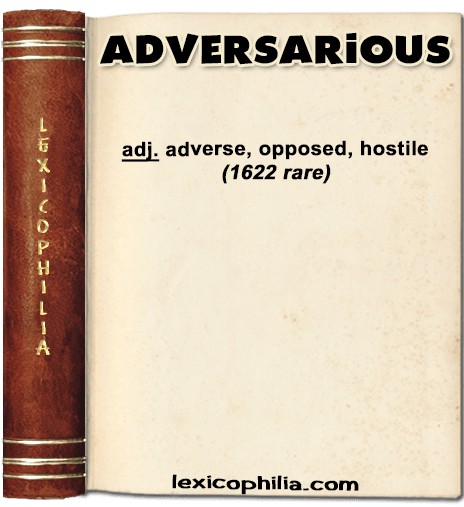
Word of the Day: ADVERSARIOUS

ETYMOLOGY
from Latin adversarius (opposed, hostile, adverse, harmful, injurious) + -ous

EXAMPLE
“…This resisting and aduersarious Empire, while it fought against Christ it serued Christ, while it killed his Church it increased his Church, and while it fought against Religion, it became a meanes to spread and inlarge it…”

From: Diseases of the Time Attended by their Remedies
By Francis Rous, 1622

Word of the Day: PIPPIN-HEARTED

ETYMOLOGY
from pippin, from Anglo-Norman pepinpepinepopin and Middle French pepin (seed or pip of a fleshy fruit), possibly a derivative of a Romance base meaning ‘small’

EXAMPLE
“…and were put under the command of very valiant tailors and man-milliners, who, though on ordinary occasions the meekest, pippin-hearted little men in the world, were very devils at parades and court-martials, when they had cocked hats on their heads, and swords by their sides…”

From: A History of New York,
From the Beginning of the World to the end of the Dutch Dynasty
By Washington Irving, 1809

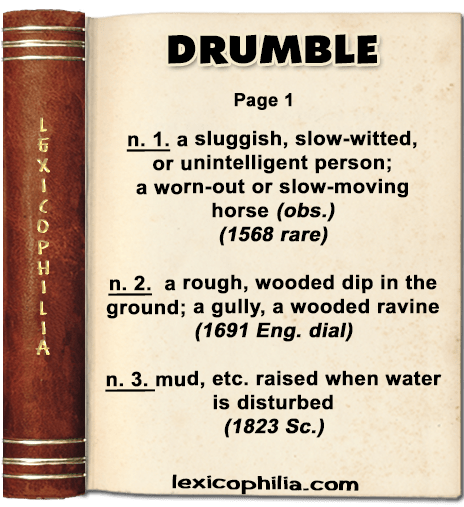
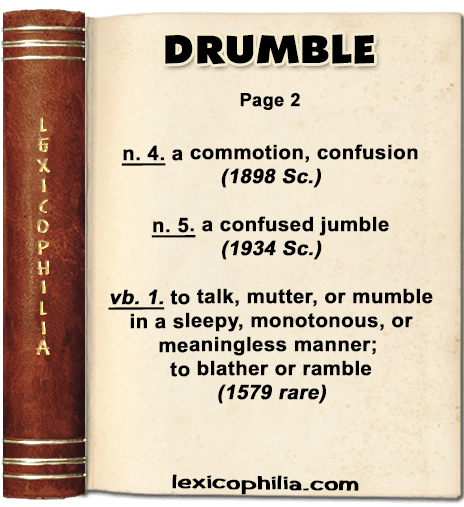
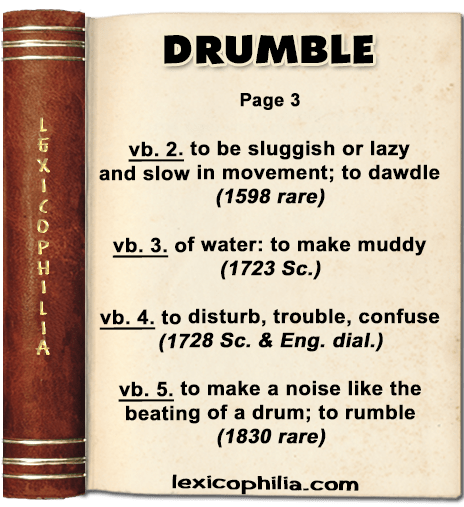
Word of the Day: DRUMBLE

ETYMOLOGY
n. 1.: ? variant of dumbledummel (Eng. dial., a stupid, slow person)

n. 2.: a variant or alteration of dimble (a deep, shady dell, a dingle)

vb. 4.: apparently a nasalized form of drubble (to trouble, disturb), parallel to drumblydrumly (adj.) from drubly; but possibly a back-formation from the adj.

vb. 5.: blend of drum and rumble

EXAMPLE
“…Yea but what am I, a Scholer, or a scholemaister, or els some youth.
A Lawier, a studient or els a countrie cloune
A Brumman, a Baskit maker, or a Baker of Pies,
A flesh or a Fishmonger, or a sower of lies:
A Louse or a louser, a Leeke or a Larke:
A  Dreamer, a Drommell, a fire or a sparke:
A Caitife, a Cutthrote, a creper in corners,
A herbraine, a hangman, or a grafter of horners
…”

(Note: drommell is the earliest variant of drumble)

From: A New Tragicall Comedie of Apius and Virginia
By R.B., 1575

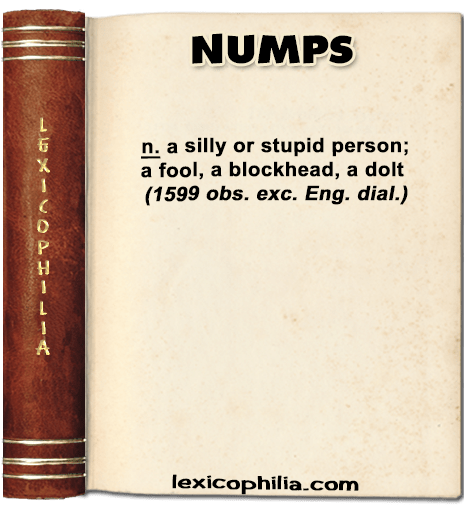
Word of the Day: NUMPS

ETYMOLOGY
of uncertain origin;
From the OED: “Perhaps originally a pet form of the male forename Humphry, as suggested by the context in … examples.”

EXAMPLE
“…to his worthie good patron, Lustie Humfrey, according as the townsmen doo christen him, little Numps, as the Nobilitie and Courtiers do name him, and Honest Humfrey, as all his friends and acquaintance esteeme him…”

From: Lenten Stuffe
By Thomas Nashe, 1599

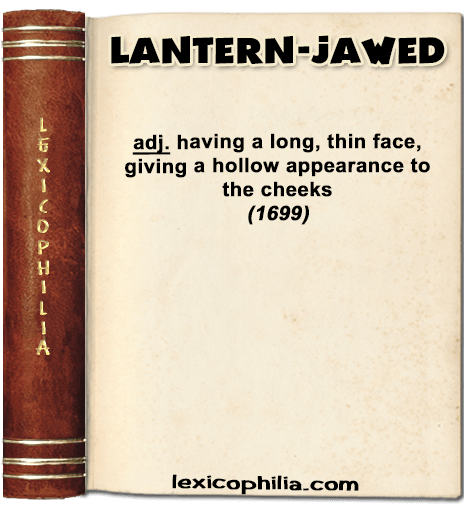
Word of the Day: LANTERN-JAWED

ETYMOLOGY
from the fancied resemblance of the face to the shape of a lantern

EXAMPLE
“…A lanthorn-jaw’d woman, with a hatchet face, sunk eyes, a hook nose, taper lips, leather cheeks, dark Gums, straggling teeth, and such a low forehead, that her hair serves instead of eyebrows…”

From: The Comical Works of Don Francisco de Quevedo
Translated by John Stevens, 1707

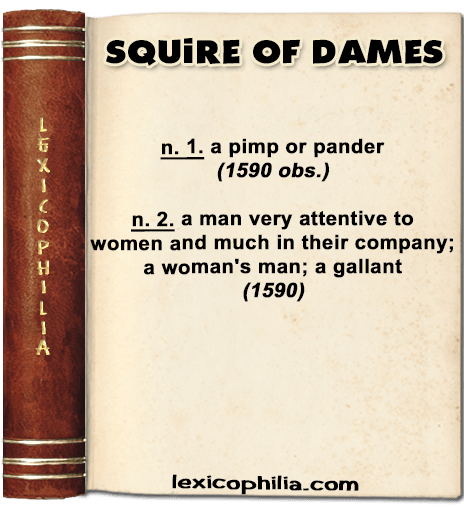
Word of the Day: SQUIRE OF DAMES

ETYMOLOGY
from squire

EXAMPLE
“…Me, silly wretch, she so at vantage caught,
After she long in wait for me did lie,
And meant unto her prison to have brought,
Her loathsome pleasure there to satisfy;
That thousand deaths me lever were to die
Than break the vow that to fair Columbell
I plighted have, and yet keep steadfastly.
As for my name, it mistreth not to tell;
Call me the Squire of Dames, that me beseemeth well
…”

From: The Faerie Queene
By Edmund Spenser, 1590

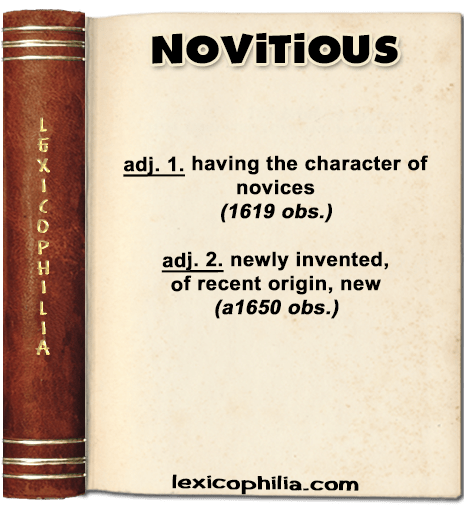
Word of the Day: NOVITIOUS

ETYMOLOGY
from Latin novitius, from novus (new)

EXAMPLE
“…I know many great and ancient families have been subject to eclipses and interruptions, which some mistaking for their primeve original, have erroneously accounted those families mean and novitious which have been truly ancient and ennobled…”

From: The Autobiography and Correspondence of Sir Simonds D’Ewes (a1650)
Edited by James Orchard Halliwell, 1845

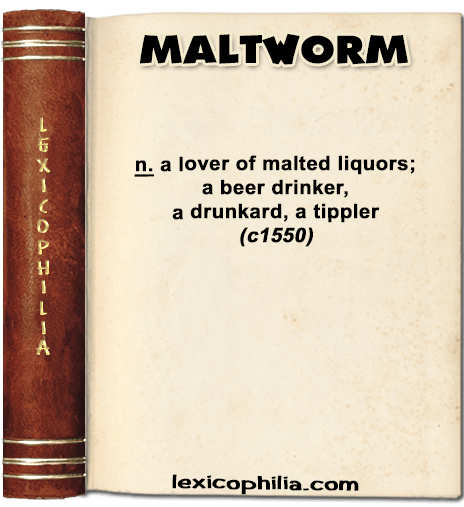
Word of the Day: MALTWORM

ETYMOLOGY
from malt + worm

EXAMPLE
“…And Kytte, my wyfe, that as her lyfe
Lovethe well good ale to seke,
Full ofte drynkythe she that ye maye se
The teares ronne downe her cheke.
Then dothe she troule to me the bolle
As a goode malte-worme sholde,
And say, “Swete harte, I have take my parte
Of joly goode ale and olde
…”

From: The Poetical Works of John Skelton (1843)
Drinking Song (I Cannot Eate But Lytyll Meate)