Word of the Day

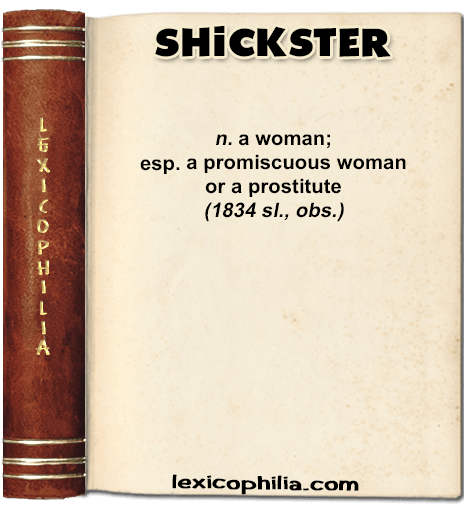
Word of the Day: SHICKSTER

ETYMOLOGY
from shiksa (in Jewish speech, a gentile girl) 

EXAMPLE
“…The Parson is on the highfly in a fantail banger and a milky mill tog. He got the cant of togs from a shickster whose husband’s in a bone-box. He’ll gammon the swells. He touched one for an alderman the first ten minutes…”

From: The Sydney Slang Dictionary, 1880

Word of the Day: ROUNDABOUTATION

ETYMOLOGY
from roundabout (engaging in circumlocution, long-winded)+ -ation

EXAMPLE
“…At dinner fair Adelaide brought up a chicken
A bird that she never had met with before;
But, seeing him, scream’d, and was carried off kicking,
And he bang’d his nob’gainst the opposite door.
To finish my tale without roundaboutation,
Young master and missee besieged their papa;
They sung a quartetto in grand blubberation
The Stranger cried Oh! Mrs. Haller cried Ah!
Though pathos and sentiment largely are dealt in,
I have no good moral to give in exchange
…”

From: Rejected Addresses;
Or, The New Theatrum Poetarum 
– Horatio Smith and James Smith, 1812

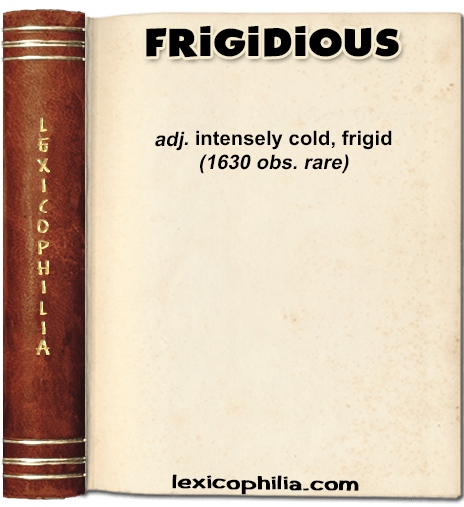
Word of the Day: FRIGIDIOUS

ETYMOLOGY
irregular from frigid + -ious

EXAMPLE
“…Like curelesse cures, past and repast repaire:
Frigidious Ianus two-fold frozen face,
Turnes moyst Aquarius into congeal’d yce:
Though by the fires warme side the pot haue place
…”

From: All the workes of Iohn Taylor the water-poet
Beeing sixty and three in number
Anagrams and Sonnets, 1630

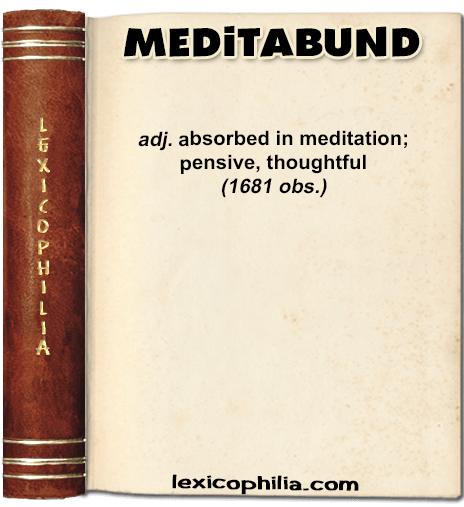
Word of the Day: MEDITABUND

ETYMOLOGY
from Latin meditabundus
from meditari (to meditate) + -bundus (suffix forming verbal adjectives)

EXAMPLE
“…While this he spoke, his Horse he lights off,
And with his Handkerchief he dights off
Tears from his eyes, then on the ground
He grovelling lyes meditabound,
His Horses grievous succussation
Had so excoriat his Foundation,
That till the Hide his Hips did come on,
The earth he could not set his Burn on
…”

From: Mock Poem,
Or, Whiggs Supplication
– Samuel Colvil, 1681

Word of the Day: FANDANGOUS

ETYMOLOGY
from fandangs (fanciful adornments in personal attire, trinkets (Eng. dial.))

EXAMPLE
“…who though a little proud and finical, to be sure he will yaw a parcel of nonsense about jukes and lords, and them sort of fandangus trumpery, and puts a parcel of gibberish whims into the head of all the women he falls in with…”

From: The Beggar Girl and Her Benefactors
– Agnes Maria Bennett, 1797

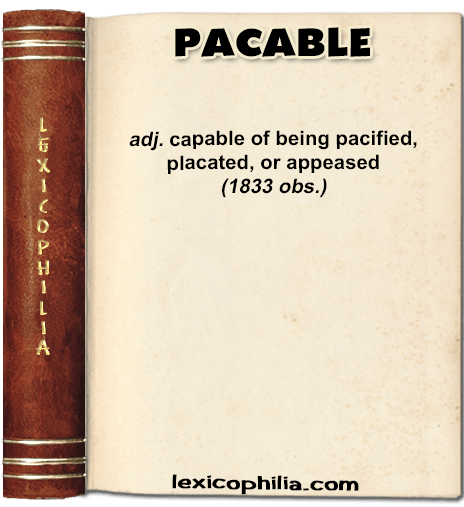
Word of the Day: PACABLE

ETYMOLOGY
from Latin pacabilis (placable),
from pacare (to appease, pacify) + -bilis (-ble)

EXAMPLE
“…Divil a worse, sir, yet not more now than ever. – Time immemorial, – wasn’t it always so? a house burned here, and a pacable tinant carded there; one villain murthering another, for teeking land over his head…”

From: Dramatic Scenes from Real Life
Manor Sackville
by Lady Sydney Morgan, 1833

Word of the Day: QUALTAGH


ETYMOLOGY
from Manx quaaltaghqualtagh (the first person one meets after leaving the house, the first person one meets on New Year’s Day, literally ‘someone who meets or is met’),
from quaail (meeting, also action of meeting) + -agh, suffix expressing belonging, with insertion of -t-, perhaps by association with an unattested reflex of Early Irish comaltae (foster-brother, companion)


EXAMPLE
“…Again we assemble, a merry New Year,
To wish to each one of the family here,
Whether man, woman, or girl or boy,
That long life and happiness all may enjoy.
May they of potatoes and herrings have plenty,
With butter and cheese, and each other dainty,
And may their sleep never, by night or by day,
Disturbed be by even the tooth of a flea,
Until at the Quaaltagh again we appear
To wish you, as now, all a happy New Year!
…”

From: An historical and statistical account of the Isle of Man
– Joseph Train, 1845


Note: A company of young lads or men generally went in old times on what they termed the Qualtagh, at Christmas or New Year’s Day, to the houses of their more wealthy neighbours; some one of the company repeating in an audible voice the following rhyme:

Ollick ghennal erriu as blein feer vie;
Seihll as slaynt da’n slane lught thie
Bea as gennallys eu bio ry cheilley,
Shee as graih eddyr mraane as deiney
Cooid as cowryn, stock as stoyr.
Palchey phuddase, as skaddan dy-liooar;
Arran as caashey, eeym as roayrt ;
Baase, myr lugh, ayns uhllin ny soalt;
Cadley sauchey tra vees shiu ny lhie,
As feeackle y jargan, nagh bee dy mie
.”

‘When this was repeated they were then invited in to partake of the best that the house could afford. (See example above for a translation.)

From: Dictionary of the Manks language, with the corresponding words or explanations in English, interspersed with many Gaelic proverbs
– Archibald Cregeen, 1835