Word of the Day

Word of the Day: GENETRIX

ETYMOLOGY
from Latin genetrixgenitrix (female parent, mother; originator, creator),
from gen- stem of gignere (to beget, give birth)

EXAMPLE
“… The roundelayes, and charming lullabies,
That my indulgent
genetrix did warble?
What are my braines grown dry, or my bloud cold?
Or am I on a sudden waxen old?
I thought, though Cupids aire-deviding shaft,
Soone penetrated the well tempered
Corslet: which the hot-halting god of fire,
Made for his boysterous rivall, it should not find,
Or make a way to vulnerate my mind.
…”

From: Εροτοπαιγνιον (Erotopaignion), or, The Cyprian Academy
By Robert Baron, 1647
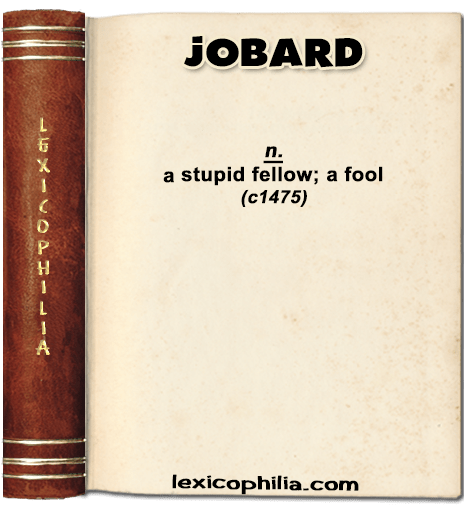
Word of the Day: JOBARD

ETYMOLOGY
from French jobard (a person who is easily fooled or very credulous)

EXAMPLE
“… False supplantyng, clymbyng of foolis
Unto chayers of worldly dignite,
Looke of discrecioune sette
jobbardis upon stoolis,
Whiche hathe distroyed many a comunalte,
Marchol to sitte in Salamons see,
What folwithe after no reason no justice,
Injuste promocioune and parcialite,
By false prerogatyf theyr neyghburghs to dispise.
…”

From: A Selection from the Minor Poems of Dan John Lydgate
Printed for the Percy Society, 1840
The Moralite of the Hors, the Goose, and the Sheepe
Composed c1440

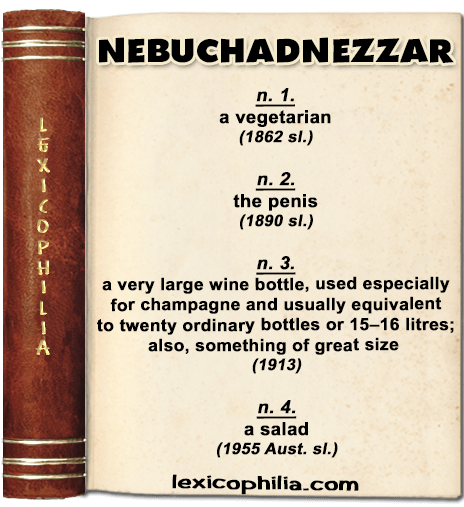
Word of the Day: NEBUCHADNEZZAR

ETYMOLOGY
from the name of Nebuchadnezzar (died c562 BC) ruler of the Babylonian empire (604–562 BC), after French nabuchodonosor (large wine bottle used for champagne)

EXAMPLE (for n. 3.)
“… That didn’t prevent me strewing my whole room with little bits of paper, when I undressed that night. Fireworks ensue, then (children dismissed) supper and afterwards, the most magnificent Nebuchadnezzars, and finally a good form of blind-man’s buff, where everyone stands round the room in a circle and the blind man walks up and prods someone, telling him at the same time to make a noise … sch as the sound of rain falling on mud – and the speaker has to be recognised by the sound of his voice. …”

From: Letters of Aldous Huxley
By Aldous Huxley, 1969
Letter to Leonard Huxley, 11 November, 1913

PRONUNCIATION
neb-yuh-kuhd-NEZ-uh

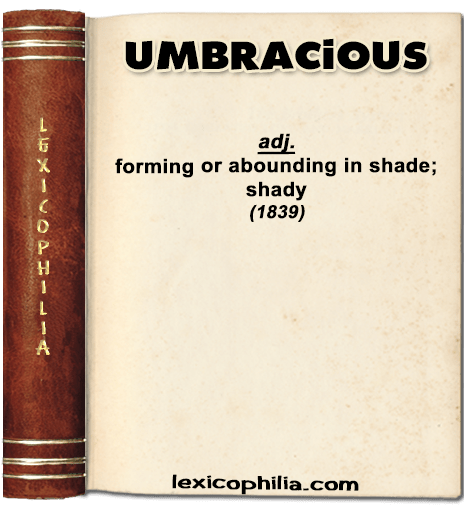
Word of the Day: UMBRACIOUS

ETYMOLOGY
irregular from Latin umbra (shade, shadow) + -acious

EXAMPLE
“… About the same period also an approach was made, by altering and levelling the ground, and planted with elms, sycamores, and chestnuts on each side, which have already become very umbracious, and will in the course of a few more years, when he who planted them rests beneath their shade, form a stately avenue. …”

From: The History and Topography of the Isle of Axholme
By William Brocklehurst Stonehouse, 1839

Word of the Day: FAM

ETYMOLOGY
short for famble;
for n. 4.: shortened from family

EXAMPLE (for n. 1.)
“… Jenny being very genteely dressed, he observed a Gentleman who was a very Rum Muns, (that is, a great Beau) who had a very Glim Star, (that is, a Ring) upon his Feme, (that is, Hand} which she longed to make, so giving the Hint to her Companions to Bulk the Muns forward, (that is, Push) they pushed him quite in; …”

From: Select trials at the Sessions-House in the Old-Bailey, for murder, robberies, rapes, sodomy, coining
From the year 1720, to this time. 1742
The following is a particular Account of the Transactions of the Life of Mary Young, alias Jenny Diver, &c. &c. &c.

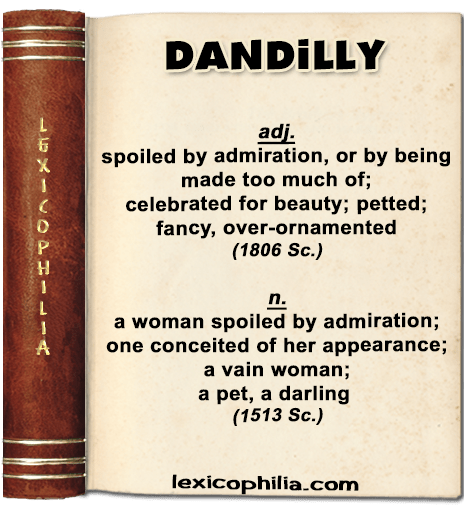
Word of the Day: DANDILLY

ETYMOLOGY
apparently a derivative of dandle (to move (a child, etc.) lightly up and down in the arms or on the knee)

EXAMPLE
“… I wes in youthe, on nureice kne,
Cald
dandillie, bischop, dandillie,
And quhone that age now dois me greif,
A sempill vicar I can nocht be:
Exces of thocht dois me mischief.
…”

From: Dunbar: A Critical Exposition of the Poems
By Tom Scott, 1965
Don is a Battell on the Dragon Blak
Composed by William Dunbar, a1513

Word of the Day: DUBITATE

ETYMOLOGY
from Latin dubitat-, participial stem of dubitare (to doubt)

EXAMPLE
“… as it shall now fare with him, the whole Future may be this way or be that. If, for example, he were to loiter dubitating, and not come; if he were to come, and fail: the whole Soldiery of France to blaze into mutiny. …”

From: The French Revolution: a History
By Thomas Carlyle, 1837

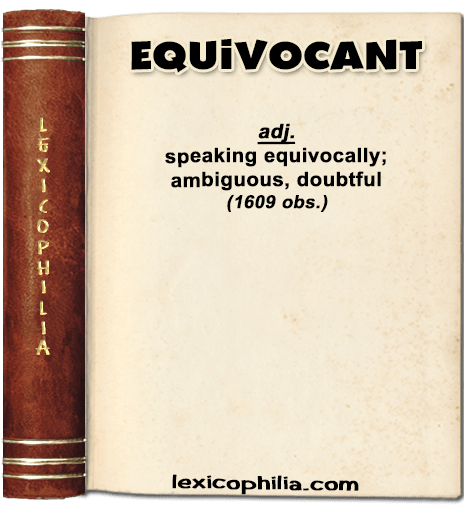
Word of the Day: EQUIVOCANT

ETYMOLOGY
from Latin aequivocantem, present participle of aequivocare, from aequivocus (ambiguous)

EXAMPLE
“… to trie battaile with the Medes: yea, and and answere by Oracle later than these before cited, which verily was true, but no lesse ambiguous and equivocant, …”

From: The Roman History Of Ammianus Marcellinus
Translated by Philemon Holland, 1609

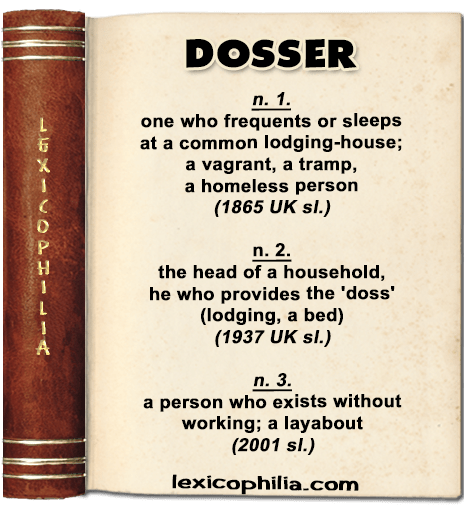
Word of the Day: DOSSER

ETYMOLOGY
from doss (n. lodging, a bed) (vb. to sleep)

EXAMPLE
“… Most of the ‘dossers’ were transient customers, people who were always on the move. …”

From: New York Police Gazette
Leaves from the Diary of a Celebrated Burglar; Being a Compilation of the Events and Occurences of the Most Exciting, Interesting and Extraordinary Character in the Life of a Thief
By Anonymous, 1865

Word of the Day: LUDIBUND

ETYMOLOGY
from Latin ludibundus, from ludere (to play)

EXAMPLE
“… I promise you, Hylobares, tho’ the fancy of Cuphophron may seem more ordinarily ludibund and lightsomely sportful, yet what he points at seems to be overlamentably true …”

From: Divine Dialogues, Containing Sundry Disquisitions & Instructions Concerning the Attributes and Providence of God
By Henry More, 1668