Word of the Day

Word of the Day: BUBBLY-JOCK

ETYMOLOGY
from bubbly (full of bubbles) + the Scots male forename Jock 

EXAMPLE (for n. 1.)
“… there was the turkey, whom the poetical Scott calls the bubbly-jock, gobbling in the distance, with a melodious gurgle as of an oboe played softly; …”

From: With Harp and Crown, A Novel
By Walter Besant and James Rice, 1800

Word of the Day: IRRUENT

ETYMOLOGY
from Latin irruentem, present participle of irruere (to rush in or upon)

EXAMPLE
“… Under such an irresistible impulsion, mind and soul both were now following hand in hand a new path of progressive and irruent development. …”

From: Music:  A Monthly Magazine 
Devoted to the Art, Science, Technic, and Literature of Music
W. S. B. Mathews, Editor
Volume IV. May, 1893 to October 1893
The Old Lyric Stage and the New One

Word of the Day: CLIBBY

ETYMOLOGY
formed from Old English clibbor (sticky, adhesive); 
related to Old English clifian (to cleave, adhere)

EXAMPLE
“… Which tother spying well, hotly pursues his poynt,
And each proffred resistance, chops off ioynt by ioynt,
Threatning, insisting, striking, wounding, reuelling,
Till meeke disarm’d stilnes proclaim’d his conquering:
Then 
clibbie ladder gainst his battered flanck hereares,
And vp it him, and he it vp, slow scaling beares.
…”

From: A Herrings Tayle
By Richard Carew, 1598

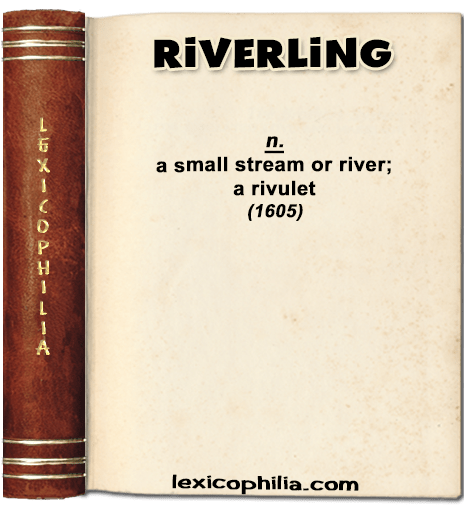
Word of the Day: RIVERLING

ETYMOLOGY
from river + -ling

EXAMPLE
“… Of him she also holds her silver Springs.
And all her hidden Crystall
Riverlings:
And after (greatly) in two sorts repayes
Th humour she borrows by two sundry wayes.
…”

From: Bartas His Deuine Weekes and Workes
By Guillaume de Saluste Du Bartas
Translated by Joshua Sylvester, 1605
The third Day of the first Week.

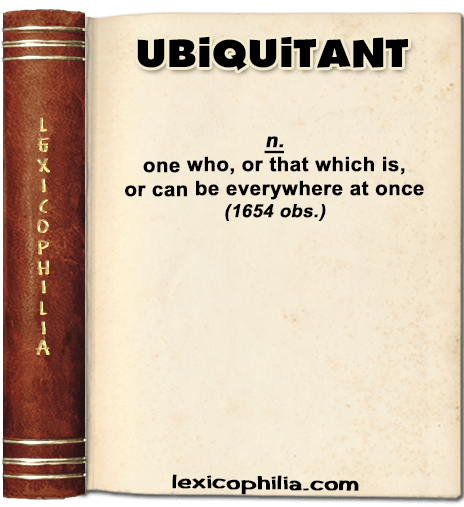
Word of the Day: UBIQUITANT

ETYMOLOGY
from ubiquit- (in ubiquitair (adj.), ubiquitarian (n.), ubiquitism (n.), ubiquity (n.), etc.) + ‑ant 

EXAMPLE
“… as neither is pure Air. Hence divers Divines aver Angels to be corporeal, becaus finit and limited to place; being bounded, as it were, with a superficies, that they cannot be ubiquitants every wher or elswher at once: Much more then Mens Souls, which liv in Bodies. …”

From: Theoremata Theologica: Theological Treatises.
Octo theses theologicæ: Eight theses of divinity
By Robert Vilvain, 1654

Word of the Day: ZODIOGRAPHER

ETYMOLOGY
from Greek ζῴδιον diminutive of ζῷον (animal) + γράϕειν (to write)

EXAMPLE
“… Notwithstanding upon enquiry we find no mention hereof in Ancient Zodiographers, and such as have particularly discoursed upon Animals,
as Aristotle, Elian, Pliny, Solinus and many more; who seldom forget proprieties of such a nature, and have been very punctual in less considerable Records. …”

From: Pseudodoxia Epidemica
By Sir Thomas Browne, 1650
Of the Picture of the Pelecan

Word of the Day: IMPUDICOUS

ETYMOLOGY
from Latin impudicus (shameless, unchaste) + -ous

EXAMPLE
“… To the first, though the Libertines boast, that what is sinne in others, is not in them; and the Popish Canonists tell us, that though it may be a wanton and impudicous act in another to kiss a woman, yet a Priest doing it, it is to be pre­sumed he doth it onely to bless her; yet we think it abominable to have such divers Weights, and divers Measures; …”

From: Coena quasi Κοινὴ: The new-inclosures broken down, and the Lords Supper laid forth in common for all Church-members
By William Morice, 1657

Word of the Day: GLIMFLASHY

ETYMOLOGY
from glim (a light of any kind; a candle, a lantern) + flashy (given to show)

EXAMPLE
“… What ho, my kiddy,” cried Job, “don’t be glimflashy: why you’d cry beef on a blater; the cove is a bob cull, and a pal of my own; and, moreover, is as pretty a Tyburn blossom as ever was brought up to ride a horse foaled by an acorn.. …”

From: Pelham; Or, The Adventures of a Gentleman
Volume I, Second Edition, 1828