Word of the Day

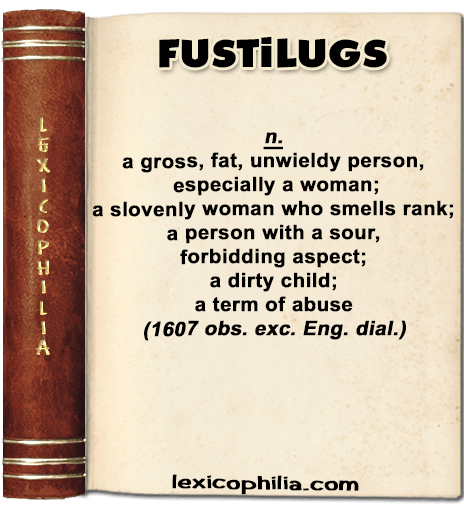
Word of the Day: FUSTILUGS

ETYMOLOGY
? from fusty (having an unpleasant or stuffy smell), + lug (something heavy and clumsy), in the sense of something heavy or slow

EXAMPLE
“… Whereupon the richest Babylonians intending to marry, buy the fairest and most beautifull virgins in the company, one out-bidding another in the bargain. The country swains contenting themselues though they haue not the fairest, take the woodden-fac’d wenches, and the ill-fauourd-foule-fustilugs for a small summe, …”

From: A World of Wonders,
Or an Introduction to a Treatise Touching the Conformitie of Ancient and Moderne Wonders.
By Henri Estienne
Translated by R.C., 1607

Word of the Day: TROIL

ETYMOLOGY
vb.: from Old French troilliertruilliertreuiller, from Middle High German trüllen

EXAMPLE (for vb.)
“… Thus with treison and with trecherie · þow troiledest hem boþe,
And dudest hem breke [here] buxomnesse · þorw false by-heste;
Thus haddest þou hem oute · and hyder atte laste.
…”

(Thus with treason and with treachery · thou troiledest them both,
And diddest them break their buxomness · through false byhest;
Thus haddest thou them out · and hither at the last.
)

From: The Vision of William concerning Piers the Plowman
By William Langland, 1393

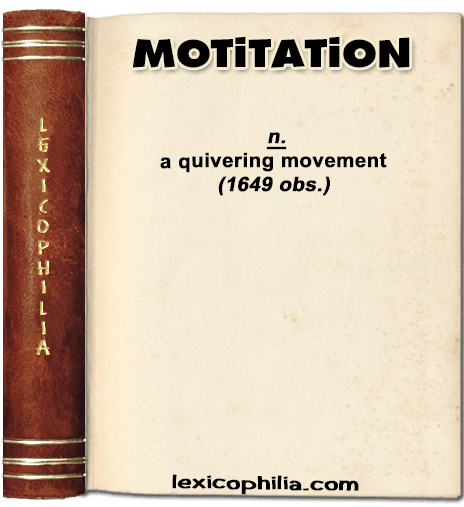
Word of the Day: MOTITATION

ETYMOLOGY
from Latin motitat-, past participial stem of motitare (to move),
from motare (to set in motion, to keep moving) + -itare (-itate) + -ion

EXAMPLE
“… because muscles in this, scarce otherwise then in other functions, are strained; & therefore you rest a trembling Head upon a cush∣on, you shall soon stay the trembling, and free it from that motitation. And hence it is that we know this motion of the Head is voluntary …”

From: Pathomyotamia, or, A dissection of the significative muscles of the affections of the minde
By John Bulwer, 1649

Word of the Day: SUDATE

ETYMOLOGY
from Latin sudat-, past participial stem of sudare (to sweat)

EXAMPLE
“… Take five Wallenuttes with their shelles, glowe them in the fyere then proiecte them in a gobblet with oulde wine, cover the same least the vigor therof exhalate. Drincke then the Wine as warm as you may, & then rest theron, and cause yourselfe to be well deckede, because you might sudate, and it will helpe. …”

From: The Boock of Physicke
By Oswald Gaebelkhover
Translated by A.M., 1599

Word of the Day: JIGGALORUM

ETYMOLOGY
of uncertain origin; probably influenced by jig and jog

EXAMPLE
“… Even Humfrey King finds an excuse for his own mediocrity in that it is not the lowest: ‘I see my inferiours in the gifts of learning, wisdome, & vnderstanding, torment the Print daily with lighter trifles, and Iiggalorums, then my russet Hermit is, the which hath made me the bolder to shoulder in amongst the’…”

From: Halfe-penny-worth of Wit
By Humphrey King, 1613

Word of the Day: CLODPATE

ETYMOLOGY
from clod (lump) + pate (head)

EXAMPLE
“… VVHat Clod-pates, Thenot, are our Brittish swains,
How lubber-like they loll upon the plains?
No life, no spirit in ’em; every Clown
Soone as he layes his Hook and Tarbox down,
That ought to take his Reed, and chant his layes,
Or nimbly run the winding of the Maze,
Now gets a bush to roam himselfe, and sleepe;
Tis hard to know the shepheard from the sheepe.
…”

From: By Thomas Randall/Randolph
in: Annalia Dubrensia, vpon the yeerely celebration of Mr. Robert Dovers Olimpick Games vpon Cotswold-Hills, 1636
Edited by Alexander Grosart, 1877