Word of the Day

Word of the Day: DILOGICAL

ETYMOLOGY
from Greek δίλογος (dilogos) (doubtful), διλογία (repetition) + -ic + -al, after logical

EXAMPLE
“… Therefore some of the subtler, haue deliuered their opinions in such spurious, enigmaticall, dilogicall termes, as the Diuell gaue his Oracles; that since Heauen will not follow their Instructions, their Constructions shall follow Heauen. And because the Weather hath not fallen out, as they haue before tolde, they will now tell as the weather falles out. …”

From: The Sacrifice of Thankefulnesse 
By Thomas Adams, 1616
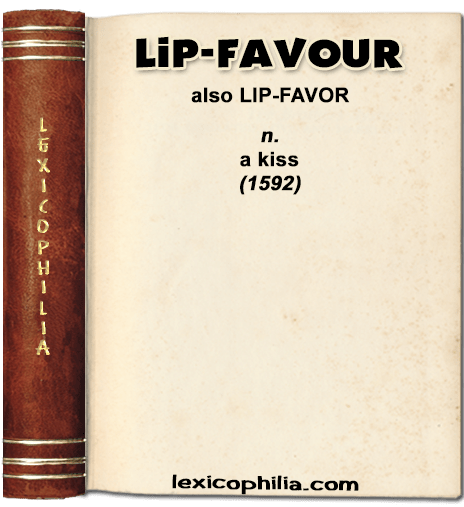
Word of the Day: LIP-FAVOUR

ETYMOLOGY
from lip + favour

EXAMPLE
“… As soon as she had sealed up her letter, she brooked no delay but sent it straight by one of
her waiting-women to Lutesio, whom she found sitting alone in his chamber reading
upon a book. Interrupting his study, she delivered him the letter and the message of her
lady. Lutesio, kind, gave the gentlewoman a kiss, for he thought she valued a
lip-favour
more than a piece of gold, and with great courtesy gave her leave to depart. She was
scarce out of the chamber but he opened the letter and found what he expected, the
resolution of a chaste countess, too worthy of so jealous a husband. …”

From: Philomela
The Lady Fitzwater’s Nightingale
By Robert Greene, 1592

Word of the Day: PERPOTATION

ETYMOLOGY
from Latin perpotation-perpotatio (continued drinking, drinking bout), 
from perpotat-, past participial stem of perpotare (to drink heavily),
from per- + potare (to drink) + ‑io (-ion) 

EXAMPLE
“… How could the inner man be capable of appreciating epic, when the outer man had been clogged with so much adventitious matter? Some of the guests seemed eminent professors of perpotation. My host was old, but still a literary enthusiast. His poetic fire had increased with his corporeal frigor. …”

From: The Mirror of Literature, Amusement, and Instruction
Containing Original Essays, Historical Narratives….
Volume VIII. 1826
“Epicism”

Word of the Day: AIDANCE

ETYMOLOGY
from Middle French aidance, from aider (aid) + -ance

EXAMPLE
“… All swolne with chafing, downe Adonis sits,
Banning his boystrous, and vnruly beast;
And now the happie season once more fits
That louesicke loue, by pleading may be blest:
For louers say, the heart hath treble wrong,
When it is bard the
aydance of the tongue. …”

From: Venus and Adonis
By William Shakespeare, 1593

Word of the Day: NOTT-HEADED

ETYMOLOGY
from nott for notted (shorn, cut close, or smooth), from nott (to shear or poll), which is from the Saxon hnot, meaning the same

EXAMPLE
“… Your Sages in generall, by seeing too much ouersee that happinesse; Only your block-headly Tradesman; your honest meaning Cittizen; your not-headed Countrie Gentleman; your vnapprehending Stinckerd is blest with the sole prerogatiue of his Wiues chamber. …”

From: The WIddowes Teares, A Comedie
By George Chapman, 1612

Word of the Day: HUMGRUFFIN

ETYMOLOGY
A made-up word, from humgruff, griffin.

EXAMPLE
“… The Demoniac crowd
In an instant seem’d cowed;
Not one of the crew volunteer’d a reply,
All shrunk from the glance of that keen-flashing eye,
Save one horrid
Humgruffin, who seem’d by his talk,
And the airs he assumed, to be Cock of the walk,
He quailed not before it, but saucily met it,
And as saucily said, “Don’t you wish you may get it?”
…”

From: The Ingoldsby Legends
The Lay of St. Cuthbert, or, The Devil’s Dinner-Party
By Richard Harris Barham (Thomas Ingoldsby), 1842

Word of the Day: DEIGNOUS

ETYMOLOGY
apparently  a shortened form of dedeignous (disdainous), French dédaigneux, Old French desdeignous 

EXAMPLE
“… Boste & deignouse pride & ille avisement
Mishapnes oftentide, & dos many be schent.
þe proude kyng Pharaon, þat chaced Israel, [Exempla viciorum, quibus gra|tia extin|guitur.]
Dronkeld euerilkon, & Gode’s folk went wel.
Sodom & Gomor fulle vile synne þat stank,
Boþe for euer more doun tille helle þei sank. …”

From: Robert Mannyng of Brunne, The Chronicle, c1330

Word of the Day: LATIBULATE

ETYMOLOGY
from participial stem of Latin latibulari, from latibulum (hiding place)

EXAMPLE
“…Shhhh! Do you hear the whispers?
ones that taunt, laugh and persuade
they are here, there, and everywhere
as I
latibulate with my face to the wall

Sometimes they chant a single word
in chorus or in perpetual canon
until the sound overwhelms my thoughts
Shhhh! Do you hear the whispers?
…”

From: The Monday Morbs – Volume 1 Of Fearful and Monstrous Things
By S.B. Pearce, 2023
‘Hiding in the Corner’

Word of the Day: NUMBROUS

ETYMOLOGY
from number (n.) + -ous

EXAMPLE
“… She sawe, she sawe the prophane route,
rushe in, without all measure:
Unto thy sacred holy house,
that route, whiche thou (O Lorde)
Forboddste, that they, ne shoulde come in,
the mansion of thy worde.
Her 
numbrous folke (a syghyng flocke)
and seekyng after foode,
Dyd geue for meate, what so they had,
thynges precious or good.
To cheryshe theyr so needie sowles.
…”

From: A Medicinable Morall, that is, the two bookes of Horace his satyres,
Translated by T. Drant, 1566

Word of the Day: HEEDY

ETYMOLOGY
from heed (careful attention, care, observation) + -y

EXAMPLE
“… Not wythstandynge (ryght worshipfull) I haue attempted an enterpryce in prouynge eche parcel of the pryuye masse to dysplease god, whiche I can neyther word, matier, ne reason accordynglye, and so am rather dyslyked then lyked of manye for thys my doyng, rather heady then heedy as they suppose: Howebeyt in case the sayd persons woll wythe me earnestly respect my bounden deutie in the sayd doyng, they (I doubte not (woll be rathere contented then discontented with me for the same. …”

From: A Treatise againste the preuee masse
By Edmund Gest, 1548