Word of the Day

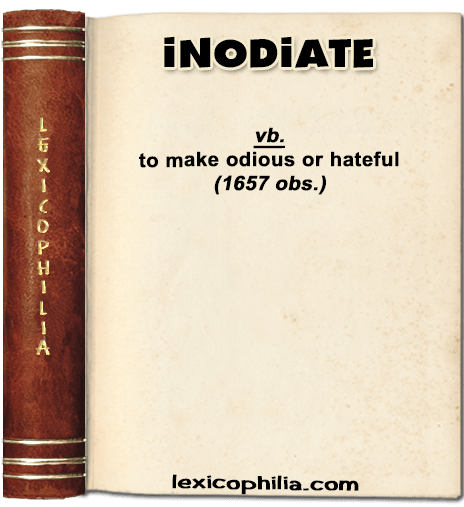
Word of the Day: INODIATE

ETYMOLOGY
from Latin type inodiare, from in- + odium (hate)

EXAMPLE
“… And if I should appeal from Philip asleep, to Philip awake, I presume the Apologists themselves will acquit me of any odium toward Ministry; I wish some of them were not more culpable for inodiating Ministers, and censorious vilifying their persons and pains, that themselves may attract more esteem and dependencies, who (like the men of China) though they may think the Presbyterians to have one eye (as the Chinois say of the Europeans,) yet they conclude all the World beside to be blind. …”

From: Coena quasi koinē
The New-Inclosures broken down, and the Lords Supper Laid forth in common for all Church-members, having a Dogmatical Faith, and not being Scandalous
By William Morice, 1657

Word of the Day: MAKE-SPORT

ETYMOLOGY
from make (to produce by action, bring about) + sport (activity involving physical exertion and skill)

EXAMPLE (for adj.)
“… Graunt that this present Tyrian with Troian asemblye
May breede good fortune to our freends and kynred heer after.
Let
make sport Bacchus, with good ladye Iuno, be present.
And ye, my freend Tyrians, thee Troian coompanye frollick
Thus sayd, with sipping in vessel nycelye she dipped.
…”

From: Thee first foure bookes of Virgil his Aeneis
Translated by Richard Stanyhurst, 1582

Word of the Day: HIPPOMOBILE

ETYMOLOGY
from French hippomobile , from hippo- from Greek ἵππος (horse), from hippos (horse) + ‑mobile after automobile 

EXAMPLE
“… Speaking generally, it is the bad driver who uses the horn most, and so brings motor-cars into disrepute by creating unnecessary alarm to other travellers. In overtaking a horse-drawn vehicle it is best to sound the horn when some distance behind, and so soon as it is seen that the signal has been noticed to avoid its use again until past the ” hippomobile.” Of course it is sometimes necessary to use the horn when quite close to a horse-drawn vehicle for instance, when it unexpectedly turns out across one’s path; but even on such occasions two moderate and short blasts are generally sufficient to warn the driver. …”

From: The Motor-Car Journal
London, Friday, March 17th, 1899
Comments, ‘The Motor-Car Horn’

Word of the Day: REPENTINE

ETYMOLOGY
from obsolete French repentin-ine, or from Latin repentinus
from repent-, repens (sudden) + ‑inus (ine)

EXAMPLE
“… Whan thou shalte ought do, of vnexpert or newe
Fyrste ponder in thy mynde, reuoluynge busely
What maner, and how great thynge, may therof ensue
Attempt nothynge weyghty, in haste nor sodaynly
If thynges may byde, tary, begyn thou nat rasshely
For enterpryses rasshe, hasty and
repentyne
Ar chefe thynges bryngynge, great warkes to ruyne
…”

From: Here begynneth a ryght frutefull treatyse, intituled The Myrrour of Good Maners,
By Dominicus Mancinus
Translated by Alexander Barclay, ?1518

PRONUNCIATION
ruh-PEN-tighn

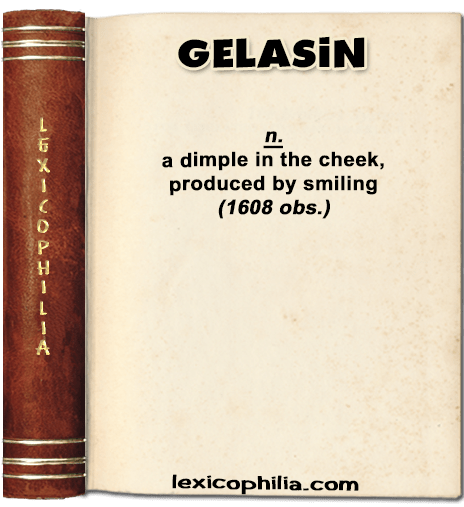
Word of the Day: GELASIN

also GELAZIN

ETYMOLOGY
from French gelasin, from Greek γελασῖνος (gelasinus), from γελᾶν (to laugh)

EXAMPLE
“… The beauty of the face consisteth in a large, square, well extended and cleere front, eye-browes well ranged, thin and subtile, the eye well diuided, cheerefull, sparkling: as for the colour I leaue it doubtfull, the nose leane, the mouth little, the lips coraline, the chinne short and dimpled, the cheekes somewhat rising and in the middle the pleasant gelasin, the eares round and well compact, the whole countenance with a liuely tincture white and vermilion. …”

From: Of Wisdome, three bookes written in French by Peter Charron
Translated by Samson Lennard ?1608

Word of the Day: EXIMIOUS

ETYMOLOGY
from Latin eximius (excepted, select, choice), from eximere (to take out) + -ous;
common in 17th century literature

EXAMPLE
“… For this matter let euery man make frendes to the kinges maiestie, for it doth perteine to a king to help this infirmity, by the grace the which is giuen to a king anointed. But for as much as some men doth iudge diuers times a Fistle or a French pocke to be the kings euil, in such matters it behoueth not a king to meddle withal, except it be thorow & of his boutiful goodnes to giue his pitifull and gracious councell. For kinges & kinges sonnes & other noble men hath been eximious Phisicions, as it appeareth more largely in ye Introduction of knowledge, a booke of my making. …”

From: The Breuiarie of Health vvherin doth folow, remedies, for all maner of sicknesses & diseases,
By Andrew Boorde, 1547

PRONUNCIATION
uhg-ZIM-ee-uhss, ek-SIM-ee-uhss

Word of the Day: MOSTWHAT

ETYMOLOGY
from most (greatest in size, bulk, etc.) + what (pronoun); probably after somewhat (adv.)

EXAMPLE (for adv. 2.)
“…  The parentes and freindes with whom I haue to deale, be mostwhat no latinistes: and if they were, yet we vnderstand that tounge best, whervnto we are first borne, as our first impression is alwaie in English, before we do deliuer it in Latin. …”

From: Positions vvherin those primitiue circumstances be examined, which are necessarie for the training vp of children, either for skill in their booke, or health in their bodie,
By Richard Mulcaster, 1581

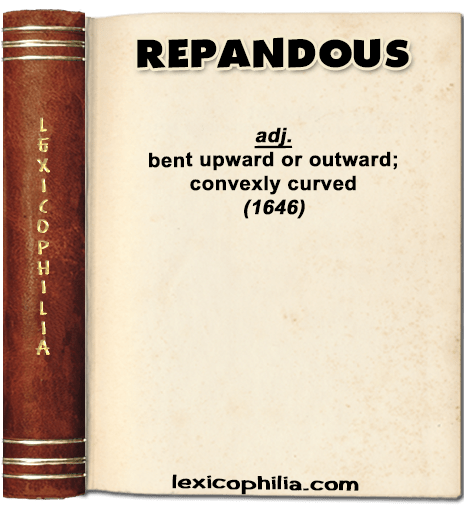
Word of the Day: REPANDOUS

ETYMOLOGY
from Latin repandus (bent backwards, turned up), from re- + pandus (bent)

EXAMPLE
“… And as indeed is deducible from pictures themselves; for though they be drawn repandous, or convexedly crooked in one piece, yet the Dolphin that carrieth Arion is concavously inverted, and hath its spine depressed in another. …”

From: Pseudodoxia Epidemica: 
Or Enquiries Into Very Many Received Tenents and Commonly Presumed Truths
By Thomas Browne, 1646

Word of the Day: OMNISCIOUS

ETYMOLOGY
from Latin omniscius all-knowing, from omni- scire (to know) + -ous

EXAMPLE
“… Schoolemen may phantastically dreame, or philosophically discourse of new Adams, Salomons, and diuers putatiue wisemen, euen in that omniscious, and omnisufficient veine: but I wis such blacke Swans are very rare birds: and true prophets in the rightest, purest, and diuinest kinde, euen full as rare, or percase rarer, than they: as may haply be discussed more fully, and exactly, at more conuenient leisure. …”

From: A Discoursiue Probleme concerning Prophesies how far they are to be valued, or credited, according to the surest rules, and directions in diuinitie, philosophie, astrologie, and other learning;
By John Harvey, 1588