Word of the Day

Word of the Day: NESTCOCK

also NESCOCK, NESCOOK (Eng. dial.)

ETYMOLOGY
from nest + cock

EXAMPLE
“… As for Rafe – despite his love for the theater and his determination to travel the Circuit, he was essentially a homebody, a confirmed nestcock eagerly anticipating marriage to Crisiant and a settled home with a dozen rambunctious children. …”

From: Touchstone
By Melanie Rawn, 2012

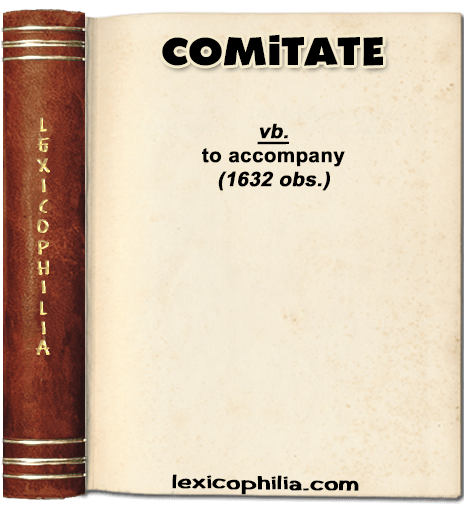
Word of the Day: COMITATE

ETYMOLOGY
from Latin comitat- ppl. stem of comitari (accompany, attend, follow)

EXAMPLE
“… Thus to his guest Aeneas lodgings went
This Heroë brave, mindfull of’s high intent
And of his promis’d aid. With no lesse care
Aeneas in the morning doth prepare.
With Pallas young the king associated,
Achates kinde Aeneas comitated.
Met, they shake hands, and down together sit,
And having time for talk, and leisure fit,
The king thus first began; Great prince of Troy,
I ne’re shall think (whiles thou dost life enjoy)
Troyes crowns and comforts to be brought to thrall …”

From: The XII Aeneids of Virgil, the Most Renowned Laureat-Prince of Latine-Poets
Translated by John Vicars, 1632

Word of the Day: EXITIABLE

ETYMOLOGY
from Latin exitiabilis (causing or bringing death or destruction, fatal, deadly),
from exitium (a going out, destruction) + -abilis (-able) 

EXAMPLE
“… But this is very necessarye to be knowen, after what sorte he handled themperoure, when he toke thaigle by the throte? In the time of Iohan the .xii. and Otto the firste there was stablyshed a greuouse intollerable, hurtefull and exitiable othe to all thempire, to be sworne of all emperours in this maner. …”

From: The Beginning and Endynge of all Popery, or Popishe Lyngedome
By Walter Lynne, 1548

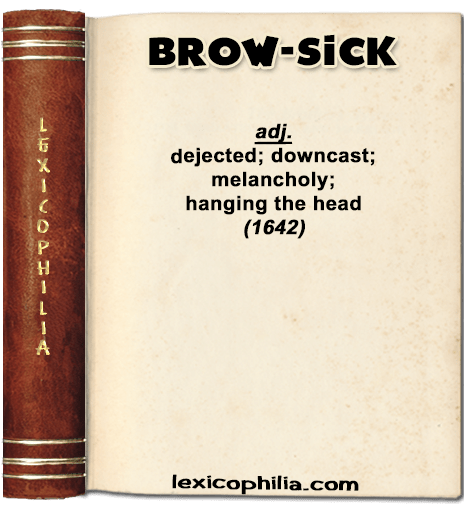
Word of the Day: BROW-SICK

ETYMOLOGY
from brow + sick

EXAMPLE
“… Besides though, I confess, Parnassus hardly,
Yet Helicon this Summer-time is dry:
Our wits were at an ebbe or very low,
And, to say troth, I think they cannot flow.
But yet a gracious influence from you
May alter Nature in our  
Browsick crew.
Have patience then, we pray, and sit a while;
And, if a laugh be too much, lend a smile
. …”

From: The Last Remains of Sr John Suckling
A Prologue of the Author’s to a Masque at Witten, 1659

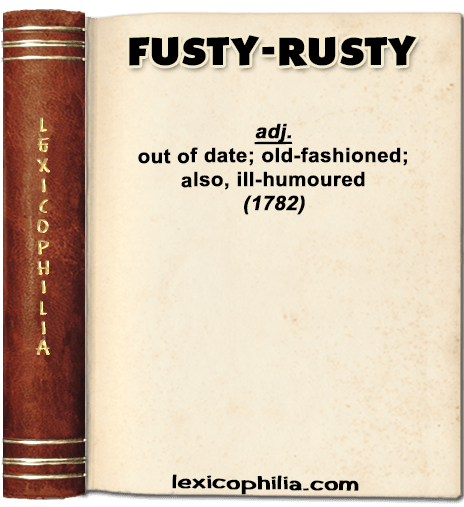
Word of the Day: FUSTY-RUSTY

ETYMOLOGY
from fusty (adj.)

EXAMPLE
“…There is a fashion in these things, which the Doctor seems to have forgot. But what shall we say of his fusty-rusty remarks upon Henry and Emma? I agree with him, that morally considered both the knight and his lady, are bad characters, and that each exhibits an example which ought not to be followed. …”

From: The Life and Posthumous Writings of William Cowper
By William Hayley, Volume III, 1804
Letter XLVII. To the Rev. William Unwin, January, 5, 1782

Word of the Day: DRUMBELO

also DROMMELL, DROMOS (plural), DRUMBLE (Eng. dial.), DRUMMIL (Eng. dial.)

ETYMOLOGY
possibly from dialect drumble (to talk meaninglessly or monotonously, to blather or ramble)

EXAMPLE
“… This before remēbred ſupplicatiō was attentiuely noted & much feared, amongſt ye curſed companie of drouſie dreaming Dromos, I mean Baals Baldons yt mungrel Maſſalians & cruel churchrobbers whome it touched moſt in effect, in ſo muche that the groſſe Goſpeller, Ethnike Epicures, beaſtly bellygods, wicked worldlyngs and ſpirituall ſhauelyngs, were fallen in a pelting chafe, the bloudy Biſhoppes broyled, the cullionly Cardinalles coured, the proude Priours frouned, the fat Abbots ſwet, the pore Friers curſed, the white Chanons chafed, the poore Nunnes puled like Puttockes, in concluſion, all the ſectarie Sathaniſts were ſore diſpleaſed …”

From: Polybius
The Hystories of the most Famous and Worthy Cronographer Polybius discoursing of the Warres betwixt the Romanes and Carthaginenses
Translated by C. Watson, 1568

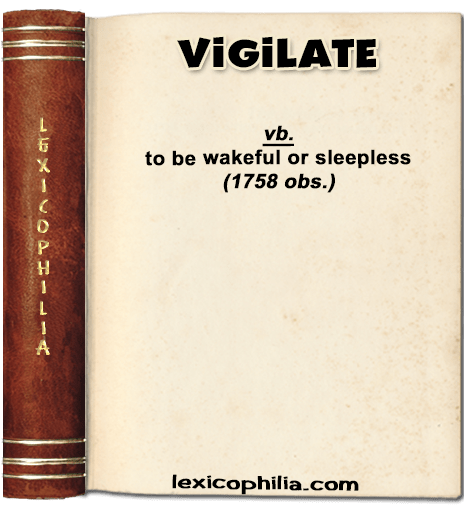
Word of the Day: VIGILATE

ETYMOLOGY
from Latin vigilat-, ppl. stem of vigilare (to remain awake)

EXAMPLE
“… Mountain Hawkweed with long slender stalks and small flowers. The flowers are in their expanded or vigilating state from five or six in the morning till about ten. …”

From: Philosophical Transactions
Volume L. Part II. For the Year 1758
Printed 1759
“Some Observations upon the Sleep of Plants”

Word of the Day: CUFFER

ETYMOLOGY
for. n. 1. & n. 2. from cuff (to strike with the fist or open hand, to buffet) + -er
for n. 4. from cuff (to discuss, to talk over) + -er

EXAMPLE (for n. 1.)
“… LET US LEARN THE LAWS OF FASTING, that we run not uncertainly, nor beat the air, nor be as such cuffers who fight as it were with their shadow. Fasting is a medicine; but physick, although it be never so good, that is prescribed, oftimes becomes unprofitable, by reason of the imprudence of him that useth it. …”

From: The Paschal or Lent-Fast, Apostolical & Perpetual at first deliver’d in a sermon preached before His Majesty in Lent and since enlarged
By Peter Gunning, 1662