Word of the Day

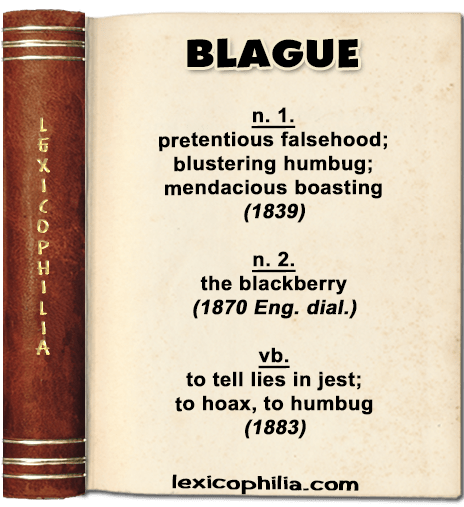
Word of the Day: BLAGUE

ETYMOLOGY
noun: from the French
verb: French blaguer, from the noun

EXAMPLE
“…In later editions of The French Revolution Carlyle did not alter a word of his original account. Instead, he added directly to the main text a new concluding paragraph correcting Barere’s story, which he terms a ‘masterpiece; the largest, most inspiring piece of blague manufactured, for some centuries, by any man or nation. As such, and not otherwise, be it henceforth memorable’…”

From: The French Revolution
By Thomas Carlyle, 1839

Word of the Day: TERRIBLIZE

ETYMOLOGY
from terrible + -ize

EXAMPLE
“…Both Camps appoach, their bloudy rage doth rise,
And even the face of Cowards 
terriblize;
New Martial heat inflames their mindes with ire,
Their bloud is moov’d, their heart is all on fire.
Their cheerfull limbs (seeming to march too slowe).
Longing to meet, the fatall drums out-goe;
And even already in their gesture fight:
Th’ iron-footed coursers, lusty, fresh, and light,
…”

From: Du Bartas his Deuine Weekes and Workes translated
By Guillaume de Salluste Du Bartas
Translated by Josuah Sylvester, 1606

Word of the Day: MOTABLE

ETYMOLOGY
from late Latin motabilis (mobile, moving), from Latin motare (to set in motion, keep moving) (from mot-, past participial stem of movere (to move)) + -abilis (-able)

EXAMPLE
“…The heat had, also, made the whole atmosphere tremulous and visible, so that the outline of towers, turrets, and majestic edifices of stone and marble, was fluttering and motable as if an etherial sea of some subtle fluid, with trembling waves and a constant, rippling motion, was flowing and dancing over it. …”

From: The Ladies’ Companion
A Monthly Magazine Embracing Every Department of Literature
Volume XIV, Printed 1841
‘The English Family; Or, Who Are They? ‘
A Sketch by Joseph Holt Ingraham

Word of the Day: AGILIOUS

ETYMOLOGY
from Latin agilis (agile) + -ous

EXAMPLE
“…What is become of all these iugling gambalds, Apish deuises, with all the rest of your squint-eyed trickes? when as through your deepe studies, long practises, & apt bodies, both strong & agilious, you haue attained to the height of all these things. …”

From: Paradoxes of Defence wherein is proued the true grounds of fight to be in the short auncient weapons, and that the short sword hath aduantage of the long sword or long rapier
By George Silver, 1599

Word of the Day: TAKY

ETYMOLOGY
from take (to catch the fancy or affection of; to excite a liking in; to captivate, delight, charm) + -y

EXAMPLE
“…Speaking thus, Mr. Blyth now proceeded to perform by one great effort those two difficult and delicate operations in art, technically described as “putting in taky touches, and bringing out bits of effect.” These arduous final processes, are, as all painters know, only to be accomplished through the medium of certain mystic bodily evolutions, …”

From: Hide and Seek,
By Wilkie Collins, Vol. I. 1854

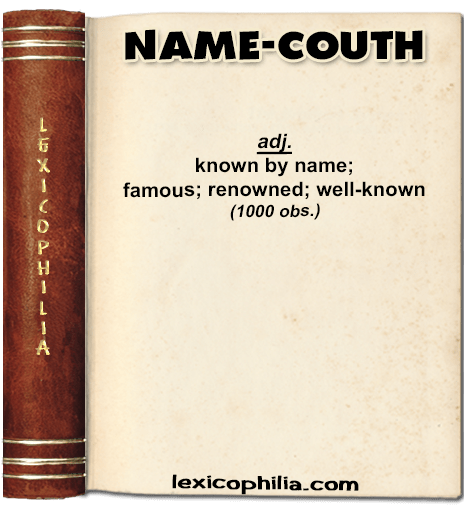
Word of the Day: NAME-COUTH

ETYMOLOGY
formed similarly to Middle Dutch namecontnaemcont, Danish navnkund (obs.); from the Germanic base of name (n.) + the Germanic base of couth (known (obs.)

EXAMPLE
“…In eche of this Epicicles was ficched one of the seven namecouth planetes, that be called sterres Erratikes, saaf only þat the sonne was withowt þe epicicle, fiched evene in the circumference of his difference. ….”

From: The Booke of the Pylgremage of the Sowle
Translated from the French of Guillaume de Guileville
From the Egerton Manuscript, a1500

Word of the Day: FOGGISH

ETYMOLOGY
adj. 1.: from fog (fat, bloated) + -ish
adj. 2.: from fog (cloud of small water droplets that is near ground level) + -ish

EXAMPLE (for adj. 1.)
“…He that lyueth after the rules of phisike lyueth wretchedly. As thoughe it were an happynes and felicitie, the body to be swolen and stretched out with surfettyng, to be brasted with the pleasure of the body, to waxe foggyshe with drinkyng of good ale, & to be sepulte and drowned in slepe …”

From: Declamatio in Laudem Nobilissimæ Artis Medicinæ.
= A declamacion in the prayse and co[m]me[n]dation of the most hygh and excellent science of phisyke
By Desiderius Erasmus
Translated out of Latin into English, ?1537

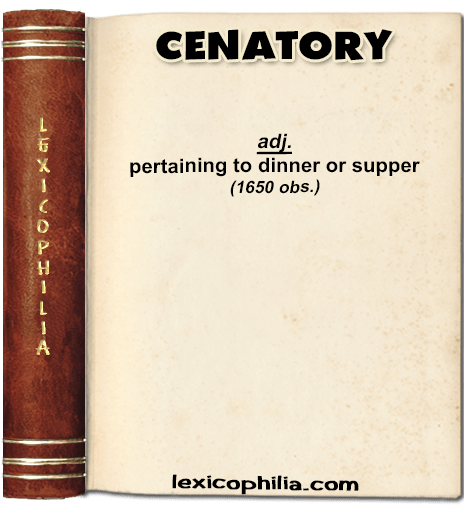
Word of the Day: CENATORY

ETYMOLOGY
from Latin cenatorius (pertaining to dinner)

EXAMPLE
“…The consent of the Jews with the Romans in other ceremonies and rites of feasting, makes probable their conformity in this. The Romans washed, were anointed, and wore a cenatory garment: and that the same was practised by the Jews, is deduceable from that expostulation of our Saviour with Simon, that he washed not his feet, nor anointed his head with oyl: the common civilities at festival entertainments: and that expression of his concerning the cenatory or wedding garment; and as some conceive of the linnen garment of the young man or St. John; which might be the same he wore the night before at the last Supper. …”

From: Pseudodoxia Epidemica:
Or, Enquiries into Very many Received Tenents and And Commonly Presumed Truths
By Thomas Browne, 1650

Word of the Day: GALACTOPOTE

ETYMOLOGY
from Latin galactopota (milk-drinker); from Greek γαλακτοπότης (milk drinker)

EXAMPLE
“…Moreover, it not only satiates the country people with abundance of milk and cheese, but also garnishes the tables of the elegant with agreeable and numerous dishes. To some nations, indeed, which are intirely destitute of corn, it furnishes their whole sustenance: hence it is, that very many of the Nomades and Getae are called Galactopotae (milk-drinkers). …”

From: L. Junius Moderatus Columella Of Husbandry
By Lucius Junius Moderatus Columella, 1745

Word of the Day: VILIORATE

ETYMOLOGY
from Latin vilior, comparative of vilis (vile) + -ate; after meliorate

EXAMPLE
“…Secondly, that there is a medium in the watery temperature of the earth, either extream of
which
viliorates the juice, where there is not an equal heat of the sun or fatness in the earth to correct the juices of the superluxuriant grass. …”

From: Observations in Husbandry
By Edward Lisle, a1722