Word of the Day

Word of the Day: PRICK-ME-DAINTY

ETYMOLOGY
from prick (to attire a person with clothes and ornaments fastened by pins, bodkins, etc.) + me + dainty

EXAMPLE
“… But, syr, among all
That sat in that hall,
There was a
pryckemedenty,
Sat lyke a seynty,
And began to paynty,
As thoughe she would faynty ;
She made it as koy
As a lege de moy ;
She was not halfe so wyse
As she was peuysshe nyse.
She sayde neuer a worde,
But rose from the borde,
And called for our dame,
Elynour by name.
…”

From: Here after foloweth Certayne Bokes
By John Skelton, ?1545
The Tunnyng of Elynour Rummyng, a1529

Word of the Day: LINGUACIOUS

ETYMOLOGY
from Latin linguaci-linguax (loquacious, talkative) (from lingua tongue + -ax [-acious]) + -ous

EXAMPLE
“…These and such like starting-holes and subtilties have made of Physick a Meander, a Wildernesse, and wild labirynth of incertainty and unstable formalities. We desire the linguacious Chymistry of these heads to tell us, how many bitter things there are in taste, which neverthelesse (according to the edict of that rule) are not hot at all?  …”

From: Matæotechnia Medicinæ Praxeōs, The Vanity of the Craft of Physick
By Noah Biggs, 1651

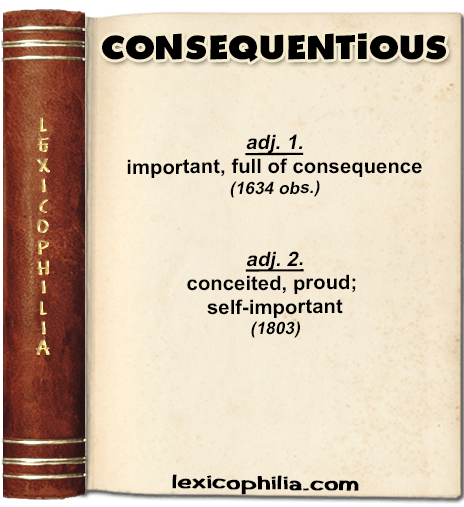
Word of the Day: CONSEQUENTIOUS

ETYMOLOGY
from. obs. French consequentieux, from Latin consequentia: + -ous

EXAMPLE
“…Now when the politicke Ambassadour, had wrought Prince Temeriske, as he desired, he then perswades with Abbas, that the Georgians hated him, that their King had entertained discourse with the Grand Signior, and sought but an aduantage to betray his trust, that if his words seemed of no moment, the matter was not consequentious, and his employment carried him, to other ends then forreigne Obiects. …”

From: A Relation of some Yeares Trauaile begunne anno 1626. Into Afrique and the greater Asia
By Thomas Herbert, 1634

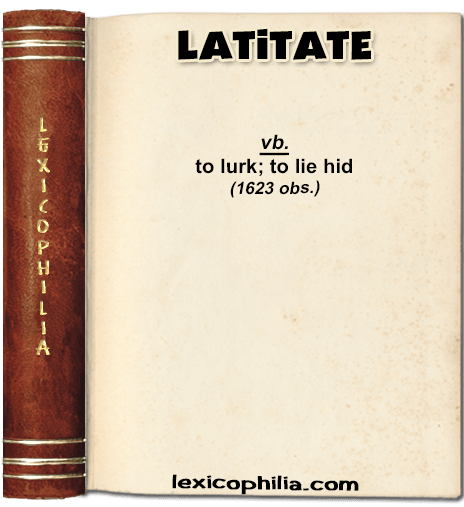
Word of the Day: LATITATE

ETYMOLOGY
from Latin latitat-, participial stem of latitare (to lie hid)

EXAMPLE
“…According to the statement of Townsend, a gardener and discharged servant of Sheriff Lax, but which was afterwards proved to be highly coloured, and in parts wholly false, one of the sheriffs had fled to the Recorder’s bed-room and taken refuge behind the state bed; and other aldermen were latitating in the upper bed-rooms. …”

From: Modern State Trials
By William Townsend, 1850
Trial at Bar of Charles Pinney, Esq. Mayor of Bristol,
On a Criminal Information for Neglect of Duty, in the Court of King’s Bench,
October 25, 26, 27, 29, 30, 31, and November 1, 1832

Word of the Day: REELING-RIPE

ETYMOLOGY
from reeling (moving with a swaying or staggering motion) + ripe (adj.)

EXAMPLE
“…  SEBASTIAN He is drunk now. Where had he wine?
ALONSO And Trinculo is reeling ripe. Where should they
 Find this grand liquor that hath gilded ’em?
 ⌜To Trinculo.⌝ How cam’st thou in this pickle?
TRINCULO  I have been in such a pickle since I saw you
 last that I fear me will never out of my bones. I
 shall not fear flyblowing
. …”

From: The Tempest
By William Shakespeare, a1616

Word of the Day: TOMLING

ETYMOLOGY
from tom (a male cat) + -ling

EXAMPLE
“…We are promised to succeed him a Black Tomling, whom I have named Prester John – that hierarch being the most remarkable black potentate whom I could call to mind. Long live Prester John! and may he be more fortunate than his predecessors, Othello and Pulcheria. …”

From: Selections from the Letters of Robert Southey
Edited by John Wood Warter, Vol. III, 1856
Letter from R.S. to G.C.B., April 29, 1821

Word of the Day: CLUNCH-FISTED

ETYMOLOGY
from clunch (to clench) + fist + -ed

EXAMPLE
“…He (that is, He that will confesse Abraham to have paid no other tithes then, Heb. 7. 4.) delivers to the world, Abraham to Godward, to have been piteously penurious. That of his dues to Religion he was a niggardly Micher: That he was an Abraham clunchfisted, and all that this way went he thought it onely wast: that the good child Judas, that he did, he did learn of his Father Abraham, Quorsum perditio haec?…”

From: A Discourse of Proper Sacrifice
By Edward Dering, 1644

Word of the Day: WAG-TONGUE

ETYMOLOGY
from wag (vb.) + tongue (n.)

EXAMPLE
“…but now indeet her tongue is loosened, and she talks, yes indeet, she does talk nineteen to the dozen and more. A silent woman she was. It is the nearest approach to a miracle I ever care to see. A chatterbox she is, and worse – a regular woman wag-tongue, a regular woman wag-tongue. I cannot get in a word edgeways now …”

From: Macmillan’s Magazine
Volume LXXXVI, May to October,1902
A Woman Wag-tongue

Word of the Day: VINOMADEFIED

ETYMOLOGY
from Latin vinum (wine) + madefieri (to be soaked) + -ed

EXAMPLE
“…The Prince unwilling to miss of his mark, and not having in all the quivers of his reason one shaft wherewith to hit it, resolved to interpose some authority with his argumentations, and where the foxes skin could not serve, to make use of the Lyons: to the prosecuting of which intent, he with his vinomadefied retinue, resolved to press in upon the Page, and, maugre his will, to get up staires, and take their fortune in the quest of the Chamber they aimed at: for albeit the stradling as wide as he could, of pretty Pomponacio at the door whereat they made account to force their passage, did for a while retard their designe, …”

From: Εκσκυβαλαυρον, Ekskybalauron: or, The Discovery of a Most Exquisite Jewel, more precious then diamonds inchased in gold, the like whereof was never seen in any age
By Thomas Urquhart, 1652

Word of the Day: HOLE-CREEPER

ETYMOLOGY
from hole (n.) + creeper (n.)

EXAMPLE
“…He qualified himself as to the good eating which the statute requires, by ‘hole-creeping’ after his neighbours’ geese and pigs – est communis holecreppar anserum et porcellorum tenentium – and as to the good drinking, we have seen the clandestine but thrice-abundant provision which he made for that. …”

(est communis holecreppar anserum et porcellorum tenentium = is a common hole-creeper of geese and piglets)

From: The Quarterly Review
Vol. XCII. Published in December, 1852, and March 1853
No. CLXXXIV. History of the Ancient Barony Castle Combe in the County of Wilts,
By George Poulett Scrope, 1462