Word of the Day

Word of the Day: BLASTFUL

ETYMOLOGY
from blast (a blowing or strong gust of wind) + -ful

EXAMPLE
“…Breezy hills and blastful mountains,
Chirp of birds, and thunder’s roll.
Tinkling rills and gushing fountains.
Powers that spurn weak man’s control.
Cradle song and chariot’s rattle.
Mighty thoughts that stir the soul,
Throng of business, roar of battle,
All make music In the whole.
…”

From: Blackwood’s Edinburgh Magazine,
July – December 1883
‘October Song’

Word of the Day: AGAMIST

ETYMOLOGY
from Greek ἄγαµ-ος (unmarried) + -ist

EXAMPLE
“…to exhort these spirituall Fathers first to cease from murdering of their owne children to spare the bloud of innocentes, & not to persecute Christ so cruelly in his members, as they do, and furthermore to exhort in like maner these Agamistes, and wilful reiecters of matrimony, to take themselues to lawfull wiues, and not to resist Gods holy ordinaunce, nor encounter his institution with an other contrary institution of theyr own deuising, lest perhappes they preuented by fragilitie, may fall into daunger of suche inconueniences aboue touched …”

From: Actes and Monumentes 
By John Foxe, 1570

Word of the Day: CRYPTONYMOUS

ETYMOLOGY
from Greek κρυπτός (hidden) + ὄνοµα (name)

EXAMPLE
“…The Ballad Book. Edinb. 1 827. 8vo. Maillet, Benedict de. Telliamed, being a Translation from the French.
A cryptonymous book — Telliamed being the anagram of M. de Maillet. It consists of * Discourses between an Indian philosopher and a French missionary on the diminuation of the sea, the formation of the earth, the origin of men and animals, and other curious subjects relating to natural history and philosophy. …”

From: The Bibliographer’s Manual of English Literature, Vol. III
By William Thomas Lowndes, 1834

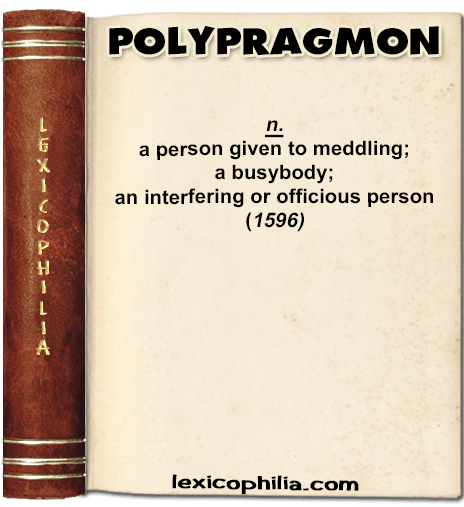
Word of the Day: POLYPRAGMON

ETYMOLOGY
from Greek πολυπράγµων )busy about many things, meddlesome, officious),
from  πολυ- (poly comb. form) + πρᾶγμα (thing done)

EXAMPLE
“… till this Polypragmon troubled us with his Blankes and matters of Estate
we lyved in Scot: peacably, administred the sacramentes, and
preached daly the trewe will and worde of oure savioure Jesus
…”

From: In Spanish influences in Scottish history, Appendix (1596)
By John Rawson Elder, 1920

Word of the Day: STRATIOTIC

ETYMOLOGY
from Latin stratioticus (characteristic of a soldier), and its etymon ancient Greek στρατιωτικoς (military, warlike), from στρατιώτης stratiote (a Greek soldier) + ‑ικός (‑ic)

EXAMPLE
“…The Theoric board dominated the financial administration, as later on Demosthenes’ own Stratiotic board did.…”

From: The Olynthiac Speeches of Demosthenes
By Terrot Reaveley Glover, 1897

Word of the Day: MARITORIOUS

ETYMOLOGY
humorously from Latin maritus (husband) + –orious

EXAMPLE
“…Tis grosse and fulsome: if your husbands pleasure
Be all your object, and you ayme at honour
In living close to him, get you from Court,
You may have him at home; these common put-ofs
For common women serve: “my honour! husband!”
Dames maritorious ne’re were meritorious:
Speak plaine, and say “I doe not like you, sir,
Y’are an ill-favour’d fellow in my eye,”
And I am answer’d
. …”

From: Bussy D’Ambois: a tragedie
By George Chapman, 1607

Word of the Day: SACK-PANTS

ETYMOLOGY
from sack + pants

EXAMPLE
“…I left the brig at 10 ½ A.M. with but five dogs and a load so light as to be hardly felt. 
It required some suggestive incident to show us how we have gradually become assimilated in our habits to the necessities of our peculiar life. Such an incident I find in my equipment. Compare it with similar sledge outfits of last winter and you will see that we are more than half Esquimaux. It consists of
1. One small sledge, five feet six by two.
2. An extra jumper and sack pants for sleeping.
3. A ball of raw walrus meat. This is all …”

From: Arctic Explorations:
The Second Grinnell Expedition
In Search of Sir John Franklin, 1853, ’54, ’55
Journey in Search of Hans. Tuesday Apr. 10.
By Elisha Kent Kane, 1856

Word of the Day: PAM-CHILD

ETYMOLOGY
from pam ( a card-game in which the knave of trumps was the highest trump card) + child


EXAMPLE
“…Yet rake I am, and abominably so, for a person that begins to wrinkle reverently. I have sat up twice this week till between two and three with the Duchess of Grafton, at loo, who, by the way, has got a pam-child this morning; and on Saturday night I supped with Prince Edward at my Lady Rochford’s, and we stayed till half an hour past three…”

From: The Letters of Horace Walpole
Volume 3, Letter 9 To George Montagu, Esq. Arlington Street, Jan. 14, 1760

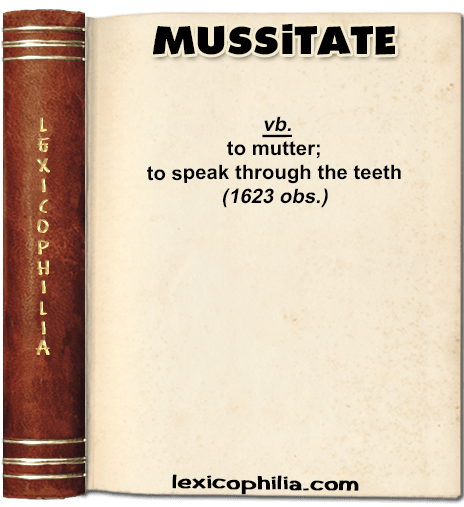
Word of the Day: MUSSITATE

ETYMOLOGY
from past participial stem of Latin mussitare (to mutter),
from mussare (to mutter) + –itare (-itate)


EXAMPLE
“…those I meane which are not Neutralizers (if any such heare mee this day) Neutralizers, I say, or Interim-ists; such as dare secretly mutter and mussitate; Rome and the Reformed Churches agree in the substance of Religion, that there is no fundamentall difference betwixt them and vs; and againe that they teach no Heresies; …”

From: A Sermon Preached at Paules Crosse Laying open the Beast, and his Marks
By Richard Sheldon, 1625