Word of the Day

Word of the Day: LABION


ETYMOLOGY
from Latin labion-labio  also Latin labeon-labeo (a person who has large lips)
from labealabia ‑o


EXAMPLE
“…for it must necessarily be a meanes to hinder their speech by thickning their lips, as experience teacheth in those who either by Nature or by accident have thick, swoln, blabber lips, causing them to speak in their mouth, uttering their words very baldly and indistinctly, and assuredly the same or worse must befall these artificiall Labions, for their Lips must needs hang in their light, and their words stick in the birth, when such unwealdy Pourers out of speech occasion a hinderance to their delivery …”

From: Anthropometamorphosis: = Man Transform’d:
Or, The Artificiall Changling
By John Bulwer, 1653
Word of the Day: BATRACHOPHOBIA


ETYMOLOGY
from batracho- (comb. form) [from Greek βάτραχος (bátrakhos, frog)] + ‑phobia 


EXAMPLE
“…The world looks down upon them, gives them ill names, affects a sort of horror of them, and does its best to kick them out of sight; and the consequence is that the world knows next to nothing about them, and thus misses one of the most marvellous chapters in the whole range of zoological science. The Batrachophobia is at length giving way in one direction, it is true; for the Aquarium, has made it manifest that the Water-Newts, spite of a long-cherished belief to the contrary, are perfectly harmless little creatures…”

From: Links In The Chain;
Or, Popular Chapters On the Curiosities of Animal Life
By George Kearley, 1863
‘The Ancient Order of Batrachians’


PRONUNCIATION
bat-ruh-koh-FOH-bee-uh

Word of the Day: MASCULOUS


ETYMOLOGY
from Latin masculus (male) + -ous


EXAMPLE
“…I doubt not but he will send a Copy of it to your L. and then it will speak for it self; believe me I never heard him do any thing like it, and so thinketh every one in the Synod; it was learned, devout, and the stile masculous …”

From: Golden Remains of the Ever Memorable, Mr. John Hales
By John Hales, 1659
Dr. Balcanquals Letters from the Synod of Dort, March, 1619

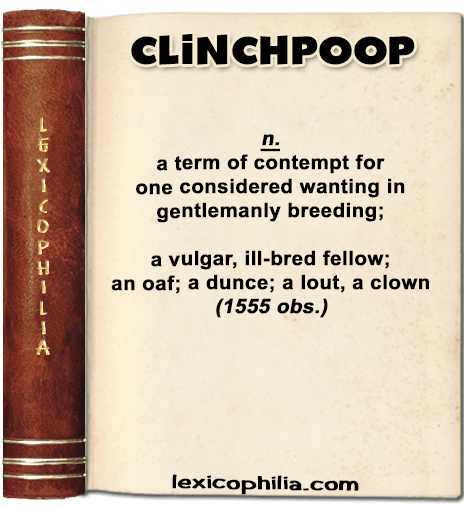
Word of the Day: CLINCHPOOP


ETYMOLOGY
of uncertain origin;
perhaps from one who clinches or clenches the poops of vessels,
a clincher (a workman who clinched the bolts in shipbuilding)


EXAMPLE 1.
“…Yf a Gentlemanne haue in hym anye humble behauour, then Roysters doo cal suche one by the name of a Loute, a Clynchepope, or one that knoweth no facyons…”

From: The Institucion of a Gentleman
By Humfrey Braham, 1555


EXAMPLE 2.
“…Cléante
Ma chere, ma chere, c’est vrai, c’est vrai,
But my rival is a juggins –

Angélique
A muggins –

Cléante
A noodle and a looby –

Angélique
A lopdoodle, a dunderhead, a pigsconce and a booby

Cléante
A Clinchpoop, a gobemouche, a snollygoster, a gongoozler

Angélique
A lickspiggot, a fuzzdutty, a jobbernowl, an ass –

Thomas
It’s highly amusing.

Cléante
Who’s in love with the sound of his own braying …”

From: The Hypochondriac
Roger McGough’s translation of Molière’s Le Malade Imaginaire, 2009

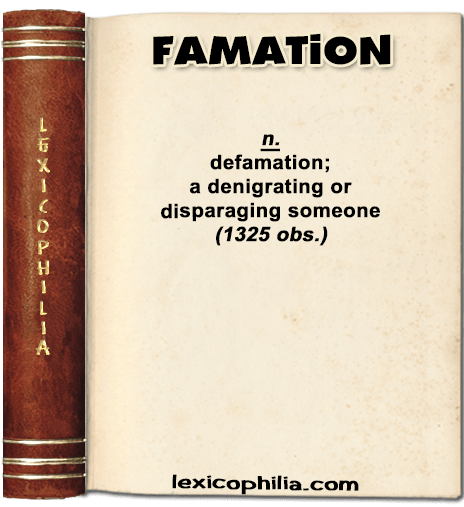
Word of the Day: FAMATION


ETYMOLOGY
? aphetic from defamation (n.)


EXAMPLE 1
“…Ich wile þat y ben hanged & drawe
Boute y defende me wiþ þe lawe
Of þis famacioun,
Þat þow seist y scholde selle
Me lordes sone þat ich of telle,
Þat men clepede Reinbroun
…”

From: The Romance of Guy of Warwick
The first or 14th-century version, c1325


EXAMPLE 2
The well-known actor brought a legal action against the magazine for famation of character.

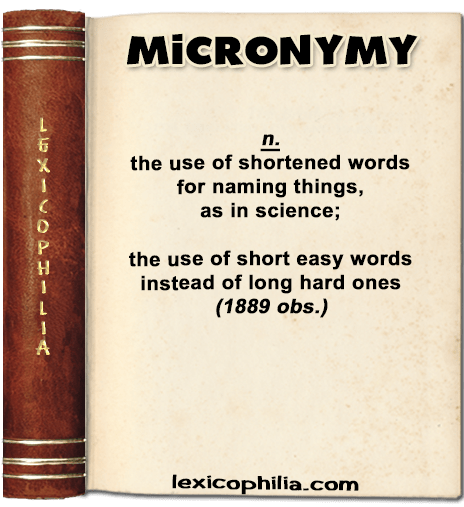
Word of the Day: MICRONYMY


ETYMOLOGY
from Greek µῑκρός (small) + ὄνυµα (name), ὄνοµα, after synonymy, etc.


EXAMPLE
“…Astronomers have set an example in micronymy that anatomists might well fellow; the first asteroid discovered was named Ceres, and many of its successors have dissyllabic or, at most, trisyllabic names. This is the more noteworthy, because, in the first place, these bodies are not, and are hardly likely to become objects of popular discussion; and, secondly, each has its assigned numeric symbol, so that the professional astronomer need not employ the names at all. Now that the choice is offered, the anatomist who deliberately says aponeurosis for fascia, anfractuosity for fissure, and convolution for gyre, runs the risk of association, in the minds of others at least equally well-informed with the “penny-a-liner.” or the village orator who distinctly prefer conflagration to fire …”

From: A Reference Handbook of the Medical Sciences
Edited by Albert H. Buck, 1889

Word of the Day: WHEY-BLOODED


ETYMOLOGY
from whey  + blooded


EXAMPLE
“…Beantosser
Here here, a pox o’ these full mouth’d Fox hounds.

Hectorio
They hunt devilish hard, I’me affrai’d they’l earth us.

Stephania
Give Hectorio a dram of the Bottle, the Whey-Blooded Rogue looks as if his heart were melted into his Breeches…”

From: The Mock-Tempest, or, The Enchanted Castle
By Thomas Duffett, 1675

Word of the Day: PULCHRITUDINOUS


ETYMOLOGY
from Latin pulchritudin-,  pulchritudo (beauty) + -ous


EXAMPLE
“…Returning to the pulchritudinous Fanny Newlove, she was reclining on a settee, listening with all her ears, to the ‘out pourings’ of a personage, whose appearance at once apprehended my attention, as indicative of anything except the clean potato …”

From: The Anglo-American Magazine
From July to December, 1854
Vol V, ‘The Purser’s Cabin’


PRONUNCIATION
pul-kruh-CHOO-duh-nuhss

Word of the Day: ELF-LOCKED


ETYMOLOGY
from elf-lock (a tangled mass of hair, superstitiously attributed to the agency of elves, especially Queen Mab: ‘which it was not fortunate to disentangle’),
from elf & lock


EXAMPLE
#1

“…Had VIRGIL had nor house-room, nor a Boy
Whom he about his bus’ness might imploy:
The elfe-lockt Fury all her Snakes had shed,
His Pipe play’d nothing rare, but flat and dead.
We tragick Poets now would think it fair,
If that, which kept th’ old Buskins in repair,
Might not from RUBREN LAPPA be with-drawn,
Whose Cloak and Papers ATREUS hath in pawn…”

From: Mores hominum – The Manners of Men described in Sixteen Satyrs by Juvenal,
Translation by Robert Stapleton, 1647


#2

“…At my question, the young wonder coolly winked, nodded his elf-locked head, wounded up his top-cord, pouched his toy, and urged me laconically to accompany him with a beck and a shout thus – “Here it’s! – yont here, sir!” and immediately trotted off before me to point out where,,,”

From: Rural Rhymes and Sketches in East Lothian
By James Lumsden, 1885
‘Country Chronicles’

Word of the Day: BRAN-FACED


ETYMOLOGY
from bran (the husk of a cereal after grinding) + -faced


EXAMPLE
“…And for the rest, if any fuddling, bolus-brained, bran-faced, turnip-tongued, hippopotamus-headed moon-calf doubts my word, let him remember that there are pistols for two – and coffee for one, in Belgium, and let him tremble…”

From: Punch, Or The London Charivari
Vol. 98, 1890
In The Know (By Mr. Punch’s Own Prophet)