Word of the Day

Word of the Day: PERLEGATE


ETYMOLOGY
from Latin perlegere to read through, from per- + legere (to read) + ate


EXAMPLE
“…I am vouchsafede to perlegate vvith pleasure, & imploye a small of their time in the readinge, of my scriptsons, and vvritinges, I most courtiouslye desire thē, that they vvould more vvith good vvill, then vvith a spirite…”

From: The Frenche Chirurgerye, or all the Manualle Operations of Chirurgerye
By Jacques Guillemeau
Translated by A.M., 1598

Word of the Day: ELENCHIZE


ETYMOLOGY
from elench ,from Latin elenchus, from Greek ἔλεγχος (cross-examination) + -ize


EXAMPLE
“…Lady. So do all Politicks in their Commendations.
   Host. This is a State-bird, and the verier Fly;
Tipto. But  Hear him problematize.   Prudence. Bless us, what’s that?
   Tipto. Or syllogize, elenchize.   Lady. Sure, petard’s,
To blow us up.   Lat. Some inginous strong words!
   Host. He means to erect a Castle i’ the Air,
And make his Fly an Elephant to carry it
….”

From: The New Inne, or The Light Heart, a Comedy
By Ben Jonson, 1631

Word of the Day: PODGER


ETYMOLOGY
for n. 1. – a variant of pottinger
for n. 2, 3, 4 – from podge (anything short or thick)  + ‑er 


EXAMPLE
“…He cannot deal the knock-me-down blows of Old Brough, and if you watch your opportunity you may give him a podger. I am seldom in a cause of any consequence before him without getting into some squabble with him…”

From: Life of John, Lord Campbell, 1881,
Letter dated 9 March, 1816

Word of the Day: NIDDICOCK


ETYMOLOGY
of obscure formation: possibly a blend of nidiot and nodcock (a fool, a simpleton)


EXAMPLE
“…And as touching implements for warre, they were neuer such fond niddicockes, as to offer anie man a rod to beat their owne tailes, or to betake their mastiues vnto the custodie of the woolues, maruelling much that their capteine would so farre ouershoot himselfe, as to be taken with such apparent repugnancie….”

From: R. Holinshed’s Chronicles of England, Scotland, and Ireland, 1577

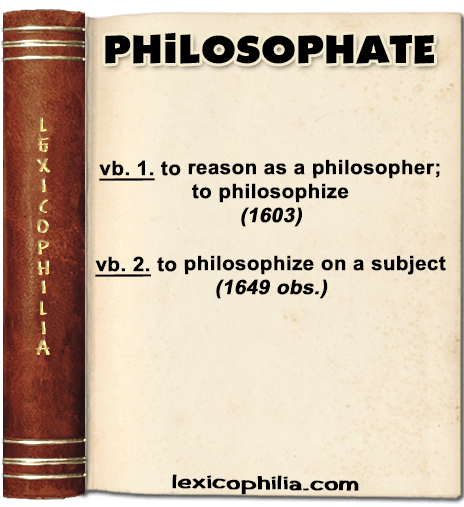
Word of the Day: PHILOSOPHATE


ETYMOLOGY
from Latin philosophāt-, ppl. stem of philosophārī (to do the philosopher, to philosophize), from philosophus (a philosopher)


EXAMPLE
“…If, as some say, to philosophate be to doubt; with much more reason to rave and fantastiquize, as I doe, must necessarily be to doubt: For, to enquire and debate belongeth to a scholler, and to resolve appertaines to a cathedrall master…”

From: The Essayes, or Morall, Politike, and Millitarie Discourses of Lord Michaell de Montaigne 
Translated by John Florio, 1603


PRONUNCIATION
fuh-LOSS-uh-fayt