Word of the Day

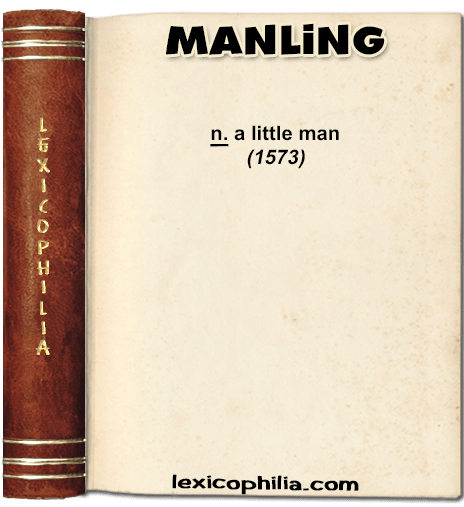
Word of the Day: MANLING


ETYMOLOGY
from man + -ling


EXAMPLE
“…Marry sir euen all in all, a well lyned pursse, wherwith he could at euery call, prouide such pretie conceytes as pleased hir péeuish fantasie, and by that meanes he had throughly (long before) insinuated him selfe with this amorous dame. This manling, this minion, this slaue, this secretary, was nowe by occasion rydden to London forsothe: and though his absence were vnto hir a disfurnishing of eloquence…”

From: A Discourse of the Aduentures Passed by Master F. I.
In ‘A Hundreth Sundrie Flowres bounde vp in one small poesie’
By George Gascoigne, 1573

Word of the Day: BEFLUM


ETYMOLOGY
from be-flum;
perhaps influenced by Scots blaflum, bleflum (to cajole)


EXAMPLE
“…that are but ill settled yet, till they durst na on ony errand whatsoever gang ower the door-stane after gloaming, for fear John Heatherblutter, or some siccan dare-the diel, should tak a baff at them: then, on the hand, I beflum’d them wi’ Colonel Talbot – wad they offer to keep up the price again the Duke’s friend? did na they ken wha was master?…”

From: Waverley; or, ‘Tis Sixty Years Since,
By Walter Scott, 1814

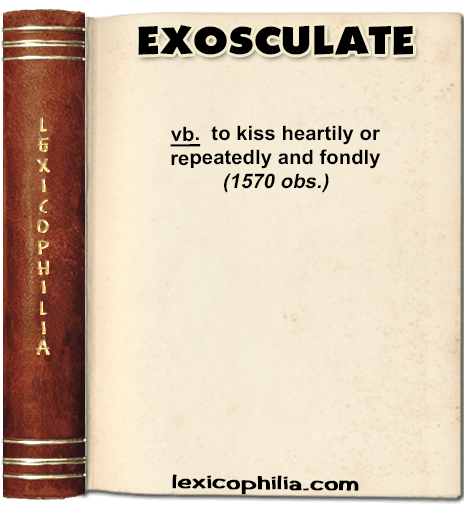
Word of the Day: EXOSCULATE


ETYMOLOGY
from participle stem of Latin exosculari, from ex- + osculari (to kiss), from osculum (a kiss)


EXAMPLE
“…And thus having copulated our plebeian endeavours, we exosculate the subumbrations of your subligacles; and sooner shall the surges of the sandiferous sea ignify and evaporate, than the cone of our duty towards you be in the least uncatenate or dissolved; always wishing you health and happiness…”

From: The Works of Jonathan Swift
By Jonathan Swift, 1814

Word of the Day: OPSOPHAGIZE


ETYMOLOGY
from opsophagy (the eating of delicacies) + -ize;
from Greek ὀψοϕαγία (opsofagia), formed on ὀψοϕάγος (opsofagos – an eater of dainties);
formed on ὄψον (opsonic)  + -ϕάγος (phage, eating, eater)


EXAMPLE
“…Few men enjoyed the privilege of going ‘tick’ with the fishmonger, who, secure of a ready sale, did not encourage long bills; and even had they been complaisantly disposed, the opsonomoi, or comptrollers of the fish-market, would have interfered to prevent it. At Corinth, where the supervision was particularly strict, the law enacted that none should ‘opsophagize‘ but such as could prove their income sufficient to support the extravagance; a poor offender was first cautioned, then mulcted and, if still incorrigible, handed over to the ‘carnifex’…”

From: Prose Halieutics, Or, Ancient and Modern Fish Tattle
By David Badham, 1854

Word of the Day: SNATTER


ETYMOLOGY
vb.: from Dutch snateren or Low German snat(t)ern (Greek schnattern, Swedish snattra),
of imitative origin


EXAMPLE (for vb.)
“…for if thou considerest the things are easie attained, every ditch offering the some of them, and the preparation so trinial, that there is as much art to make a mess of pottage; in this above all other I have deserved well at thy hand, if thou hast a heart to improve it, neither do I doubt, although many will be angry and snatter at it, but this entrance which I have given in this receipt will stand while the world indures and get strength, and my memory held in honor, for so good service in it…”

From: The Unlearned Alchymist His Antidote
By Richard Mathews, 1662

Word of the Day: NIMBLE-CHOPS


ETYMOLOGY
from nimble + the plural of chop (the jaws and cavity of the mouth)


EXAMPLE
“…Why frend Nimblechaps me thinks you seeme rather ready to play with ye shadowe of euery thing then wi[l]ling to vnderstand the substantiall matter in a­ny thing: can you rightly gather vpon my speech that a woman is euill? if you do well vnderstande mee, you shal finde nothing lesse, but rather that shee is for the most parte one of the greatest good thinges in this world, and most necessa­ry of any thing els besydes…”

From: A Short Inuentory of Cer­tayne Idle Inuentions
The Fruites of a Close and Secret Garden of Great Ease, and Litle Pleasure
By C. Thimelthorpe, 1581

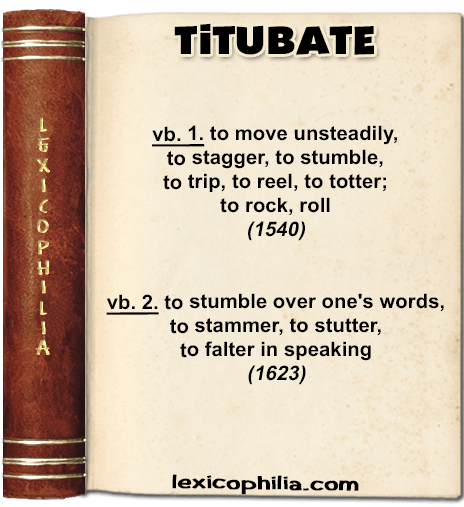
Word of the Day: TITUBATE


ETYMOLOGY
from Latin titubat-, past participial stem of titubare (to walk unsteadily, to totter, to stagger, to falter, to vacillate or dither, to make a mistake, slip up, or stumble (in speech or action)


PRONUNCIATION
TIT-yuh-bayt


EXAMPLE
“…Repercussed by the ryght redolent & rotounde rethorician R. Smyth P. with annotacios of the mellifluous and misticall Master Mynterne, marked in the mergent for the enucliacion of certen obscure obelisques, to thende that the imprudent lector shulde not tytubate or hallucinate in the labyrinthes of this lucubratiuncle…”

From: An Artificiall Apologie (title page)
By R. Smyth, 1540

Word of the Day: MICACIOUS


ETYMOLOGY
from Latin micare (to shine, sparkle, dart, move swiftly) + -acious 


PRONUNCIATION
migh-KAY-shuhss


EXAMPLE
“…Others little inferior in splendour followed in procession; and what added much to their gorgeous appearance was, that as the oars were lifted, the water was perfectly micacious, and they appeared to glide over a sea of liquid gold…”

From: Constantinople Ancient and Modern:
With Excursions to the Shores and Islands of the Archipelago and to the Troad
By James Dallaway, 1797

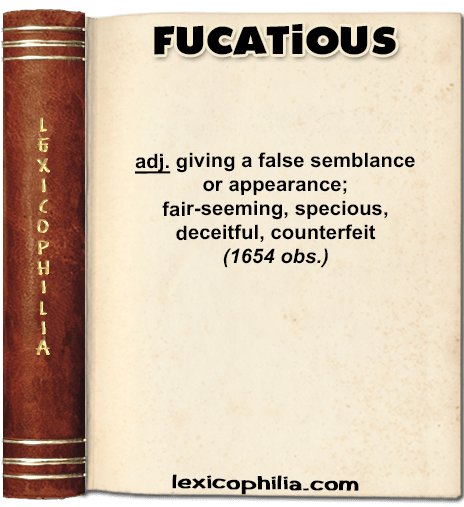
Word of the Day: FUCATIOUS


ETYMOLOGY
from fucation (a painting the face; hence, the giving of a false semblance or appearance, counterfeiting), (from Latin fucatus, pa. pple. of fucare (to paint, rouge)) + -ous


EXAMPLE
“…but then the condition must be possible in his power to whom ’tis made, and the perfor∣mance according to the promisers Wil or liking; els it can∣not be candid or current. For to offer a courtesy under impossible condition, is frivolous or fucatious: as if one should offer mony to a blind Man on condition he wil tel what coin ’tis; which is al one as to deny an alms: nay in som sort wors, sith ’tis a denial with delusion and derision, or a meer mockery…”

From: Theoremata Theologica: Theological Treatises.
Octo theses theologicæ: Eight theses of divinity
By Robert Vilvain, 1654