Word of the Day

Word of the Day: MULCIBLE

ETYMOLOGY
from Latin mulcibilis, from mulcere (to soothe) + -ibilis (-ible)

EXAMPLE
“… But now, partly through the ineffable quality of rich comedy, which was so much the constitution of Elliston, and partly from Miss Warren’s mulcible nature, which, to do her justice, was unrivalled, and all this aided by the pacific disposition of the clerk of the “long-room,” peace was tolerably restored. …”

From: Memoirs of Robert William Elliston, 
Comedian, 1774-1810
By George Raymond, 1844

Word of the Day: SEMISOMNOUS

ETYMOLOGY
from Latin semisomnissemisomnus, (from semi- + somnus (sleep) + -ous

EXAMPLE
“… ‘‘ Time sadly overcometh all things,” says Sir Thomas Brown, ‘‘and is now dominant, and sitteth upon a sphinx, and looketh unto Memphis and old Thebes; while his sister Oblivion reclineth semisomnous on a pyramid, gloriously triumphing, making puzzles of Titanian inscriptions, and turning old glories into dreams. History sinketh beneath her cloud. …”

From: The Superhuman Origin of the Bible: inferred from itself
By Henry Rogers, 1873

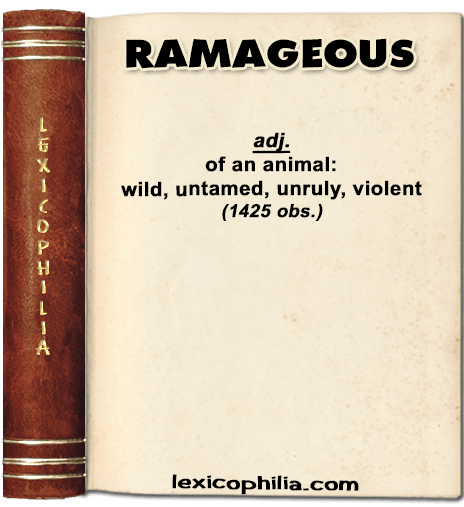
Reverse Dictionary: RAMAGEOUS

ETYMOLOGY
apparently from ramage (of an animal: wild, untamed, unruly, violent) + ‑ous 

EXAMPLE
“… Ordeyned hath, by ful gret cruelte,
This Ram to kepe, bolys ful vnmylde,
With brasen feet,
ramegous and wylde,
And ther-with-al ful fel and dispitous,
And of nature wood and furious,
To hurte and sleen euere of o desyre.
…”

From: Troy Book
By Guido delle Colonne
Translated by John Lydgate, c1425

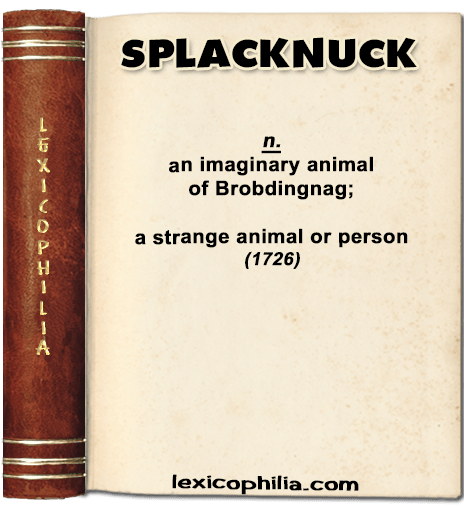
Word of the Day: SPLACKNUCK

ETYMOLOGY
coined by Jonathan Swift as the name of an imaginary animal of approximately human size mentioned in Gulliver’s Travels 

EXAMPLE
“… It now began to be known and talked of in the neighbourhood, that my master had found a strange animal in the field, about the bigness of a splacknuck, but exactly shaped in every part like a human creature; which it likewise imitated in all its actions; seemed to speak in a little language of its own, had already learned several words of theirs, went erect upon two legs, was tame and gentle, would come when it was called, do whatever it was bid, had the finest limbs in die world, and a complexion fairer than a nobleman’s daughter of diree years old. …”

From: Gulliver’s Travels
By Jonathan Swift, 1726

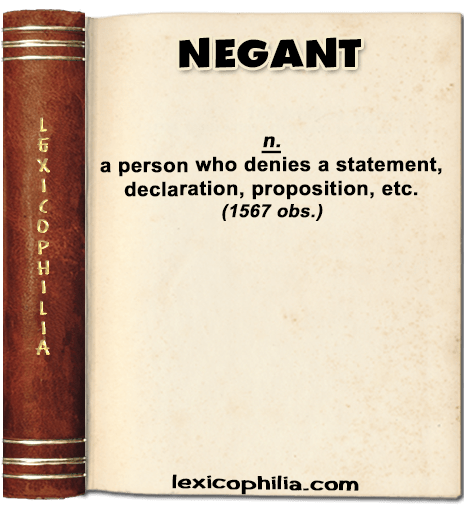
Word of the Day: NEGANT

ETYMOLOGY
from Latin negant-negans, present participle of negare (to negate)

EXAMPLE
“… The affirmantes of this proposition, were almost treble so many as were the
negantes. Amongst whiche affirmantes, diuers were then vnmaryed, and neuer dyd afterwarde take the libertie of maryage, as doctor Tailor the bishop, doctor Benson, doctor Redman, doctor Hugh Weston, maister Wotton. &c. …”

From: A Defence of Priestes Mariages stablysshed by the imperiall lawes of the realme of Englande, agaynst a ciuilian, namyng hym selfe Thomas Martin doctour of the ciuile lawes,
Archbishop Matthew Parker, 1567?

Word of the Day: ATTOXICATED

ETYMOLOGY
from Latin at-ad- (to) + toxicare (to poison) + -ed

EXAMPLE
“… Who seeth and feeleth not, that oftentimes while Reason attendeth to Contemplation, a villanous passion of Loue withdraweth the attention, and with an attoxicated delight imprisoneth the Affection? Who perceiueth not, that diuers times Reason would pardon all iniuries, and Ire opposeth it selfe, importuning reuenge? …”

From: The Passions of the Minde
By Thomas Wright, 1604

Word of the Day: LIVER-FACED

ETYMOLOGY
from liver (the bodily organ regarded as the seat of cowardice (usually characterized as light-coloured or white), obs.) + faced

EXAMPLE
“… “Only a little crack’d, ever since that one-eyed, liver-faced spalpeen came athurt us – a hard hiccup to his dying speech!

“What one-eyed, liver-faced spalpeen do you mean?” asked Elwin.
“Did I say them words then, your honor ?” said Tade, ” ’cause if I did, I must be dreamin’, for divil sich a parson I ever see, since my mother weaned me.”
…”

From: The Prediction
By Isabella Steward, 1834

Word of the Day: TWIGGER

ETYMOLOGY
apparently from twig (to do anything strenuously or vigorously, obs.) + -er

EXAMPLE
“… Eaws yerely by twining, rich masters do make the lamb of such twynners, for breeders go take.
For twinlings be
twiggers, encrease for to bring:
though some for their twigging, peccantem may sing
Calues likely, yt come betwene Christmas & Lent,
take huswife to rere, or else after repent.
…”

From: Fiue Hundreth Points of Good Husbandry vnited to as many of good huswiferie first deuised,
By Thomas Tusser, 1573

Word of the Day: WATER-FUNK

ETYMOLOGY
from water + funk (a cowardly or nervous person)

EXAMPLE
“… The arms, he may next be taught, do little more in the act of swimming than support the body; the necessary speed is procured by the action of the legs. A sensible lad, who is not a “ water-funk ”— to use the expressive term of the period— if the theory of the art be thus explained to him, ought to swim in six or seven lessons. …”

From: The Academy. A weekly review of literature, science, and art
Swimming. By A. Sinclair and W. Henry
August, 1893