Word of the Day

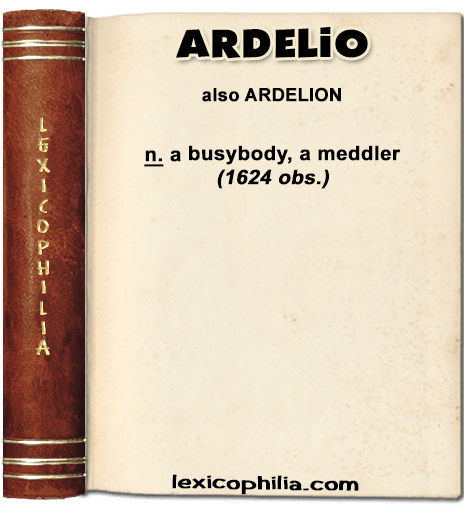
Word of the Day: ARDELIO


ETYMOLOGY
from Latin ardelio, from ardere (to burn, be eager or zealous)


EXAMPLE
“…we run, ride, take indefatigable pains, all up early, down late, striving to get that which we had better be without, (Ardelion’s busybodies as we are) it were much fitter for us to be quiet, sit still, and take our ease…”

From: The Anatomy of Melancholy
By Robert Burton, 1624
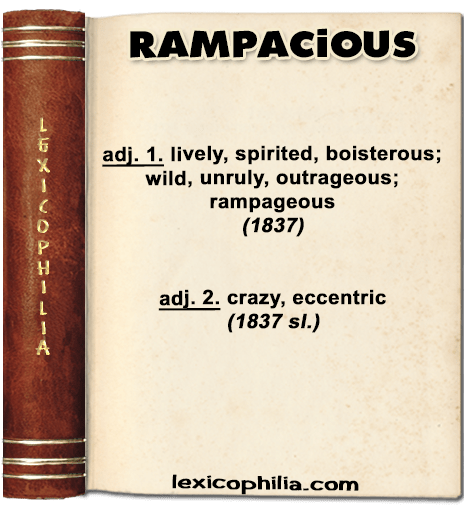
Word of the Day: RAMPACIOUS


ETYMOLOGY
variant of rampageous, after adjectives ending in -acious


EXAMPLE
“…In the main street of Ipswich, on the left-hand side of the way, a short distance after you have passed through the open space fronting the Town Hall, stands an inn known far and wide by the appellation of the Great White Horse, rendered the more conspicuous by a stone statue of some rampacious animal with flowing mane and tail, distantly resembling an insane cart-horse, which is elevated above the principal door…”

From: The Pickwick Papers
By Charles Dickens, 1836

Word of the Day: FALSILOQUENCE


ETYMOLOGY
from Latin falsiloquus (from falsus (false) + loqui (to speak)) + -ence


EXAMPLE
“…And that their Mutual Forces Join’d,
Harnass’d with Wit so much refin’d;
And so adorn’d instead of Sense,
With Trappings of Falsiloquence,
Might draw misjudging Fools to be,
In Love with their Sincerity;
…”

From: The Fifth and last Part of Vulgus Britannicus
By Edward Ward, 1710

Word of the Day: EACHWHERE


ETYMOLOGY
from each + where


EXAMPLE
“…A sely synful was she þis
For al hir synne turned in to blis
She was lyuynge in cuntre þere
Whenne ihesus preched vche where
And mony a pert myracle did
Wher wiþ to men he him kid
And mony seke he ȝaf her hele
And as he coom bi o castele
…”

From: Cursor Mundi (The Cursur o the World).
A Northumbrian poem of the XIVth century, a1400

Word of the Day: GIM


ETYMOLOGY
perhaps a variation of jimp (slender, slim, delicate, graceful, neat)


EXAMPLE
“…Hys wifis, Toppa and Partelot, hym by,
As byrd al tyme that hantis bigamy.
The pantyt povn, pasand with plomys gym,
Kest vp his taill, a provd plesand quheill rym,
Yschrowdyt in hys fedrame brycht and scheyn,
Schapand the prent of Argus hundreth eyn
…”

From: Virgil’s Aeneid translated into Scottish verse
By Gavin Douglas, 1513

Word of the Day: ONOMATOUS


ETYMOLOGY
from Greek ὀνόµατὄνοµα (name) + -ous


PRONUNCIATION
uh-NOM-uh-tuhss


EXAMPLE
“…For our own parts, we will not be forward to remove the disguise, and, indeed, in very many cases we should as a rule prefer the anonymous to the onomatous mode of addressing the public…”

From: The Spectator
A Weekly Review of Politics, Literature, Theology, and Art
Volume the Forty-Second, 1869

Word of the Day: ARGUITIVE


ETYMOLOGY
from Latin arguit- ppl. stem of arguere + -ive, as if from Latin arguitivus (attacking or accusing)


EXAMPLE
“…But, as it is, the only knowledge of God to which the mind of man can naturally attain, is arguitive, being deduced from his cognitions of the creature; and therefore in the enunciation of the Thesis, the direct measure of the human intellect is restricted to finite Being…”

From: The Metaphysics of the School
By Thomas Harper, 1879