Word of the Day

Word of the Day: EARWIGGING


ETYMOLOGY
 from earwig (to annoy or attempt to influence by private talk) + -ing 


EXAMPLE
“…I remember the first introduction of Boswell on what may be called the Johnsonian stage. What is ludicrously called his earwigging, began to attract notice; and my father enquired of Mr. Langton, who this novel performer was, meaning rather, I believe, to be on good terms with him, as a frequenter in Bolt Court…”

From: Memoirs, Anecdotes, Facts, and Opinions
By Laetitia Matilda Hawkins, 1824
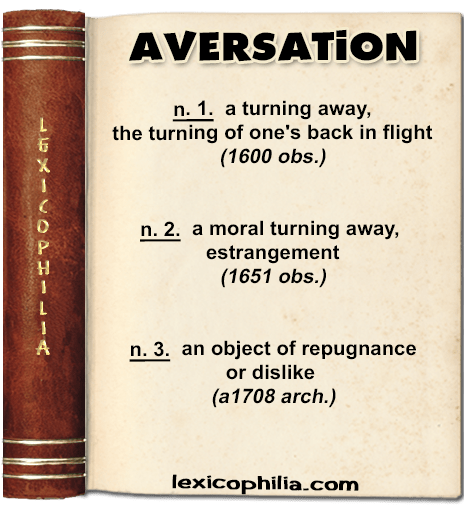
Word of the Day: AVERSATION


ETYMOLOGY
rom Latin aversationem, noun of action from aversat-


EXAMPLE
“…He can bear glory to their fleet, or shut up all their toils In his one suff’rance on thy lance.” With this deceit she led, And, both come near, thus Hector spake: “Thrice have I compassed This great town, Peleus’ son, in flight, with aversation That out of fate put off my steps; but now all flight is flown, The short course set up, death or life. Our resolutions yet Must shun all rudeness, and the Gods before our valour set For use of victory;…”

From: The Whole Works of Homer in his Iliads and Odysses
Translated by George Chapman, 1616

Word of the Day: OPITULATION


ETYMOLOGY
from Latin opitulari (to bring aid, to assist), from opem (aid) + tul- (to bring)


EXAMPLE
“…The excellence of this boocke, hath therfore, incitatede, & as it vveare copellede me to vse this audacitye (in signe of gratitude, for soe manye, & innumerable benefites, vvhich next after God, of your Royall Mtye. through your continualle ayde, & opitulatione vve reape) humblelye to presente, and dedicate this verye necessarye boocke…”

From: The Frenche Chirurgerye, or All the Manualle Operations of Chirurgerye
By Jacques Guillemeau,
Translated out of Dutch into English, by A.M., 1598

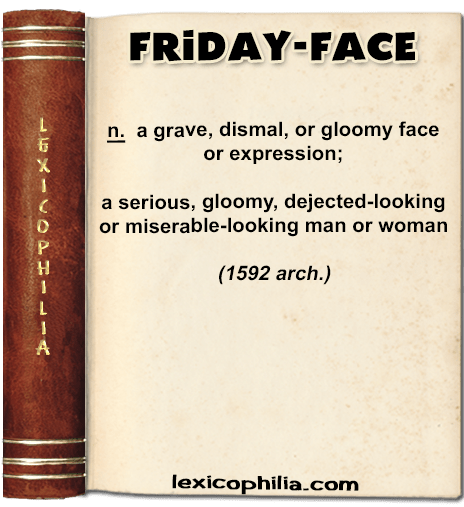
Word of the Day: FRIDAY-FACE


ETYMOLOGY
probably from the time when Friday was a day of abstinence


EXAMPLE
“…The Fox on a time came to visit the Gray, partly for kindred, chiefly for craft, and finding the hole empty of all other company, saving only one Badger enquiring the cause of his solitariness: he described the sudden death of his dam and sire with the rest of his consorts. The Fox made a Friday face, counterfeiting sorrow: but concluding that death’s stroke was inevitable persuaded him to seek some fit mate wherewith to match.…”

From: Greene’s, Groat’s-Worth of Witte, bought with a million of repentance 
Robert Greene, 1592

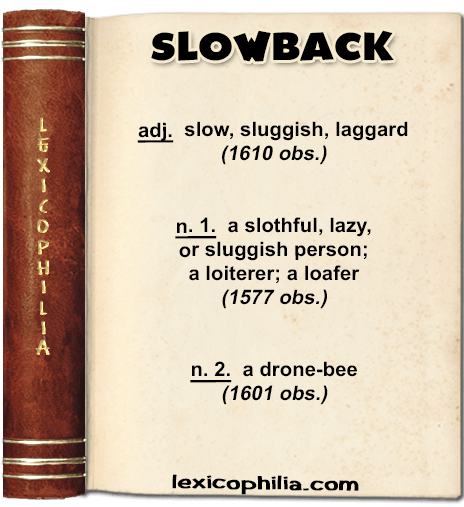
Word of the Day: SLOWBACK


ETYMOLOGY
from slow (adj.) + back (n.)


EXAMPLE
“…For God doth not assiste slouthfull persons and idle slowbackes. Now I call those needelesse occupations, whiche idle and ill disposed people do vse, thereby to be troublesome to their neighbours and to deceiue other men, exercising, I confesse, an occupation, but such an one as is vtterly vnlawfull & vnprofitable to all men…”

From: Fiftie Godlie and Learned Sermons Diuided into Fiue Decades
By Heinrich Bullinger, 1577

Word of the Day: PREHEND


ETYMOLOGY
from Latin prehendere (to grasp, seize, catch), variant of præhendere
from præ, (pre-) + a second element; sometimes perhaps aphetic from apprehend


EXAMPLE
“…but he lay not longe ther, but was delyveryd with-owt punyshment & styll Inioyed his beneffysis; they were greatly blamed that prehended hym and comitted hym…”

From: Political, Religious, and Love Poems
By John Stowe, a1605
Edited by Frederick James Furnivall, 1866

Word of the Day: ORNITHOPHILITE


ETYMOLOGY
from ornitho-  (comb. form bird) + Greek ϕίλ-ος (lover)


EXAMPLE
“…Every one asked them to dinner, and they left on the 25th. As long as he was in France he never omitted this ornithophilite excursion, which was only interrupted when he was sent on a mission to Rome, where he died as penitentiary in 1688…”

From: The Handbook of Dining
Or How to Dine Theoretically Philosophically and Historically Considered,
By Leonard Francis Simpson, 1859

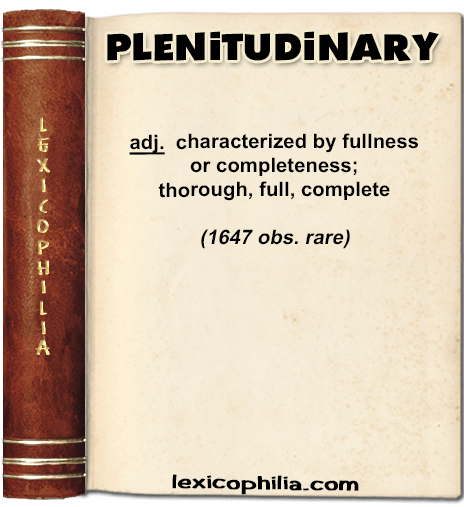
Word of the Day: PLENITUDINARY


ETYMOLOGY
from Latin plenitudinarius (full, complete, plenary),
from Latin plenitudin-plenitudo (abundance, fullness, fullness of shape, thickness, full amount, the whole) + -arius (-ary)


EXAMPLE
“…and a strange kind of Government must that needs be, wherein the Servants Throne is above his Masters, and a Subject shall have a plenitudinary power beyond that which his Lord and King had, or, as the times then were, was capable of …”

From: An Historical and Political Discourse of the Laws & Government of England from the First times to the End of the Reign of Queen Elizabeth
By Nathaniel Bacon, 1647