Word of the Day

Word of the Day: FREMESCENT


ETYMOLOGY
as if from Latin fremescentem, pr. pple. of fremescere
freq. vb. from Latin fremere (to roar)


EXAMPLE
“… The tide advances; Syndic Roederer’s and all men’s straits grow straiter and straiter. Fremescent clangor comes from the armed Nationals in the Court; far and wide is the infinite hubbub of tongues …”

From: The French Revolution: A History
By Thomas Carlyle, 1837

Word of the Day: NISEY


ETYMOLOGY
of unknown origin;
perhaps from nice (obsolete adj. foolish, stupid senseless)


EXAMPLE
“…Susan, I this Letter send thee,
Let not sighs and tears attend thee,
We are on the Coast of France;
Taking prizes from those Nizeys,
my sweet Jewel to advance.
Since we London have forsaken, five rich
Prizes have we taken,
Two of them Nantz Brandy Wine;
Chests of money, my sweet Honey! with
rich silks and sattin fine…”

From: The Roxburghe Ballads
Love and Loyalty:
Or, A Letter from a Young-man on Board of an English Privateer, to his beloved Susan in the City of London.
To the Tune of, Tender Hearts of London City
c1689

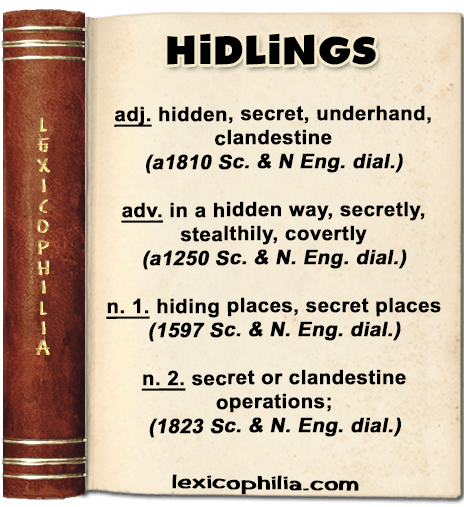
Word of the Day: HIDLINGS


ETYMOLOGY
from hid (adj.) + -ling 


EXAMPLE
“…Anna: Yes: to come to me without loss of time. There is money for thee. Do thy errand speedily and secretly: let nobody know that I have sent thee
Bawldy: An’ she’s to come to you here, hidlings, as it war?
Anna: Yes, Bawldy; and when she comes, let her wait for me in the cattle shed…”

From: Witchcraft
By Joanna Baillie, 1836

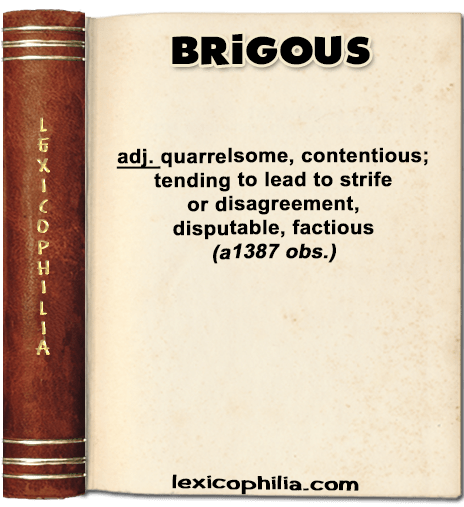
Word of the Day: BRIGOUS


ETYMOLOGY
either from:
a) Middle French brigeux (from brigue (a quarrel, an argument; strife, contention)) + -eux (-ous)
b) from Latin brigosus (from briga (quarrel, dispute, strife) + -ōsus (-ous) + -ous 
c) or directly from brigue (a quarrel, an argument) + -ous


EXAMPLE
“…Þis answere assoileth noght at all This brigous questioun…”

From: De Consolatione Philosophiae (on The Consolation of Philosophy)
By Anicius Manlius Severinus Boethius
Translated by John Walton, c1450

Word of the Day: WLATSOME


ETYMOLOGY
from wlat (nausea, loathing, disgust) from Old English wlætta


EXAMPLE
“…þe thrid pine es hard to drei,
O wormes þat sal neuer dei,
Fell dragons and tades bath
þat ar apon to lok ful lath,
Ful  wlatsum  on to here or se,
Ful wa es þam þat þare sal be;
Als we se fixs in water suim,
Sua liue þai in þat lou sa dim….”

From: Cursor Mundi
A Northumbrian poem of the 14th century

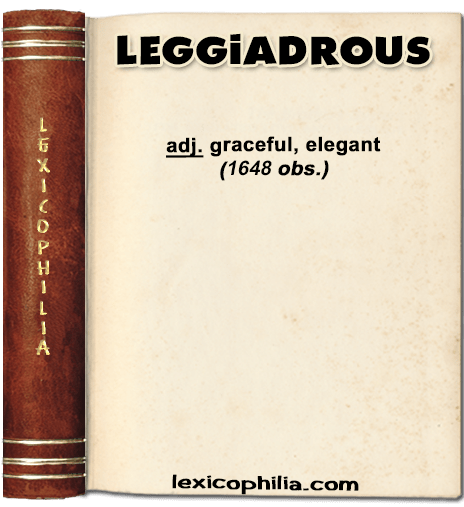
Word of the Day: LEGGIADROUS


ETYMOLOGY
from Italian leggiadro (elegant, graceful) + -ous


EXAMPLE
“…Her Motions and her Gestures travers’d are
By thy attending thoughts, and ravish’d thou
Think’st silver Venus through her limpid sphere
Swims with less gagliardise, and knows not how
So well to justify her Stile, and prove
Her self the Queen of soft leggiadrous Love…”

From: Psyche, or, Loves Mysterie
By Joseph Beaumont, 1648

Word of the Day: VOUST


ETYMOLOGY
of unknown origin


EXAMPLE
“…Circuland abowt with swift fard of the cart
The feildis our all quhar in euery art,
And schew hir bruthir Turnus in his char,
Now brawland in this place, now voustand thar;
Na be na way wald scho suffir that he
Assembill hand for hand suld with Enee…”

From: The Æneid of Virgil
Translated Into Scottish Verse
By Gavin Douglas, 1513

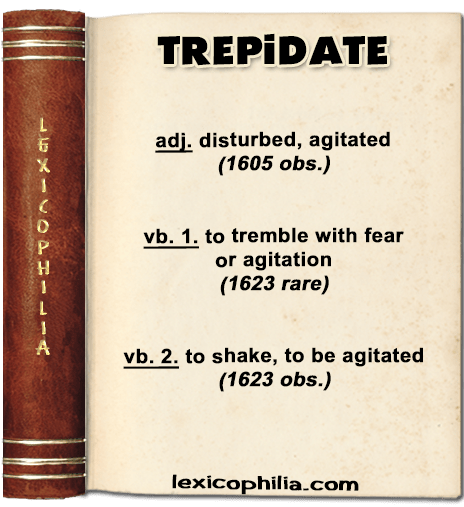
Word of the Day: TREPIDATE


ETYMOLOGY
adj.: from Latin trepidatus, past participle of trepidare
vb.: participial stem of trepidare (to hurry, bustle, be agitated or alarmed)


EXAMPLE
“…The celestiall spheres in continuall volubilitye..their diurnall or daylye course from the East to the West, their retrograde and vyolent motion from the West to the East, their trepidat motion from the South to the North…”

From: A Confutation of Atheisme
By John Dove, 1605